Backend architecture examples: 6 real-world patterns

Backend architecture examples are real implementations of backend system designs that illustrate how to organise services, data flows, and infrastructure for scalable and maintainable applications. Whether you are building a startup MVP or an enterprise platform, the pattern you choose shapes every decision that follows, from database selection to deployment strategy. This article walks through six concrete examples, from classic layered monoliths to cloud-native serverless hybrids, drawing on open-source case studies and production-grade reference architectures. Each example includes the tech stack, the trade-offs, and the design reasoning that makes it worth studying.
1. Classic layered architecture: controller, service, and repository
The layered monolith is the most widely deployed backend pattern in production today, and for good reason. Its structure maps directly to how most teams think about request handling: a request arrives, business logic processes it, and data is persisted or retrieved. The backend architecture playbook formalises this as a controller → service → repository → persistence flow, with explicit boundary models at each layer transition.
The boundary model is what separates a well-built layered architecture from a tangled one. Data Transfer Objects (DTOs) live at the HTTP edge and carry only what the client needs. Domain models sit inside the service layer and encode business rules. Persistence models map to your database schema. Keeping these three representations distinct prevents your database structure from leaking into your API contracts, which is one of the most common sources of long-term maintenance pain.

Cross-cutting concerns such as request ID tracing, authentication enforcement, and input validation belong in the pipeline before the controller ever executes. Centralising auth at the HTTP edge means your service layer never needs to ask "is this user allowed?" It only asks "what should happen next?" That separation makes unit testing dramatically faster because you can test service logic without mocking auth infrastructure.
Pro Tip: Assign a unique "request_id` at the entry point of every inbound request and propagate it through every log line. When something breaks in production, you will trace the full call chain in seconds instead of hours.
This pattern suits teams building their first production service, or any domain where the complexity does not yet justify distributed systems. Spring Boot, Django REST Framework, and Express.js all implement this pattern naturally.
2. Microservices with Kafka and database-per-service
The OrderStream microservices example demonstrates a production-grade event-driven backend where order, payment, inventory, and notification services each own their data and communicate exclusively through Apache Kafka. This is the canonical microservices pattern for high-throughput transactional systems.
The architecture works as follows:
- An API Gateway sits at the edge, handling routing, load balancing, and rate limiting for all inbound client traffic.
- Each service owns a dedicated PostgreSQL instance, so a schema change in the inventory service never touches the payment service.
- Apache Kafka carries all inter-service events asynchronously, decoupling producers from consumers entirely.
- Redis caches frequently read data such as product catalogue entries and session tokens, reducing database load.
- Services are containerised with Docker and deployed on AWS ECS, giving the team independent scaling per service.
Idempotent Kafka consumers are non-negotiable in this design. When Kafka rebalances partitions or a consumer crashes mid-processing, events get replayed. Without idempotency guards, an order gets charged twice. OrderStream handles this by storing a processed event ID in Redis before committing any state change.
API Gateways centralise routing, authentication, rate limiting, and observability, but they become a global failure point if not designed with redundancy. Run at least two gateway instances behind a load balancer and set aggressive circuit breakers on downstream services.
The Java Spring Boot stack used in OrderStream is a deliberate choice. Spring's ecosystem includes native Kafka integration, JPA for PostgreSQL, and Spring Security for token validation, which means the team spends time on domain logic rather than plumbing.
3. Hexagonal (ports and adapters) architecture
Hexagonal architecture, coined by Alistair Cockburn and detailed by Thoughtworks, places your domain logic at the centre of the system and forces all external interactions through defined ports. Nothing in your business logic knows whether it is talking to a PostgreSQL database, a REST client, or a message queue. That knowledge lives exclusively in the adapters.
The structure breaks down into two port types:
- Inbound ports (driving): Define what the application can do. A REST controller is an inbound adapter that calls an inbound port. So is a Kafka consumer.
- Outbound ports (driven): Define what the application needs from the outside world. A repository interface is an outbound port. The JPA implementation is the outbound adapter.
In a Spring Boot implementation, you enforce this by organising packages around domain, application, and infrastructure layers, with a strict dependency rule: infrastructure depends on application, application depends on domain, and domain depends on nothing external.
Separating command and query ports lets you write tests that exercise your entire business logic without spinning up a real database. Commands handle state changes; queries optimise read-only transactions. Your test suite swaps the outbound adapter for an in-memory implementation and runs in milliseconds.
Pro Tip: When you need to swap a payment processor from Stripe to Adyen, hexagonal architecture makes it a one-file change. Write a new outbound adapter, update your dependency injection config, and your domain logic never notices.
The intrinsic separation of domain logic from infrastructure means you can replace your entire persistence layer without touching a single business rule. That is not a theoretical benefit. Teams that adopt this pattern consistently report faster onboarding because new developers can read the domain package and understand the system without understanding the infrastructure.
4. Cloud-native hybrid: stable APIs with serverless async workers
Some workloads do not fit neatly into either a synchronous API or a pure serverless model. AI pipelines, document processing, and multi-step workflow orchestration need both. The TinyDOOR system architecture solves this by splitting the backend into two distinct layers.
| Layer | Responsibility | Example tech |
|---|---|---|
| Stable application backend | Durable business APIs, authentication, stateful queries | Next.js, Django, FastAPI |
| Serverless async workers | Event-driven, long-running, or orchestrated workflows | AWS Lambda, Step Functions |
| Multi-store data layer | Relational data, object storage, managed identity | PostgreSQL, S3, AWS Cognito |
The stable backend handles everything that needs a consistent response time and a predictable cost profile. The serverless workers handle everything that can tolerate latency in exchange for near-infinite scalability and zero idle cost.
Splitting stable APIs from async workers increases scalability and decouples long-running tasks from your synchronous request cycle. A user uploads a document, the API returns a job ID immediately, and a Lambda function processes the document over the next 30 seconds without blocking the HTTP connection.
The trade-off is real. Splitting into async serverless workers demands sophisticated orchestration and observability to handle distributed state and failures. You need AWS Step Functions or a similar orchestrator to manage retries, timeouts, and continuation logic. You also need structured logging across both layers so you can trace a single user action from the API call through every Lambda invocation. For teams building scalable automation architecture, this hybrid pattern is worth the operational investment.
5. Enterprise AWS architecture: API Gateway, Lambda, RDS, and Cognito
Production enterprise backends on AWS follow a three-tier pattern that separates networking, compute, and data concerns into distinct layers with explicit security boundaries. The AWS modern cloud app reference architecture defines this as a public web tier behind an Application Load Balancer, a private application tier running Express APIs, and a private data tier using Amazon RDS.
| Tier | Components | Security boundary |
|---|---|---|
| Public web tier | ALB, API Gateway, CloudFront | Public subnet, WAF rules |
| Private application tier | Lambda, Express APIs, ECS tasks | Private subnet, security groups |
| Private data tier | Amazon RDS (Multi-AZ), ElastiCache | Isolated subnet, no public access |
JWT validation at the API Gateway authoriser runs before any Lambda function is invoked. This matters for two reasons: it blocks unauthenticated requests before they consume compute, and it centralises your security enforcement so individual Lambda functions never need to validate tokens themselves.
AWS Cognito manages user pools and identity federation, which removes the need to build and maintain your own auth service. CloudWatch and X-Ray provide observability across the entire stack. Multi-AZ RDS deployment means a database failover happens in under two minutes without manual intervention. Auto Scaling Groups on the application tier handle traffic spikes without pre-provisioning capacity.
This pattern suits any team building a production web application that needs to meet enterprise security requirements without building custom infrastructure. The managed services handle the undifferentiated heavy lifting, and your engineers focus on the application layer.
Key takeaways
The most effective backend architecture for your project is the one that matches your current scale and leaves room to evolve as domain complexity grows.
| Point | Details |
|---|---|
| Start with layered architecture | Controller, service, and repository separation gives you testability and clarity from day one. |
| Add microservices when domains diverge | Use Kafka and database-per-service only when independent scaling or deployment genuinely matters. |
| Hexagonal architecture improves longevity | Ports and adapters let you swap infrastructure without touching business logic. |
| Hybrid serverless suits async workloads | Separate stable APIs from Lambda workers for AI pipelines and long-running tasks. |
| Enterprise AWS needs explicit tier boundaries | JWT validation at the gateway and Multi-AZ RDS are non-negotiable for production security. |
Why I think most teams adopt microservices too early
After reviewing dozens of backend architecture case studies and working through how to design backend systems across projects of varying scale, the pattern I see most often is teams reaching for microservices before they understand their own domain boundaries. They split services along technical lines, create an order service and a user service on day one, and then spend the next six months writing distributed transactions to keep them consistent.
Early fine-grained microservices splitting increases engineering overhead because of distributed-system complexities, making modular monoliths the better starting point for most teams. A modular monolith gives you the clean boundaries of microservices without the operational cost. You can extract a service later, once you know exactly where the seam belongs.
The hexagonal pattern is underused and underrated. Teams that adopt it early find that their domain code stays readable for years, even as the infrastructure around it changes completely. The investment in defining ports upfront pays back every time you need to swap a vendor or add a new delivery channel.
My honest advice: start with a well-structured layered monolith, introduce hexagonal boundaries as your domain grows, and only decompose into services when a specific team or scaling need forces the decision. Architecture should follow domain understanding, not precede it.
— Rishi
See real backend blueprints before you build
Choosing the right backend pattern is faster when you can see a working blueprint before writing a single line of code.
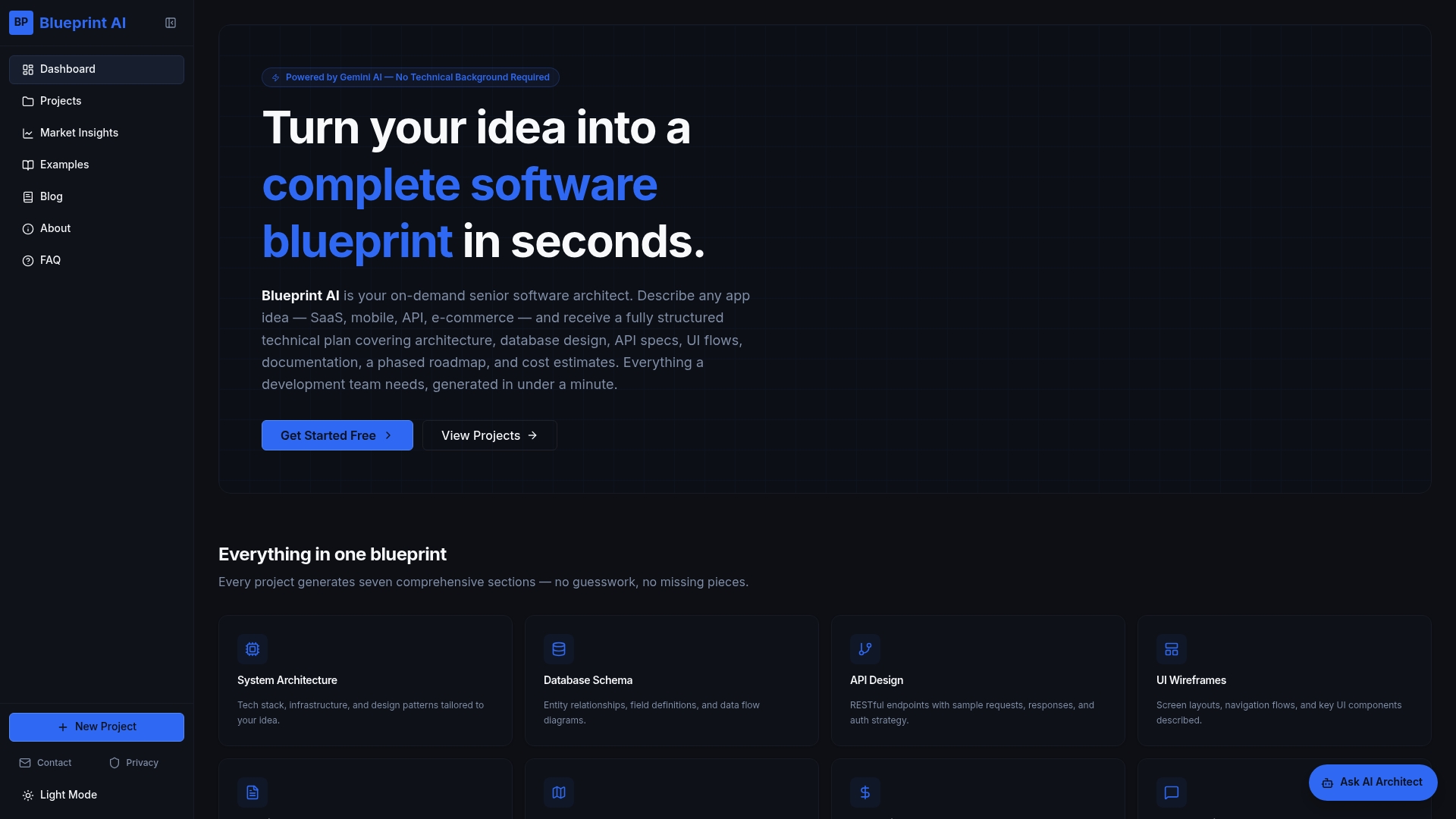
Blueprintbot generates detailed technical blueprints from a plain-language description of your app idea, including system architecture, API designs, and data models. You can browse example blueprints covering patterns from layered monoliths to cloud-native serverless designs, or explore the use cases page to see how teams across different industries have used Blueprintbot to plan their backend systems. If you are starting from scratch, the system design fundamentals guide covers the core concepts every developer needs before committing to an architecture.
FAQ
What are the most common backend architecture patterns?
The most common patterns are layered monolithic architecture, microservices with event-driven communication, and hexagonal (ports and adapters) architecture. Each suits a different scale and team structure, with layered monoliths being the most practical starting point for most projects.
When should you use microservices over a monolith?
Microservices make sense when different parts of your system need to scale independently, deploy on separate release cycles, or be owned by separate teams. For most early-stage products, a modular monolith delivers the same organisational benefits with far less operational complexity.
What is hexagonal architecture in backend systems?
Hexagonal architecture isolates your domain logic from all infrastructure by defining inbound and outbound ports, with adapters implementing the actual framework interactions. This means you can swap a database or payment processor without changing any business logic.
How does Kafka fit into a microservices backend?
Apache Kafka acts as the asynchronous event backbone between services, allowing producers and consumers to operate independently. Idempotent consumers are required to handle message replays safely during partition rebalances or service restarts.
What does an enterprise AWS backend architecture look like?
A production AWS backend typically uses API Gateway and Lambda for compute, Amazon RDS in a Multi-AZ configuration for data, AWS Cognito for managed authentication, and CloudWatch with X-Ray for observability, all separated into public, private application, and private data tiers.