What is effort estimation in software? A practical guide

Effort estimation in software is the process of predicting how much work a project requires, measured in person-hours, person-days, or story points, before you build it. The most reliable approach is a hybrid: break work into tasks under ten days, apply 3-point PERT estimates per task using the formula (Optimistic + 4 × Most Likely + Pessimistic) / 6, have the people doing the work validate the numbers, and add a contingency buffer to cover overhead and scope changes. According to PMI-related reporting, inaccurate estimates contribute to 39% of global project failures. Getting this right is not optional.
Table of Contents
- What does effort estimation actually cover?
- Why does accurate effort estimation matter?
- Which estimation techniques should you use?
- How to produce an effort estimate step by step
- A worked example: bottom-up + PERT for a small project
- How do you improve estimation accuracy over time?
- Common estimation mistakes and how to avoid them
- Key takeaways
- The part most guides skip
- How Blueprintbot speeds up your first estimate
- Useful sources and further reading
What does effort estimation actually cover?
Effort, duration, and cost are three different things, and mixing them up is where most estimates go wrong.
Effort is the total work required, regardless of who does it or when. Duration is calendar time, which depends on team capacity, parallelism, and interruptions. Cost converts effort into money using rates. An estimate that confuses these three will mislead every downstream decision.
Effort estimates feed project plans, budgets, investment analyses, and bids. The same number can mean different things depending on context: a modal estimate (most likely outcome), a median (50% probability of not exceeding), or a budget figure. Stating which one you mean prevents a lot of stakeholder confusion.
| Unit | Best used when |
|---|---|
| Person-hours | Short tasks, sprint-level planning |
| Person-days | Feature-level estimates, two-week sprints |
| Person-months | Large projects, contract bids |
| Story points | Relative sizing in agile teams with established velocity |
Story points work well for teams with historical velocity data. Person-hours and person-days are clearer for fixed-price bids or when communicating with non-technical stakeholders.
Why does accurate effort estimation matter?
Poor estimates do not just embarrass a project manager. They cascade. A budget built on an optimistic estimate runs dry mid-build. A missed market window because a launch slipped three months can cost more than the project itself.
39% of global project failures are linked to inaccurate estimates, according to PMI-related reporting.
The downstream effects are predictable once you know the root cause:
- Budget overruns that force scope cuts late in delivery, when rework is most expensive
- Missed deadlines that erode stakeholder trust and create pressure to skip QA
- Scope rework when the original estimate did not account for integration or security work
- Poor prioritisation decisions when teams cannot distinguish high-effort from low-effort features
Effort estimation is also a trust instrument. When a team consistently delivers close to what it estimated, stakeholders give it more autonomy. When it does not, micromanagement follows.
Which estimation techniques should you use?
No single method works in every context. The practical answer is to use two or three and compare them. Where they disagree, the gap tells you where the risk is.

| Technique | Best context | Accuracy trade-off |
|---|---|---|
| Expert judgement | Early exploration, novel architecture | Fast but prone to optimism bias |
| Analogy-based | Similar past project exists | Good when the analogy is close; degrades with differences |
| Bottom-up decomposition | Well-defined scope, sprint planning | Most reliable; time-intensive |
| Parametric (COCOMO, Function Points) | Large projects with detailed specs | Objective when calibrated; needs historical data |
| Story points + Planning Poker | Agile teams with velocity history | Relative, not absolute; hard to use for bids |
| 3-point PERT | Any task with uncertainty | Reduces optimism bias; works on top of any method |
Bottom-up decomposition, where you break work into sub-tasks under two weeks and estimate each individually, reduces aggregate error more reliably than a single holistic guess. Parametric models like COCOMO II and Function Point Analysis are more objective but require detailed specifications and calibration against your own historical data.
For hybrid approaches: use analogy and expert judgement early when scope is thin, then switch to bottom-up plus PERT once requirements firm up. Combining independent estimates from multiple sources or methods consistently outperforms any single-method estimate in forecasting research.
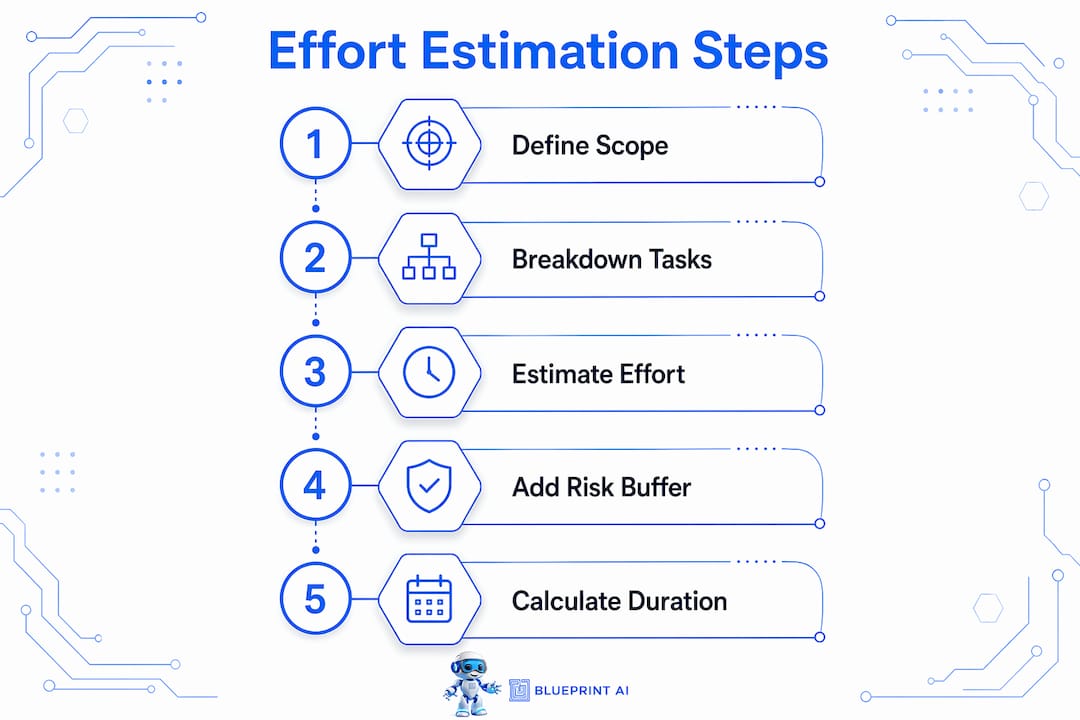
How to produce an effort estimate step by step
- Clarify scope and document assumptions. Write down what is in scope, what is out, which integrations are included, and what reuse is assumed. An estimate is only as good as its stated assumptions.
- Decompose to tasks under ten days. Break features into concrete, assignable tasks. If a task cannot be described clearly, it is not ready to estimate.
- Gather 3-point inputs from the implementers. For each task, ask the person doing the work for an optimistic (O), most likely (M), and pessimistic (P) estimate. Never let a manager estimate on behalf of a developer.
- Apply PERT per task. Calculate E = (O + 4M + P) / 6. This single formula prices the bad case without letting it dominate.
- Aggregate and add a contingency buffer. Sum the PERT estimates, then add 20–25% to cover invisible overhead: integration surprises, security hardening, QA cycles, and scope creep.
- Convert effort to duration. Divide total effort by team capacity, then apply a ~1.6× calendar multiplier to account for meetings, context-switching, and non-coding work.
- Validate against history and constraints. Compare the result to similar past projects. If it conflicts with a hard deadline, surface that conflict explicitly rather than compressing the estimate to fit.
Assumptions checklist to document: team experience level, third-party dependencies, environment setup time, degree of reuse, and known unknowns (regulatory requirements, accessibility standards).
Pro Tip: Re-estimate at every major milestone. The first estimate is a forecast with thin information; treat it as a starting point, not a contract. Best practice is to re-estimate as new information appears rather than defending the original number.
A worked example: bottom-up + PERT for a small project
Project: A mobile app with three features: user authentication, a dashboard, and push notifications. Team: one senior developer, one junior developer. Assumptions: no reuse, standard third-party auth library, no legacy integration.
| Task | O (hrs) | M (hrs) | P (hrs) | PERT E (hrs) |
|---|---|---|---|---|
| Auth: frontend + testing | 4 | — | — | — |
| Dashboard: data model | 4 | 6 | — | — |
| Push notifications: setup | 3 | 6 | — | 6 |
| Push notifications: testing | 2 | 4 | — | — |
| Total | 55.5 hrs |
Add a 20% risk buffer: 55.5 × 1.20 = 66.6 person-hours. Convert to calendar time: 66.6 ÷ (two developers at 6 productive hours/day) = ~5.6 days of effort, then × 1.6 = roughly 9 calendar days.
With Blueprintbot: instead of building that task list manually, you paste your app idea into Blueprint AI and receive a structured task breakdown with initial time suggestions in seconds. You still validate every number with your developers, but the decomposition step, which typically takes a planning session, is done. The app development time estimator gives you a starting baseline you can refine rather than a blank page.
How do you improve estimation accuracy over time?
The most reliable improvement comes from measurement and iteration, not from finding a better formula.
Track these metrics on every project: estimate vs. actual (accuracy ratio), velocity trends sprint over sprint, and how often you underrun versus overrun. When one estimator consistently runs 40% over, that is a calibration problem, not a project problem.
Research in forecasting shows that combining independent estimates from multiple sources or methods outperforms single-method estimates — the same principle that makes ensemble models more accurate than any individual model.
Process changes that move the needle: keep a project-history database with actual hours logged against estimated hours; calibrate your calendar multiplier using your own team's data rather than a generic 1.6×; run short post-mortems after each sprint to identify which task categories consistently blow up. For teams using story points, convert velocity to calendar forecasts at the start of each quarter so stakeholders get dates, not just point counts.
Common estimation mistakes and how to avoid them
The planning fallacy is the most persistent problem: initial estimates skew optimistic because people anchor on the best-case scenario. Structured decomposition and 3-point estimates reduce that bias directly.
- Confusing effort and duration. A 40-hour task done by two developers in parallel is not a 20-hour task; it is still 40 hours of effort but roughly 20 hours of calendar time.
- Single-point estimates. A single number hides uncertainty. Always present a range.
- Forgetting invisible overhead. Integration, security review, QA, deployment, and documentation routinely add 20–30% to raw coding estimates. Add them explicitly.
- Scope creep without re-estimation. When scope changes, the estimate must change too. Treating the original estimate as fixed while adding features is how projects fail quietly.
- Managers estimating instead of implementers. The person doing the work has the most relevant information. Estimates made without them are guesses dressed up as plans.
At some point, more estimation time yields diminishing returns. If you have decomposed to ten-day tasks, applied PERT, and validated against history, start delivering. Precision beyond that is speculation.
Key takeaways
Effort estimation works best as a hybrid process: bottom-up decomposition, 3-point PERT per task, team validation, and a 20–25% contingency buffer applied consistently and re-estimated at every milestone.
| Point | Details |
|---|---|
| Effort ≠ duration | Effort is total work; apply a ~1.6× multiplier to convert it to calendar time. |
| PERT reduces optimism bias | Use (O + 4M + P) / 6 per task; it prices the bad case without letting it dominate. |
| Combine methods | Hybrid approaches that blend independent estimates outperform any single technique. |
| Measure and iterate | Track estimate vs. actual on every project and re-estimate at each major milestone. |
| Blueprintbot accelerates decomposition | Blueprint AI generates structured task lists and initial estimates from your app idea, giving teams a validated starting point instead of a blank page. |
The part most guides skip
Most effort estimation guides treat the formula as the hard part. It is not. The PERT formula takes thirty seconds. The hard part is getting honest pessimistic estimates out of developers who have been burned for giving them.
When a developer says a task will take two weeks and it ends up taking four, the instinct is to blame the estimate. But often the developer knew it could take four weeks and said two because that was what the room wanted to hear. Psychological safety around estimation matters as much as the technique. If your team's pessimistic estimates are always close to the most likely ones, that is a signal, not a coincidence.
My preference for routine work is person-days with explicit overhead line items. For novel architecture or anything touching a third-party API for the first time, I switch to 3-point estimates and widen the pessimistic case deliberately. Story points work well for relative sizing within a sprint but break down the moment a stakeholder asks for a ship date. When that question comes, convert velocity to calendar weeks and present a range, not a date.
Re-estimation is not an admission of failure. It is the mechanism that keeps a project honest.
How Blueprintbot speeds up your first estimate
Getting from a product idea to a defensible task list is where most planning sessions stall. Blueprintbot solves that specific bottleneck. Paste your app concept into Blueprint AI and it generates a structured breakdown covering architecture, feature tasks, and initial time suggestions, all in seconds. That output becomes the starting point for your PERT estimates rather than a blank whiteboard.

Founders use it to validate scope before hiring a development team. Project managers use it to generate a baseline estimate for a planning workshop. Development teams use it to accelerate decomposition on new features. The software cost estimator converts that effort directly into a cost range, and the full blueprint examples show how the platform structures real projects end to end. Every AI-generated suggestion still needs validation from your implementers, but you are refining rather than starting from scratch. Try a blueprint on your current project idea and see how much of the decomposition work it handles for you.
Useful sources and further reading
- PMI-related reporting on estimation and project failure — the 39% figure and its context
- PERT formula and calendar multiplier guidance — practical application of 3-point estimation
- ICT Institute: four methods for software effort estimation — bottom-up decomposition, parametric models, and iterative re-estimation
- Wikipedia: software development effort estimation — scope, units, and the distinction between modal, median, and budget estimates
- Project management tools directory — structured tools for teams building estimation processes
- Blueprintbot estimation tools — free planning and estimation tools for software projects