Types of software development methodologies for founders

Most early-stage app projects with uncertain requirements should start with an Agile approach, specifically Scrum or Kanban, and validate the direction with an AI-generated blueprint before committing to anything heavier. The four main methodology families are:
- Sequential (Waterfall, V-Model): fixed phases, gate-based approvals, best for stable requirements and regulated environments
- Iterative (RAD, RUP): rapid prototyping and multiple small releases, suited to early product discovery when speed matters
- Agile (Scrum, Kanban, XP): short cycles, continuous feedback, built for changing requirements
- Hybrid/Scaled (SAFe, DAD): Agile principles applied across large programmes with governance layers
If your requirements are still evolving, start Agile. If you are building for a regulated industry or have a fixed contract scope, lean sequential or hybrid. If you are coordinating more than four or five teams, look at a scaled framework only after you have modularised the product.
Table of Contents
- What are the main types of software development methodologies?
- How do you choose the right approach for your project?
- Practical trade-offs: Waterfall, Scrum, Kanban, XP, and SAFe
- What engineering practices do non-technical PMs need to insist on?
- How to pilot a methodology using an AI blueprint tool
- Common pitfalls when selecting or switching methodologies
- Which methodology should you start with? A quick cheat-sheet
- Key takeaways
- The case for pragmatism over purity
- Blueprintbot turns your app idea into a sprint-ready blueprint
- Useful sources and further reading
What are the main types of software development methodologies?
Software development methodologies generally split into two broad camps: plan-driven (sequential) models and Agile models that work in short, incremental cycles. The four-category taxonomy gives you more precision.
Sequential methods treat each phase as a gate. Waterfall moves requirements through design, build, test, and deploy in strict order. The V-Model extends that by pairing each development phase with a corresponding test phase, so verification happens at every level. Both suit projects where requirements are locked before work begins, such as government contracts or safety-critical systems.
Iterative methods like RAD and RUP favour rapid prototyping and multiple small releases. RUP, maintained by IBM since 1998, organises work into four phases (inception, elaboration, construction, transition) and lets teams revisit scope within each iteration. RAD trades up-front planning for speed, interleaving design and code so requirements can shift without derailing the project.
"Agile is a mindset, not a single process." The Agile Manifesto's 12 principles emphasise sustainable development, technical excellence, and responding to change — not a prescribed set of ceremonies.
Agile frameworks operationalise that mindset differently. Scrum uses fixed-length sprints (usually two weeks) with defined roles and ceremonies. Kanban visualises work in progress and limits queue depth to expose bottlenecks. Extreme Programming (XP) adds engineering rigour through test-driven development (TDD), pair programming, and continuous refactoring. The Agile Alliance frames these as guiding principles rather than prescriptive rules, which means you can tailor any of them to your context.
Hybrid/Scaled frameworks like SAFe (Scaled Agile Framework) and DAD (Disciplined Agile Delivery) layer coordination mechanisms on top of Agile teams. SAFe introduces programme increments and release trains to synchronise multiple squads. DAD supersedes the older Agile Unified Process and gives teams a toolkit of practices to choose from rather than a single prescribed path. Both carry real organisational overhead and are rarely worth it for smaller organisations.

How do you choose the right approach for your project?
Atlassian advises that methodology choice is as much an organisational decision as a technical one. Answer these questions before picking anything:
- Are your requirements stable or still evolving?
- How large is your team, and are they co-located or distributed?
- Do you face regulatory or contractual constraints that require documented sign-offs?
- How much change can your stakeholders tolerate mid-project?
- What is your delivery cadence target: monthly releases, weekly, or continuous?
- Does your team have the engineering discipline for automated testing and CI/CD?
| Dimension | Sequential (Waterfall/V-Model) | Iterative (RAD/RUP) | Agile (Scrum/Kanban/XP) | Hybrid/Scaled (SAFe/DAD) |
|---|---|---|---|---|
| Best for | Fixed scope, regulated products | Rapid prototyping, evolving scope | Uncertain requirements, fast feedback | Large programmes, multiple teams |
| Team size | Any, works well solo or small | Small to medium | Small to medium sized teams | Large (more than four or five) |
| Requirement stability | High | Medium | Low to medium | Mixed |
| Delivery cadence | Milestone-based | Iterative releases | Sprint or continuous | Programme increments |
| Governance suitability | High | Medium | Low to medium | High |
| Technical discipline required | Low | Medium | High | High |
| Learning curve | Low | Medium | Medium | High |
| Timeline/cost shape | Predictable upfront | Moderate flexibility | Adaptive, ongoing | Complex, high coordination cost |
Pro Tip: Before committing organisation-wide, run a two-week pilot sprint or a short Kanban experiment on one real feature. A small experiment surfaces culture and tooling gaps far faster than any planning document.
Practical trade-offs: Waterfall, Scrum, Kanban, XP, and SAFe
Understanding the trade-offs is where most non-technical product managers save themselves real pain.
Waterfall gives you predictable timelines and clear documentation, which procurement and legal teams love. The catch: discovering a flawed assumption in month four means reworking months one through three. It works when you genuinely know what you are building before you start.
Scrum delivers working software every sprint, which keeps stakeholders engaged and surfaces problems early. The overhead is real though: daily standups, sprint planning, retrospectives, and a product owner who must be available to answer questions constantly. Scrum without a disciplined backlog quickly becomes a chaos engine dressed in ceremony.
Kanban has almost no ceremony, which makes it attractive for small teams or maintenance work. You visualise tasks on a board, set work-in-progress limits, and pull new work only when capacity exists. The risk is drift: without sprint goals, teams can lose strategic focus and optimise for busyness rather than outcomes.
- XP pros: TDD and pair programming produce fewer defects and more maintainable code; continuous refactoring keeps the codebase changeable as the product grows.
- XP cons: Requires strong engineering culture; pair programming can feel inefficient to stakeholders who count heads rather than output quality.
- SAFe pros: Coordinates multiple Agile teams around shared programme goals; provides governance structures that satisfy enterprise risk and compliance requirements.
- SAFe cons: Heavy process overhead; organisations often implement the ceremonies without the underlying Agile discipline, producing the worst of both worlds.
Martin Fowler warns that teams often adopt ceremonies without the technical practices needed for real agility. The result is higher overhead but no improvement in responsiveness.
A useful mental model: Waterfall for certainty, Scrum for discovery, Kanban for flow, XP for quality, SAFe for scale. Most early-stage products belong in the middle two columns.
What engineering practices do non-technical PMs need to insist on?
Agile ceremonies without engineering rigour produce faux-Agile: standups and sprint boards that generate overhead but not speed. The practices that actually sustain agility are technical.
Continuous integration (CI) means every code change is automatically built and tested the moment it is merged. Without it, integration problems accumulate silently and explode at release time. Continuous delivery (CD) extends that pipeline so a passing build can be deployed to production at any moment. Together, CI/CD compress the feedback loop from weeks to hours. Pairing automated testing with CI/CD pipelines is the single fastest way to validate that new features do not break existing ones.
TDD, as Martin Fowler describes it, functions as a design technique as much as a testing approach. Writing tests before code forces clearer interfaces and more modular architecture, which makes the codebase easier to change as requirements evolve. Refactoring, done continuously rather than in a big cleanup sprint, keeps that modularity intact. These modern engineering practices are not optional extras for teams claiming to work in an Agile way.
Red flags to watch for:
- No automated test suite, or tests that are never run in the pipeline
- "Refactoring sprint" scheduled for later (it never arrives)
- Deployments require manual steps and take more than a day
- Technical debt is tracked nowhere and discussed never
Pro Tip: Ask any team claiming to be Agile: "What is your CI pipeline, and how long does a build take?" A team without a clear answer is not yet Agile in any meaningful sense.
How to pilot a methodology using an AI blueprint tool
A two-to-four-week pilot is enough to validate whether a methodology fits your team before you reorganise around it. Here is how to run one using an AI blueprint tool like Blueprintbot.
- Define scope. Pick one feature or user story, not the whole product. Narrow scope surfaces process problems without risking the roadmap.
- Choose cadence. Decide whether you are running a two-week Scrum sprint or a Kanban flow experiment. Write it down.
- Generate a blueprint. Paste your feature idea into Blueprintbot and ask for: system architecture, a prioritised backlog, acceptance criteria for each story, and a CI/CD checklist. The output arrives in seconds and gives your team a concrete starting point rather than a blank page.
- Ask the AI for a sprint plan. Prompt: "Given this architecture and backlog, create a two-week sprint plan with story points, dependencies, and a definition of done for each item."
- Run the pilot. Execute one sprint or two weeks of Kanban flow. Track cycle time, defect rate, and whether the team hit the sprint goal.
- Retrospect and decide. One retrospective is enough to know whether the methodology fits. If the team struggled with the cadence or the ceremonies felt like overhead, adjust before scaling.
A pilot of this length costs roughly two weeks of team time and produces a real feature, a tested process, and a software development plan you can hand to any new developer.
Pro Tip: Use Blueprintbot's output as the briefing document for your pilot retrospective. Comparing what the AI predicted against what the team actually built is one of the fastest ways to calibrate your next sprint estimate.
Common pitfalls when selecting or switching methodologies
Most methodology failures are not about the framework. They are about the gap between what a team says it does and what it actually does.
Faux-Agile is the most common trap. A team adopts Scrum ceremonies (standups, sprint reviews, retrospectives) but skips automated testing, CI/CD, and refactoring. The result is more meetings and slower delivery. The fix is to treat engineering practices as non-negotiable prerequisites, not optional upgrades.
Ignoring technical debt compounds over time. Agile teams should treat technical debt as a backlog citizen, scheduling refactors alongside feature work with acceptance criteria and measurable outcomes. A debt backlog that is never prioritised signals that the team is optimising for velocity theatre rather than sustainable delivery.
Unrealistic governance shifts sink hybrid adoptions. Moving a regulated team from Waterfall to SAFe in one quarter is almost always too fast. The documentation habits, approval chains, and risk registers do not disappear because you renamed your sprints "programme increments."
"Practitioners seldom use system development methods by the book, often choosing to omit or tailor some of the practices to create an in-house method." The software development process literature confirms that tailoring is normal — the mistake is tailoring out the hard parts.
Signals that mean reconsidering your approach:
- Sprint goals are missed three or more times in a row
- The team cannot deploy without a manual approval chain taking more than two days
- Stakeholders are surprised by what gets delivered at the end of each sprint
Which methodology should you start with? A quick cheat-sheet
Map your project profile to a starting point:
- MVP / high uncertainty: Kanban for solo founders or very small teams; Scrum with two-week sprints once you have three or more people. Keep the backlog short and revisit priorities weekly.
- Regulated or fixed-scope product: Sequential (Waterfall or V-Model) with documented sign-offs at each phase gate, or a hybrid approach that adds Agile sprints inside a Waterfall envelope for the build phase.
- Large programme (multiple teams): Pilot Scrum at the team level first. Introduce SAFe or DAD only after teams are genuinely Agile and the product is modularised into clear domains.
- Maintenance-heavy or refactor-needed product: XP practices (TDD, refactoring, pair programming) plus a dedicated technical-debt backlog. Treat debt repayment as a first-class backlog item, not a side project.
The SDLC guide from Blueprintbot maps these profiles to lifecycle stages in more detail if you want to go deeper on sequencing.
Key takeaways
The single most important decision is matching your methodology to your requirement stability: uncertain requirements need Agile, fixed requirements need sequential, and large programmes need scaled frameworks only after the team is genuinely Agile.
| Point | Details |
|---|---|
| Four methodology families | Sequential, iterative, Agile, and hybrid/scaled each suit different requirement stability and team sizes. |
| Agile requires engineering discipline | CI/CD, automated testing, and refactoring are prerequisites for real agility, not optional add-ons. |
| Pilot before committing | A two-to-four-week pilot sprint validates methodology fit before any organisation-wide change. |
| Technical debt needs a backlog slot | Schedule refactors alongside features with acceptance criteria so debt does not silently accumulate. |
| Blueprintbot accelerates pilots | Blueprintbot generates architecture, backlog, acceptance criteria, and CI/CD checklists in seconds to start a pilot immediately. |
The case for pragmatism over purity
The methodology debate in software circles can get almost theological. Teams argue about whether Kanban is "really Agile" or whether SAFe has corrupted the Manifesto's original intent. For a non-technical founder or product manager trying to ship a product, that debate is mostly noise.
What actually matters is whether your team can deploy working software frequently, respond to what users tell you, and keep the codebase changeable as the product grows. A team running disciplined Scrum with solid CI/CD will outperform a team running SAFe without automated tests every time. The framework is the container; the engineering practices are what fill it with value.
AI blueprint tools shift the calculus further. When you can generate a sprint-ready backlog, an architecture diagram, and a test strategy in under a minute, the planning overhead that once justified heavyweight sequential methods largely disappears. That does not mean Waterfall is dead for regulated industries. It means the bar for choosing a heavy process has risen, and the cost of starting with a lightweight Agile pilot has dropped close to zero.
Start small, insist on the engineering fundamentals, and let the AI handle the documentation scaffolding.
Blueprintbot turns your app idea into a sprint-ready blueprint
Choosing a methodology is one decision. Having something concrete to hand your development team on day one is another. Blueprintbot generates a full technical blueprint from your app idea in seconds: system architecture, database schema, API design, a prioritised backlog with acceptance criteria, and a CI/CD checklist your team can act on immediately.
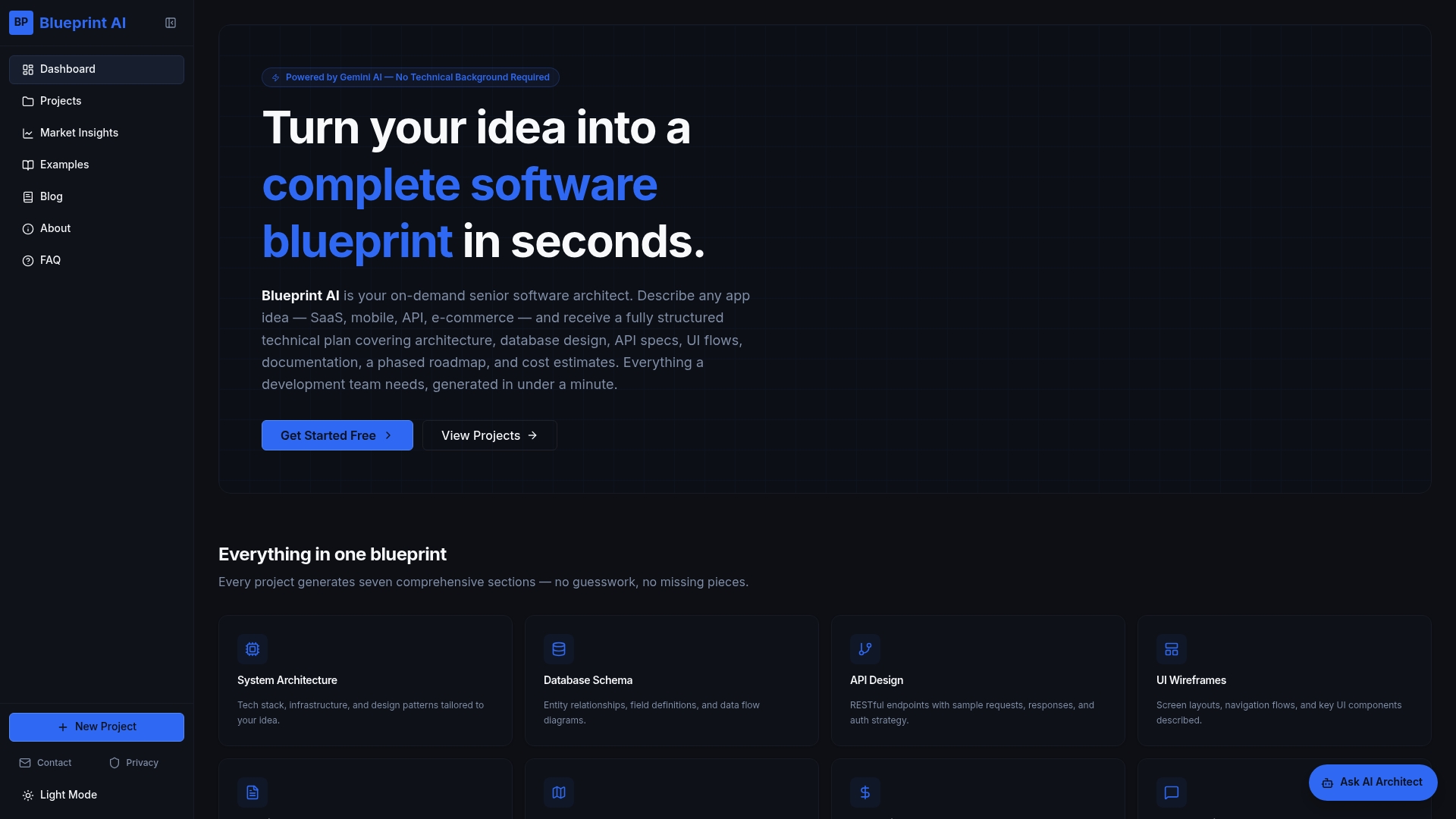
For a methodology pilot, that output is the difference between a two-week experiment and two weeks of setup before the experiment even starts. Paste your feature idea, choose your sprint length, and Blueprintbot produces the artefacts a developer needs to begin. No coding knowledge required, no agency retainer, no waiting.
Browse worked blueprint examples to see exactly what the output looks like, or open the free planning tools to run your first pilot today.
Useful sources and further reading
The sources below are the primary references behind this article. Each is worth bookmarking if you want to go deeper on any methodology.
- Agile Manifesto — agilemanifesto.org and its 12 principles: the foundational document for all Agile frameworks.
- Martin Fowler — martinfowler.com/agile.html: the clearest writing available on what Agile actually requires technically, including his warnings about faux-Agile.
- Atlassian Agile Guide — atlassian.com/agile/software-development: practical guidance on methodology selection, technical debt, and team structure.
- Agile Alliance — agilealliance.org/agile101: accessible primer on Agile principles and how to tailor frameworks to context.
- Netguru methodology overview — netguru.com/blog/software-development-methodologies: solid taxonomy of the four methodology families with examples.
- Fullscale top methodologies — fullscale.io/blog/top-10-software-development-methodologies: accessible breakdown of plan-driven versus Agile models.
- Blueprintbot SDLC guide — blueprintbot.net/blog/software-development-lifecycle-a-complete-2026-guide: maps methodology choice to lifecycle stages for non-technical product managers.
"We are uncovering better ways of developing software by doing it and helping others do it." The Manifesto for Agile Software Development remains the clearest statement of why the industry moved away from heavyweight sequential processes in the first place.