What is a software development plan? a clear guide

A software development plan is a comprehensive roadmap that defines how a team will build, test, and deliver software from start to finish. Think of it as the single source of truth connecting business goals to technical execution. It covers scope, team roles, chosen methodology, timeline, risk management, quality assurance, and stakeholder communication. Whether you are using Agile methodology, the Scrum framework, or a hybrid approach, a solid plan keeps every contributor aligned. Tools like Jira and Trello help teams track progress, but the plan itself is what gives that tracking meaning.
What are the key components of a software development plan?
A software development plan is more than a schedule. It is a structured document that answers every critical question before a single line of code is written.
SponsoredCheck out today's featured offer →Scope and objectives
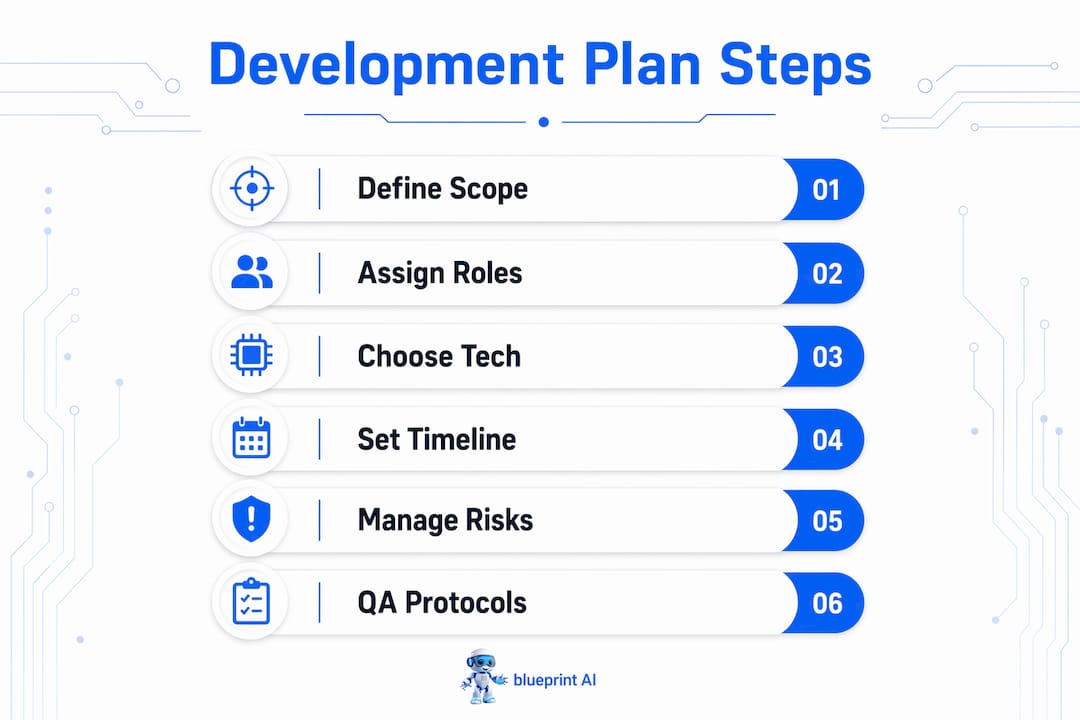
The plan begins with a clear definition of what the project will and will not deliver. This includes success criteria, boundaries, and the business problem being solved. Without this, teams fall into scope creep almost immediately.
Team roles and responsibilities
Every plan must name who owns what. Development, QA, product management, and key stakeholders each need defined responsibilities. Ambiguity here is one of the most common causes of missed deadlines.

Technical architecture and technology stack
The plan documents the chosen technologies, system architecture, database design, and API structure. These decisions shape every sprint that follows. Making them explicit early prevents costly mid-project pivots.
Methodology and timeline
Agile, Waterfall, or a hybrid approach each require different planning structures. Agile plans use sprints and iterative milestones. Waterfall plans use sequential phases with firm gates. Either way, milestones and dependencies must be documented clearly to keep delivery on track.
Risk management and quality assurance
A strong plan identifies risks before they become problems. It also defines testing protocols, quality gates, and acceptance criteria for each major deliverable. Acceptance criteria attached to deliverables prevent disputes at handover and keep quality standards enforceable.
Pro Tip: Keep your SDP and your project management plan separate. The SDP focuses on technical decisions and delivery. The broader project management plan covers budget governance, procurement, and executive reporting.
| Point | SDP | Project Management Plan |
|---|---|---|
| Primary focus | Technical execution and delivery | Budget, governance, and executive reporting |
| Audience | Dev team, QA, product leads | Sponsors, steering committees |
| Core content | Architecture, methodology, milestones | Cost baselines, procurement, risk registers |
| Update frequency | Each sprint or phase | Major governance events |
How does a software development plan relate to the SDLC?
The software development lifecycle (SDLC) is the framework. The software development plan is the document that drives decisions within it. SDLC phases include planning, feasibility analysis, system design, implementation, testing, deployment, and maintenance. Each phase needs specific inputs and outputs, and the SDP provides both.
Here is how the plan maps to each phase:
- Planning. The SDP is created here. Goals, scope, and constraints are documented. This phase is foundational because it gathers and documents project objectives to prevent scope creep later.
- Feasibility analysis. The plan records technical and financial feasibility findings. Risk assumptions are logged so the team can revisit them.
- System design. Architecture decisions, technology stack choices, and database schemas are locked into the plan. Design outputs become formal deliverables.
- Implementation. Sprint plans, coding standards, and integration protocols are drawn from the SDP. Developers reference it daily.
- Testing. Quality assurance protocols defined in the plan are executed here. Acceptance criteria determine whether each deliverable passes.
- Deployment. The plan documents release procedures, rollback strategies, and go-live checklists.
- Maintenance. Post-release responsibilities, support protocols, and update cycles are all defined in the original plan.
The SDLC helps teams balance stakeholder needs, manage resources, estimate costs, identify risks early, and improve documentation. That value only materialises when the SDP actively guides each phase rather than sitting in a shared drive untouched.
Pro Tip: Treat your SDP as a living document. Assign one person as the plan owner who is responsible for updating it after every sprint review or phase gate. A plan nobody maintains becomes fiction within weeks.
What are the biggest misconceptions about software planning?
The biggest misconception in software development planning is treating it as paperwork or a list of dates. Planning is decision-making. It is the process of resolving scope, priorities, risks, and quality standards before they become emergencies.
Several other misconceptions consistently derail projects:
- Planning equals scheduling. A schedule tells you when. A plan tells you what, who, how, and why. Confusing the two produces a calendar with no decision-making behind it.
- More detail means better planning. Overly long plans that nobody reads or updates lose trust fast. A usable plan must be concise, actively owned, and maintained throughout the project.
- Planning only happens at the start. Plans must evolve. Agile teams revisit and revise their plans every sprint. Waterfall teams update them at each phase gate.
- Activity lists are enough. Planning only at the activity level, without mapping to deliverables, is a governance failure. Deliverable-oriented planning links every work package to a verifiable output with acceptance criteria.
- Stakeholders do not need to see the plan. The SDP is a communication tool. Stakeholders who never see the plan cannot flag misalignments before they become expensive.
Pro Tip: Use a Work Breakdown Structure (WBS) oriented around deliverables, not activities. Each deliverable should have a clear owner and agreed acceptance criteria. This single change eliminates most "is it done?" arguments at review meetings.
How to write a software development plan: practical steps
Creating an effective software development plan follows a clear sequence. Skipping steps early creates confusion that compounds through every phase.
- Document goals and requirements first. Write down what the software must do, who will use it, and what success looks like. Be explicit about what is out of scope.
- Engage stakeholders before writing the plan. Gather input from business owners, developers, QA leads, and end users. Misaligned expectations caught in week one cost nothing. Caught in week ten, they cost everything.
- Define roles and governance. Name the plan owner. Clarify who can approve scope changes and who must be consulted on technical decisions.
- Choose your methodology. Agile works well for products with evolving requirements. Waterfall suits projects with fixed scope and regulatory constraints. Document the rationale for your choice.
- Use planning tools and templates. Blueprintbot generates structured software blueprints covering architecture, API design, database schemas, and development roadmaps in seconds. This is particularly useful for founders and project managers who need a complete technical specification without writing it from scratch.
- Build in risk assessment. Identify the top five risks, assign likelihood and impact scores, and document mitigation strategies. Revisit this list at every sprint review.
- Set milestones with acceptance criteria. Each phase or sprint should end with a verifiable deliverable. Vague milestones like "backend complete" invite disagreement. Specific criteria like "all API endpoints return correct responses under load testing" do not.
| Planning Step | Key Output |
|---|---|
| Goals and requirements | Requirements document with scope boundaries |
| Stakeholder engagement | Agreed priorities and out-of-scope list |
| Role definition | RACI matrix or responsibility chart |
| Methodology selection | Documented rationale and sprint or phase structure |
| Risk assessment | Risk register with mitigation strategies |
| Milestone setting | Deliverables list with acceptance criteria |
You can also explore free planning tools to support each of these steps without building templates from scratch.
Does decision-focused planning actually improve delivery?
Planning as decision-making rather than date-setting is the single most important shift a project team can make. Every architectural choice, feature prioritisation call, and quality gate is a decision. Making those decisions explicitly, and recording them in the plan, reduces surprises throughout the project.
A plan that documents decisions is a communication tool. A plan that only documents dates is a calendar.
Explicit decisions also manage stakeholder expectations. When a product owner knows that a feature was deprioritised in sprint three because of a documented risk trade-off, there are no surprises at the sprint review. The plan becomes the shared record of why the project looks the way it does.
Modern Agile teams implement this through sprint planning ceremonies, backlog refinement, and retrospectives. Each of these is a structured decision-making event. The SDP captures the outcomes so the team does not relitigate the same questions twice.
Pro Tip: Link every major engineering decision in your SDP to a business outcome. "We chose PostgreSQL because our data model requires complex relational queries at scale" is more useful than "we chose PostgreSQL." The reasoning protects the decision when stakeholders push back later.
Key takeaways
A software development plan is the decision-making document that connects business goals to technical execution, and its value depends entirely on how actively it is owned and maintained.
| Point | Details |
|---|---|
| Definition of an SDP | A structured roadmap covering scope, roles, methodology, timeline, risk, and quality for a software project. |
| Planning vs. scheduling | Planning resolves decisions about scope and priorities; scheduling assigns dates to those decisions. |
| SDLC integration | The SDP drives inputs and outputs at every SDLC phase, from feasibility through maintenance. |
| Deliverable-oriented structure | Attach acceptance criteria to every major deliverable to prevent disputes and support quality assurance. |
| Plan maintenance | Assign a plan owner and update the document after every sprint or phase gate to keep it trusted and useful. |
Why most software plans fail before the first sprint
I have reviewed dozens of software projects where the plan existed but nobody used it. The document was thorough, well-formatted, and completely irrelevant by week three. The team had moved on. The plan had not.
The pattern is consistent. Teams invest heavily in writing the initial plan and almost nothing in maintaining it. The moment the plan stops reflecting reality, developers stop consulting it. Stakeholders stop trusting it. The project reverts to ad-hoc decisions made in Slack threads.
The fix is not a better template. It is ownership. One person must be accountable for keeping the plan current. That person needs the authority to update scope, flag risks, and call a review when the plan diverges from reality. Without that accountability, even the most detailed SDP becomes a historical artefact rather than a working tool.
I also see too many plans built around activities rather than deliverables. An activity list tells you what people are doing. A deliverable list tells you what the project is producing. Only deliverables can be verified. Only deliverables have acceptance criteria. Shifting from activity-based to deliverable-based planning is the single change that most improves governance and reduces end-of-project disputes.
Agile and hybrid planning models have made this easier. Sprint reviews force teams to demonstrate working software, not just report on tasks completed. That discipline, applied consistently, keeps the plan honest.
— Rishi
Start your software plan with Blueprintbot
Translating a product idea into a structured software development plan takes time, technical knowledge, and a clear framework. Blueprintbot removes that barrier.
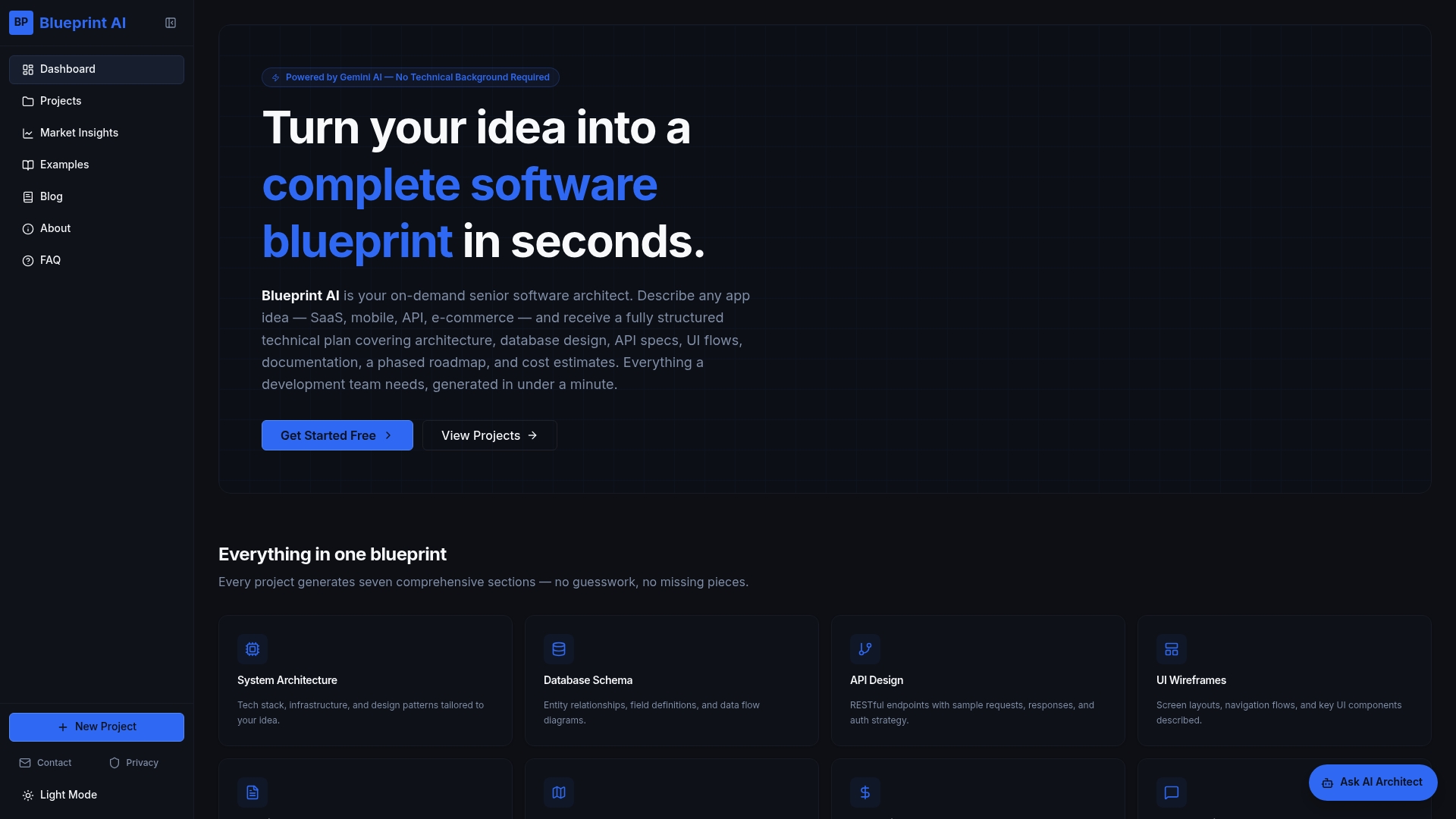
Blueprintbot uses AI to generate complete software blueprints covering system architecture, database schemas, API designs, user interface flows, development roadmaps, and cost estimates in seconds. Founders, project managers, and students can produce a detailed technical specification without writing a single line of code. The platform also includes an AI chat assistant for follow-up questions, making the planning process interactive and precise. If you want to see what a complete plan looks like before building your own, explore the worked blueprint examples to get started.
FAQ
What is a software development plan?
A software development plan is a structured document that defines how a software project will be built, tested, and delivered. It covers scope, team roles, methodology, timeline, risk management, and quality assurance.
How is a software development plan different from a project management plan?
A software development plan focuses on technical execution, including architecture, methodology, and delivery milestones. A project management plan covers broader governance, budget control, and executive reporting.
What are the key components of a development plan?
The core components are project scope and objectives, team roles, technical architecture, chosen development methodology, timeline with milestones, risk management strategies, quality assurance protocols, and a stakeholder communication plan.
How does the SDLC relate to a software development plan?
The SDLC provides the framework of phases from planning through maintenance. The software development plan drives the decisions and deliverables within each of those phases.
How do you keep a software development plan relevant throughout a project?
Assign a single plan owner responsible for updating the document after every sprint review or phase gate. Tie every major deliverable to acceptance criteria so the plan reflects what the project is actually producing.