What is a software blueprint? A founder's guide

A software blueprint is a structured, high-level plan that maps business intent to architecture and design before a single line of code is written. In software engineering, the recognised industry term for this discipline is software architecture description, formalised under ISO/IEC/IEEE 42010:2022. Whether you are an entrepreneur validating an app concept, a project manager coordinating a development team, or a student learning system design, understanding what a software blueprint contains and why it matters will save you from the most expensive mistake in software development: building the wrong thing in the wrong way.
What is a software blueprint and what does it contain?
A software blueprint is the master reference document that answers three questions before development begins: what the system must do, how it will be structured, and why specific technical decisions were made. It is not a single diagram or a requirements list. It is a collection of interconnected artefacts that together describe the complete technical intent of a project.
Effective blueprints produce a specific set of output artefacts, each serving a distinct purpose:
- System architecture overview: the high-level structure showing how major components relate to one another, including databases, services, and deployment topology.
- Use cases and user flows: step-by-step descriptions of how actors interact with the system, grounding technical decisions in real user behaviour.
- API contracts: formal definitions of how system components communicate, agreed upon before implementation begins.
- Data models: diagrams and schemas showing how information is stored, related, and retrieved.
- Quality criteria: measurable standards for performance, security, and reliability that the system must meet.
- Decision log: a record of why each major technical choice was made, including alternatives that were considered and rejected.
It helps to understand how a blueprint differs from related documents that teams often confuse with it.
| Document | Primary question answered | Typical contents |
|---|---|---|
| Software blueprint | How will the system be structured and why? | Architecture views, API contracts, data models, decision log |
| Requirements document | What must the system do? | Functional requirements, user stories, acceptance criteria |
| Design specification | How will each module be built? | Module details, algorithms, interface definitions, quality criteria |
| Project plan | When and by whom will work be done? | Timelines, milestones, resource assignments, risk register |

Pro Tip: Write your decision log entries at the moment a choice is made, not retrospectively. Teams that backfill decision logs weeks later consistently omit the context that made the decision sensible, which causes confusion during code reviews and handoffs.
How does a software blueprint guide the development process?
A blueprint is not a document you write once and file away. It is a living specification that evolves with the project, and its value compounds at each stage of the software development lifecycle. Blueprints serve as shared references that prevent teams from operating on conflicting assumptions, which is the root cause of most costly rework.
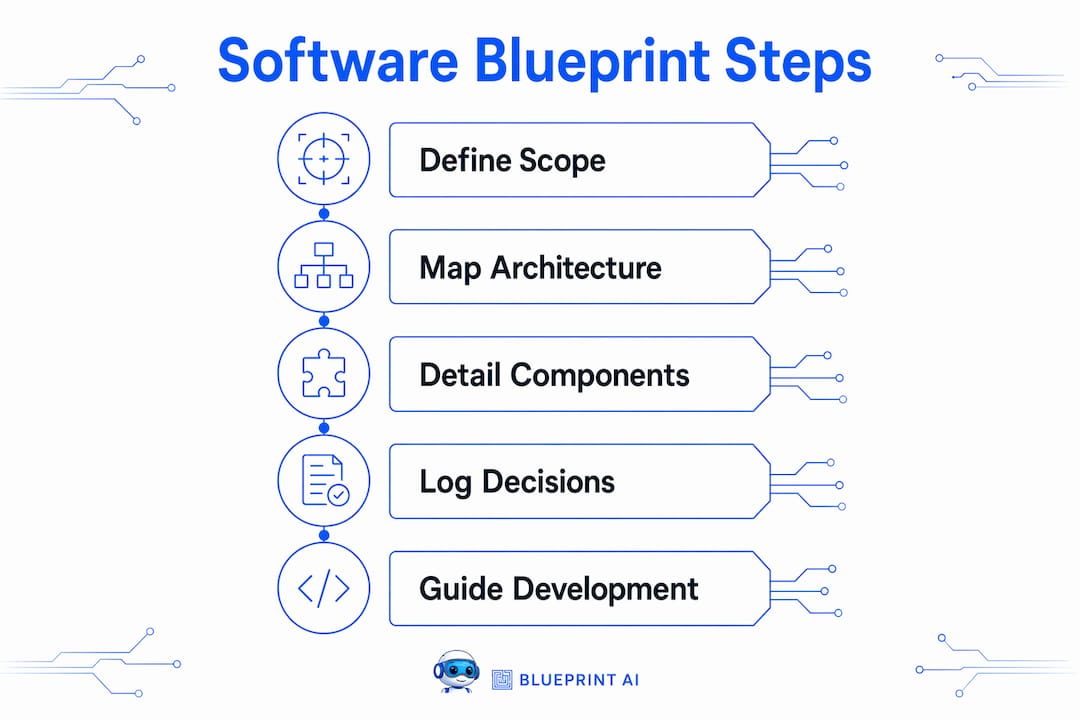
Here are the five stages where a blueprint plays a critical role:
- Requirements gathering. The blueprint captures not just what stakeholders want but the constraints and trade-offs that shape what is technically feasible. This prevents scope creep from entering the project through vague or unchallenged requirements.
- Architecture validation. Before any code is written, the blueprint allows architects, developers, and business stakeholders to review the proposed structure together. Catching a flawed database choice at this stage costs hours. Catching it after three sprints of development costs weeks.
- Sprint planning. Development teams use the blueprint to break work into coherent units. When the API contracts and data models are already defined, sprint tasks become precise rather than approximate.
- Quality assurance. Testers reference the blueprint's quality criteria to write test cases that reflect the system's intended behaviour, not just its observed behaviour. This distinction matters enormously for security and performance testing.
- Onboarding and handoff. When a new developer joins a project or a team transitions ownership, the blueprint provides context that code alone cannot. It explains the reasoning behind structural decisions that would otherwise appear arbitrary.
Pro Tip: Treat your blueprint as a first-class deliverable with the same version control discipline as your code. Store it in a repository alongside your source files so that changes to architecture are reviewed, approved, and traceable in the same way as code changes.
For a practical walkthrough of how these stages connect, the guide on creating a scalable architecture roadmap covers the sequencing in detail.
What role do architecture standards play in software blueprinting?
ISO/IEC/IEEE 42010:2022 makes a distinction that most teams miss: the architecture of a system and the documents used to describe that architecture are not the same thing. The architecture is the set of fundamental concepts and properties of a system. The architecture description is the collection of artefacts that expresses those concepts to stakeholders. Conflating the two leads to documentation that satisfies no one because it tries to serve every audience at once.
The standard introduces four concepts that give blueprinting its structure:
| Concept | Definition | Practical implication |
|---|---|---|
| Architecture | Fundamental structure and properties of the system | Exists independently of any document |
| Architecture description | Artefacts that express the architecture | Must be tailored to stakeholder concerns |
| Viewpoint | A convention for constructing a view | Defines what a view covers and how it is modelled |
| View | A representation of the system from a specific perspective | One view per stakeholder concern (e.g., security, deployment, data) |
Using viewpoints deliberately is the most underused practice in software blueprinting. A security engineer and a database administrator need different views of the same system. Writing a single monolithic architecture document that tries to address both audiences produces a document that neither finds useful. Separating views by stakeholder concern, as ISO/IEC/IEEE 42010 recommends, produces documentation that addresses stakeholder concerns with precision.
The arc42 template, which is widely used in European software teams, operationalises these concepts into a practical structure that maps directly onto the standard's requirements. It is worth examining if you are setting up a blueprint process from scratch.
What are the best practices for creating a software blueprint?
The difference between a blueprint that guides a project to success and one that gets ignored after week two comes down to discipline in how it is maintained. A well-maintained blueprint functions as a living specification that includes diagrams, decisions, and open questions, updated incrementally rather than rewritten in bulk.
Practitioners who maintain effective blueprints consistently follow these principles:
- Single source of truth. Store the blueprint in one location, structured with clear sections for context, actors, terminology, user flows, requirements, and the decision log. Teams that split documentation across wikis, slide decks, and email threads create the illusion of documentation without the substance.
- Separate stable from volatile. Stable interfaces and constraints should be locked down early and changed only through a formal review. Implementation details, by contrast, should be expected to evolve. Mixing the two causes teams to treat everything as equally negotiable, which destabilises the architecture.
- Track open questions explicitly. Every unresolved decision is a risk. A blueprint that lists open questions forces the team to acknowledge uncertainty rather than paper over it with optimistic assumptions.
- Review the blueprint at sprint boundaries. A fifteen-minute blueprint review at the start of each sprint catches drift before it compounds. Teams that review only at major milestones discover that the blueprint and the codebase have diverged significantly, making the document useless.
- Use AI-assisted tools to accelerate the first draft. Generating the initial structure of a blueprint, including architecture views, API outlines, and data model sketches, is now a task that AI tools handle well. The human contribution is the judgement applied to the output, not the mechanical assembly of the document.
For teams building their first blueprint, the software technical specification guide on the Blueprintbot blog covers how to organise requirements, design specs, and architectural plans into a coherent structure.
Pro Tip: When you write your blueprint's decision log, include the options you rejected and the reasons why. Future team members will inevitably revisit those rejected options. A log that explains why they were ruled out saves hours of repeated analysis.
Key takeaways
A software blueprint is the single most effective tool for aligning business intent with technical execution before development begins, and its value scales directly with how rigorously it is maintained.
| Point | Details |
|---|---|
| Core definition | A blueprint maps business intent to architecture, components, and constraints before coding starts. |
| Key components | Every blueprint needs an architecture overview, API contracts, data models, and a decision log. |
| Living document | Update the blueprint at each sprint boundary to prevent drift between documentation and code. |
| Standards matter | ISO/IEC/IEEE 42010 separates architecture from its description, improving stakeholder communication. |
| Stable vs. volatile | Lock down interfaces and constraints early; allow implementation details to evolve with the project. |
Why blueprints are the most undervalued tool in software projects
I have reviewed dozens of failed software projects over the years, and the pattern is almost always the same. The team had requirements. The team had a project plan. What they did not have was a shared technical reference that connected the two. The blueprint is that connection, and its absence is felt most acutely not at the start of a project but three months in, when a developer makes a database choice that contradicts an assumption the product manager made six weeks earlier.
The uncomfortable truth is that most teams skip the blueprint not because they think it is unnecessary but because they underestimate how quickly a project accumulates silent contradictions. Every undocumented assumption is a future conflict waiting to surface. Blueprints make assumptions explicit, which is uncomfortable in the short term and invaluable in the long term.
For entrepreneurs and non-technical founders, the blueprint serves a second purpose that rarely gets discussed: it is the document that tells a developer exactly what to build. Without it, you are paying for interpretation as much as implementation. A developer who receives a clear blueprint spends their time building. A developer who receives a vague brief spends their time guessing, and you pay for both the guessing and the corrections.
The rise of AI-assisted blueprinting tools has removed the last credible excuse for skipping this step. Generating a first-draft blueprint from a product description now takes minutes, not weeks. The question is no longer whether you can afford to create a blueprint. It is whether you can afford not to.
— Rishi
Turn your app idea into a technical blueprint today
Blueprintbot transforms an app concept into a detailed technical blueprint in seconds, covering system architecture, API designs, data models, and cost estimates. No technical background is required. Founders use it to validate ideas before hiring developers. Project managers use it to align teams before sprint planning begins.
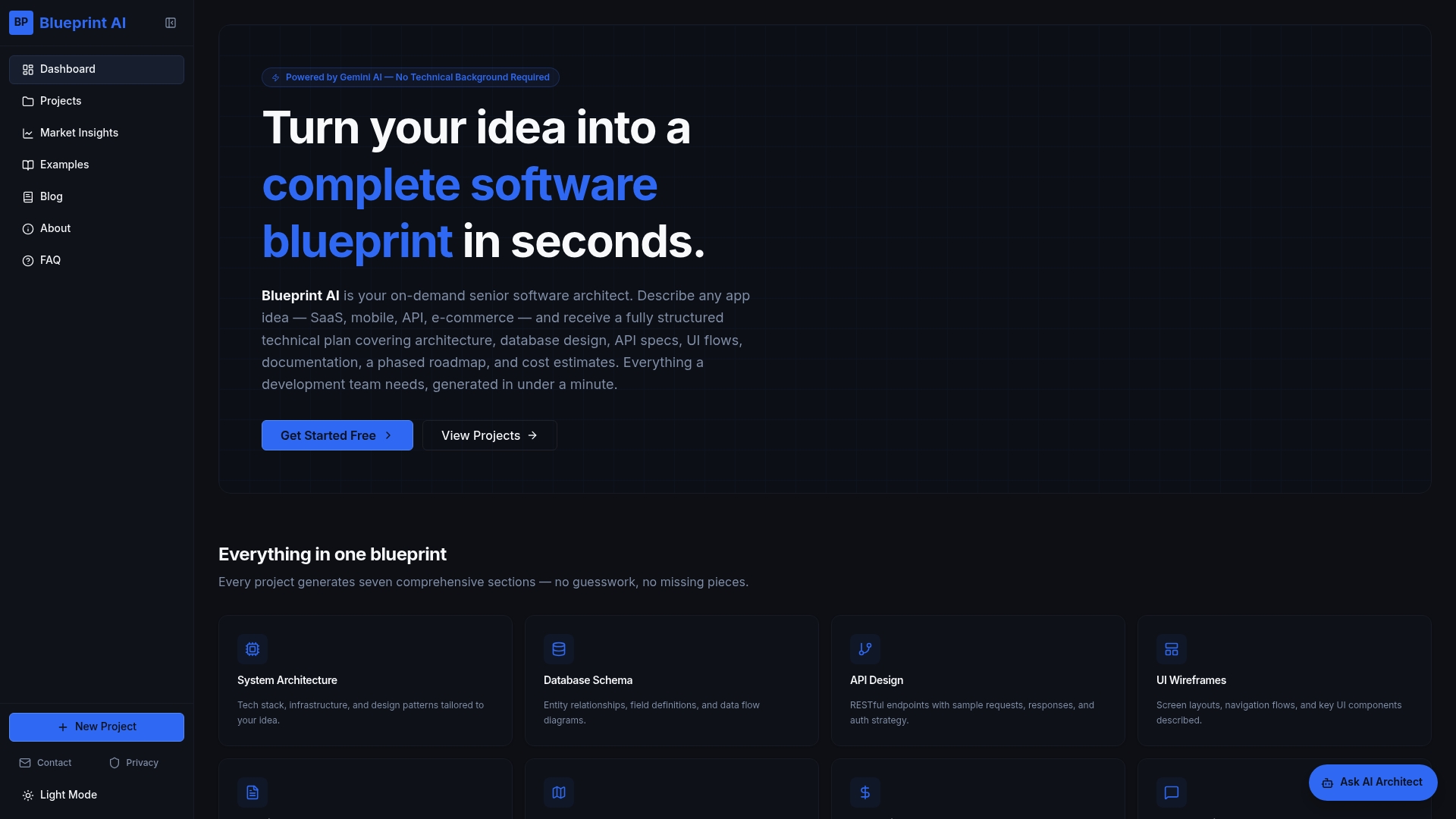
Explore real blueprint examples to see exactly what the output looks like, or browse the free planning tools to start building your own. If you are preparing for an investor meeting or a developer handoff, Blueprintbot gives you the technical credibility to walk in prepared.
FAQ
What is a software blueprint in simple terms?
A software blueprint is a structured plan that describes how a software system will be built, including its architecture, components, data models, and key technical decisions. It connects business goals to technical execution before development begins.
How does a software blueprint differ from a requirements document?
A requirements document defines what a system must do. A software blueprint defines how the system will be structured to meet those requirements, including architecture views, API contracts, and design decisions.
What are the key components of a software blueprint?
The key components include a system architecture overview, use cases, API contracts, data models, quality criteria, and a decision log that records why major technical choices were made.
Why is a software blueprint important for non-technical founders?
A blueprint gives non-technical founders a precise technical reference to share with developers, investors, and team members, reducing the risk of misinterpretation and costly rework during development.
What is ISO/IEC/IEEE 42010 and why does it matter for blueprinting?
ISO/IEC/IEEE 42010:2022 is the international standard that formalises how software architectures are described and communicated. It introduces the concept of viewpoints and views, which help teams tailor documentation to specific stakeholder concerns rather than producing one-size-fits-all documents.