Communicate with your software team effectively

Communicating with a software team effectively means translating business intent into technical clarity, and technical progress into decisions your stakeholders can act on. Most team leaders default to more meetings when alignment breaks down. That instinct is wrong. Async-first communication reduces burnout from excessive video calls and protects the deep work that engineers need to produce quality output. Tools like Slack, Notion, and Loom, combined with disciplined documentation habits, are what separate high-performing teams from ones that spend Fridays relitigating Tuesday's decisions.
How to communicate with your software team effectively using async-first principles
Async communication is the practice of exchanging information without requiring both parties to be present at the same time. For software teams, this is not a convenience feature. It is the structural foundation that protects focused work and reduces the coordination overhead that kills productivity.
The shift starts with replacing meetings. Replacing one recurring meeting with a structured async update saves teams two to four hours per person per week, with meaningful gains appearing within two to four weeks. That is not a marginal improvement. It is the equivalent of recovering half a workday every week, per person.
The mechanics are straightforward. Weekly status updates move to a shared document in Notion or Confluence. Request-for-comment threads replace exploratory brainstorms. Decision logs capture what was agreed and why. The key is structure: an unformatted Slack thread is not an async update. It is a meeting that happened in text.
Channel discipline matters just as much as format. Explicit response-time expectations per channel reduce communication anxiety across engineering teams. A practical baseline for 2026: Slack messages warrant a response within four hours during work hours, and email within twenty-four hours. When you set these norms publicly and hold to them, your team stops treating every message as urgent and starts protecting their focus time.
Escalation from async to synchronous should be the exception, not the default. Reserve live calls for decisions that genuinely require real-time negotiation, not for status updates that could have been a document.
Pro Tip: Start by replacing just one recurring meeting with a written async update. Pick the lowest-stakes meeting first. After two weeks, the habit is established and the time savings are visible enough to build on.
How do you turn technical updates into decisions?
The core purpose of engineering communication is to turn technical complexity into usable context for business and product decisions. Most technical updates fail this test. They describe mechanisms instead of trade-offs, and they end without a clear ask.
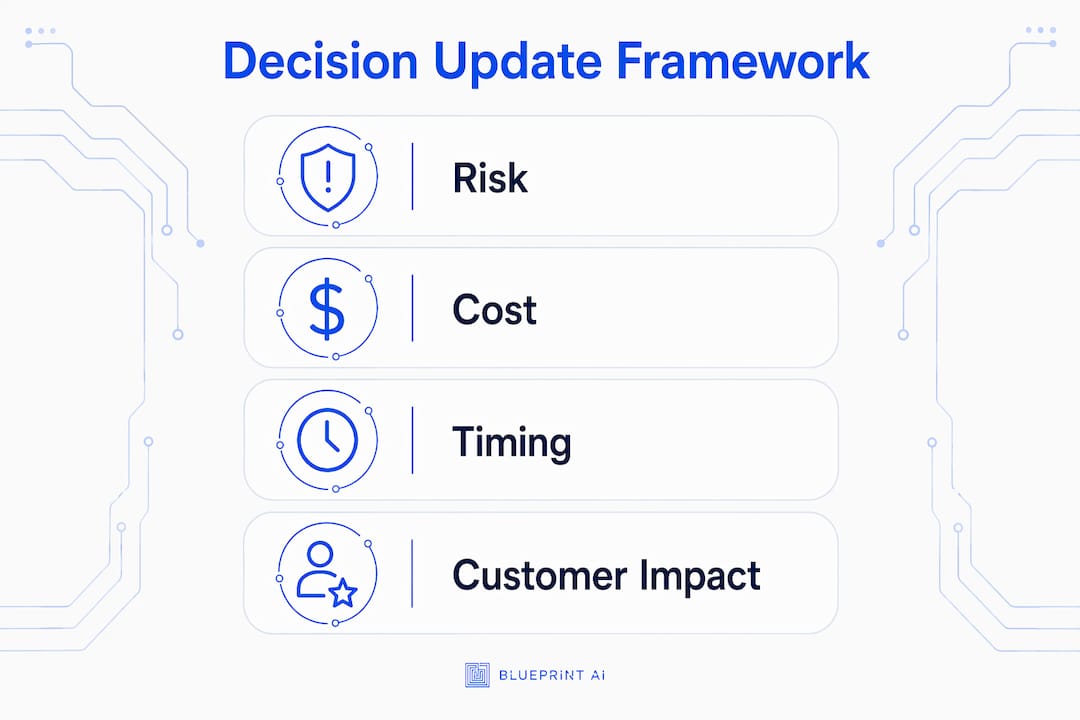
A useful framework is to frame every update around four dimensions: risk, cost, timing, and customer impact. When a developer tells you an API integration will take three weeks, that is a mechanism. When they tell you it takes three weeks because the third-party vendor's rate limits require a queuing layer, which adds cost and creates a single point of failure, that is a decision input. The first version informs. The second version enables a choice.
Present options with consequences rather than single conclusions. Instead of "we need to rebuild the authentication module," the update becomes: "Option A is a full rebuild, which takes six weeks and eliminates the current security debt. Option B is a targeted patch, which takes one week but leaves the underlying architecture fragile. Which risk are we more comfortable carrying?" That framing moves the conversation from technical territory to business territory, where the leader can actually contribute.
Close every communication with a clear next step or an explicit decision needed. The following question prompts work well in practice:
- "What decision do you need from me by end of week to keep this on track?"
- "Are there blockers I can remove, or is this waiting on a third party?"
- "What are the two or three options here, and what does each one cost us?"
- "What does 'done' look like for this sprint, and how will we know?"
The goal is not to make leaders technical. The goal is to make technical work legible to the people who hold the decisions.
Non-technical leaders improve collaboration significantly by explaining the 'why' behind requests and defining what "done" means with clear success criteria. When your team understands the business reason for a feature, they make better trade-off decisions without escalating every ambiguity to you.
What does a proper design-to-engineering handoff look like?
The most common source of costly revisions in software teams is not bad code. It is an incomplete handoff. When a developer implements a design incorrectly, the root cause is almost always a spec that was missing states, interactions, or rationale, not a developer who misread the file.

A proper Figma handoff goes well beyond sharing a link. It includes component specs, interaction behaviours, all UI states (including error, empty, loading, and disabled), responsive breakpoints, and the design rationale for non-obvious decisions. Without these, developers make assumptions. Assumptions become revisions. Revisions become delays.
The table below contrasts what a minimal handoff looks like versus what a complete one includes:
| Handoff element | Minimal (causes revisions) | Complete (enables autonomy) |
|---|---|---|
| Visual design | Figma link shared | Annotated Figma with component specs |
| Interaction states | Static screens only | All states: hover, error, empty, loading |
| Responsive behaviour | Desktop only | Breakpoints defined for mobile and tablet |
| Design rationale | None provided | Notes explaining non-obvious decisions |
| Feedback process | Ad-hoc Slack messages | Batched review in a single async thread |
Cross-team collaboration improves when request interfaces are clearly defined, including request formats, ownership, and triage processes. Treat cross-team requests the way you would treat an API: define the input format, set a response SLA, and assign an owner. Ad-hoc escalation is a symptom of poorly designed communication interfaces, not a personality problem.
Batch your design feedback rather than drip-feeding notes asynchronously. A single consolidated review comment is far less disruptive to a developer's flow than five separate Slack messages across a morning.
Pro Tip: When handing off a design, include a one-paragraph note explaining the user problem the design solves. Developers who understand the intent make better trade-off decisions when implementation constraints arise, without needing to interrupt you.
How should you structure meetings in a hybrid async environment?
Synchronous meetings earn their place only when a decision requires live negotiation. Everything else belongs in a document. That principle, applied consistently, is what separates teams that run tight syncs from teams that spend half their week in calls.
For standups and status syncs, keep updates to thirty seconds per person covering three points: what was accomplished, what is planned, and what is blocked. Anything longer is a discussion, and discussions belong in a separate thread or a dedicated working session.
Structured meeting discipline looks like this in practice:
- Send the agenda at least twenty-four hours before the meeting. Participants who arrive without context slow every decision.
- Start on time, every time. Late starts signal that preparation is optional.
- Assign a facilitator to keep the conversation on track and a timekeeper to protect the schedule.
- Capture decisions and action items and distribute them within twenty-four hours. Accountability requires a written record.
- End with a clear statement of what was decided and who owns each next step.
For founders and team leaders, the quality of your questions determines the quality of your information. Specific, action-oriented questions surface risks that vague check-ins miss entirely. "What did you accomplish yesterday?" and "What is blocking you right now?" produce useful answers. "How's it going?" produces noise.
The meeting types worth keeping synchronous are:
- Sprint planning sessions where scope trade-offs require negotiation
- Retrospectives where team dynamics need to be addressed in real time
- Escalation calls where a blocker has a time-sensitive business consequence
- Onboarding sessions where relationship-building requires presence
Documenting decisions in a project management tool or knowledge base as a single source of truth prevents the same debate from recurring two sprints later. A well-maintained decision log is one of the highest-leverage investments a team leader can make. For teams building out their specification and requirements process, a solid software requirements document gives every stakeholder a shared reference point before a single line of code is written.
Key takeaways
Effective communication with a software team requires async-first structure, complete handoff documentation, and decision-ready framing to align technical work with business priorities.
| Point | Details |
|---|---|
| Adopt async by default | Replace at least one recurring meeting with a structured written update to recover two to four hours per person per week. |
| Set channel norms explicitly | Define response-time expectations per channel (four hours for Slack, twenty-four hours for email) to reduce communication anxiety. |
| Frame updates around trade-offs | Present options with cost, risk, and timing context so leaders can make decisions, not just receive status reports. |
| Complete your design handoffs | Include all UI states, breakpoints, and design rationale in Figma handoffs to eliminate assumption-driven revisions. |
| Document every decision | Record decisions and action items within twenty-four hours to prevent repeated debates and maintain a single source of truth. |
What I have learned about communication in high-performing software teams
Most teams treat communication as a volume problem. They assume that more updates, more meetings, and more channels will produce better alignment. In my experience, the opposite is true. The teams that communicate best are the ones that communicate least, but with far more precision.
The mindset shift that matters most is moving from "keeping everyone informed" to "enabling the right decisions at the right time." Those are not the same goal. The first produces noise. The second produces alignment.
Trust is the variable that makes async communication work. When team members trust that their async updates will be read and acted on, they invest in writing them well. When leaders trust that developers are working without constant check-ins, they stop scheduling surveillance meetings. That trust is built through intentional sync time, not eliminated by it. A weekly thirty-minute team call where people actually talk, not just report status, does more for async culture than any tool configuration.
The hardest part of building better communication habits is the transition period. The first two weeks of replacing a meeting with a written update feel slower, not faster. People are not sure what level of detail to include. The format feels unfamiliar. Push through it. By week four, the habit is established and the quality of the written updates is often better than what the meeting produced.
Documentation is not a bureaucratic overhead. It is the system of record that lets your team scale without you becoming the single point of failure for every decision. A well-maintained technical specification is worth more than three alignment meetings.
— Rishi
How Blueprintbot helps teams communicate with clarity from day one
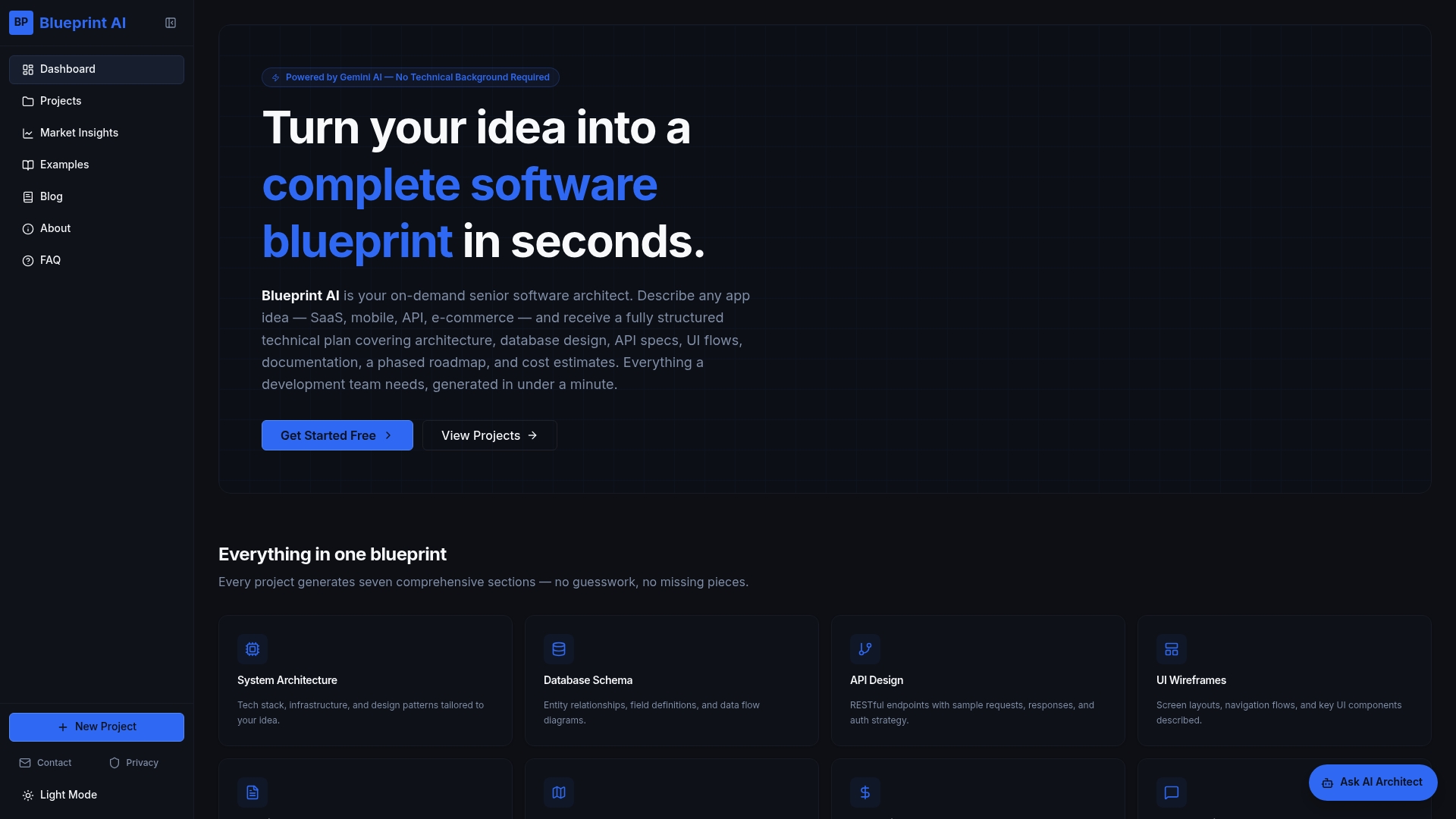
Blueprintbot transforms the part of software communication that breaks down most often: the gap between a product idea and a technical plan that developers can actually act on. When your team receives a Blueprintbot-generated blueprint, they get system architecture, API designs, and cost estimates in a format that answers the questions developers ask before writing a single line of code.
That means fewer clarification threads, fewer misaligned sprints, and fewer handoff revisions. Explore the free planning tools to see how structured documentation changes the quality of your team's conversations. Or browse example blueprints to see what a decision-ready technical plan looks like in practice.
FAQ
What is the most effective way to reduce unnecessary meetings?
Replace recurring status meetings with structured async updates in a shared document. Teams save two to four hours per person per week when they replace even one meeting with a written update.
How do you communicate technical blockers to non-technical stakeholders?
Frame blockers around business impact rather than technical detail. Present two or three options with their cost, risk, and timing consequences so the stakeholder can make a decision rather than just receive information.
What should a design handoff to developers include?
A complete handoff includes annotated Figma files with all UI states, responsive breakpoints, interaction behaviours, and a brief note on design rationale. Incomplete handoffs are the primary cause of repeated revisions and delayed timelines.
How do you set communication norms for a software team?
Define response-time expectations per channel and publish them where the whole team can see them. A practical standard is four hours for Slack and twenty-four hours for email, with escalation to a call only when async resolution is not possible.
Why does documentation matter more than meetings for distributed teams?
Decisions recorded in a project management tool or knowledge base serve as a single source of truth that prevents repeated debates. In remote or distributed teams, documentation replaces the ambient context that co-located teams absorb passively.