Why software modularity matters for scalable systems

Software modularity is the practice of designing software as independent, well-defined components that can be developed, tested, and scaled separately. This architectural discipline is the single most reliable way to keep complex systems maintainable as they grow. Teams that adopt it ship faster, debug in hours instead of weeks, and spend less on infrastructure. Those that ignore it accumulate technical debt that eventually makes every change expensive. Understanding why software modularity matters is not an academic exercise. It is a direct input to your team's velocity, your product's reliability, and your organisation's bottom line.
Why software modularity matters for development speed
The most common objection to modular design is that it slows you down at the start. The data says otherwise. Parallel development across teams reduces time-to-market by weeks or months on complex projects, because each team owns a bounded context and does not wait on others to finish their work. Amazon's service-oriented architecture, one of the most cited examples in software engineering, was built precisely to let hundreds of teams ship independently without coordinating every release.
The cost argument is equally compelling. Hidden integration costs drop by up to 30% when dependencies are managed through strict module boundaries rather than implicit coupling. That figure represents real budget: fewer emergency debugging sessions, fewer cross-team meetings to untangle shared state, and fewer rollbacks caused by one team's change breaking another's code.
Maintenance is where the compounding effect becomes undeniable. Maintenance tasks shrink from days or weeks to hours in modular systems because a change is isolated to one module and its defined interface. A monolithic codebase forces you to trace every dependency before touching anything, which turns a two-hour fix into a two-day investigation.
The benefits of modular software in development speed come down to three concrete mechanisms:
- Parallel workstreams. Teams develop, test, and deploy their modules without blocking each other.
- Contained blast radius. A bug in one module does not cascade into unrelated parts of the system.
- Faster onboarding. Modules small enough to fit in your head shorten ramp-up time for new developers, which matters when your team is growing.
Pro Tip: Define module boundaries before writing a single line of code. The boundary decision is the hardest part. Once it is made correctly, everything inside the module becomes straightforward to build and change.
How does modularity affect team autonomy and cognitive load?
The relationship between modularity in software design and team productivity is not just technical. It is organisational. Teams aligned by module ownership experience reduced cognitive load and cleaner communication patterns, which directly improves code quality and reduces the number of defects reaching production.

Cognitive load is the amount of information a developer must hold in working memory to make a safe change. In a monolithic codebase, that load is enormous. A developer modifying a payment service must understand how it interacts with the user service, the notification service, the audit log, and sometimes the front-end rendering layer. In a modular system, the same developer works within a defined boundary and communicates with other modules only through published interfaces.
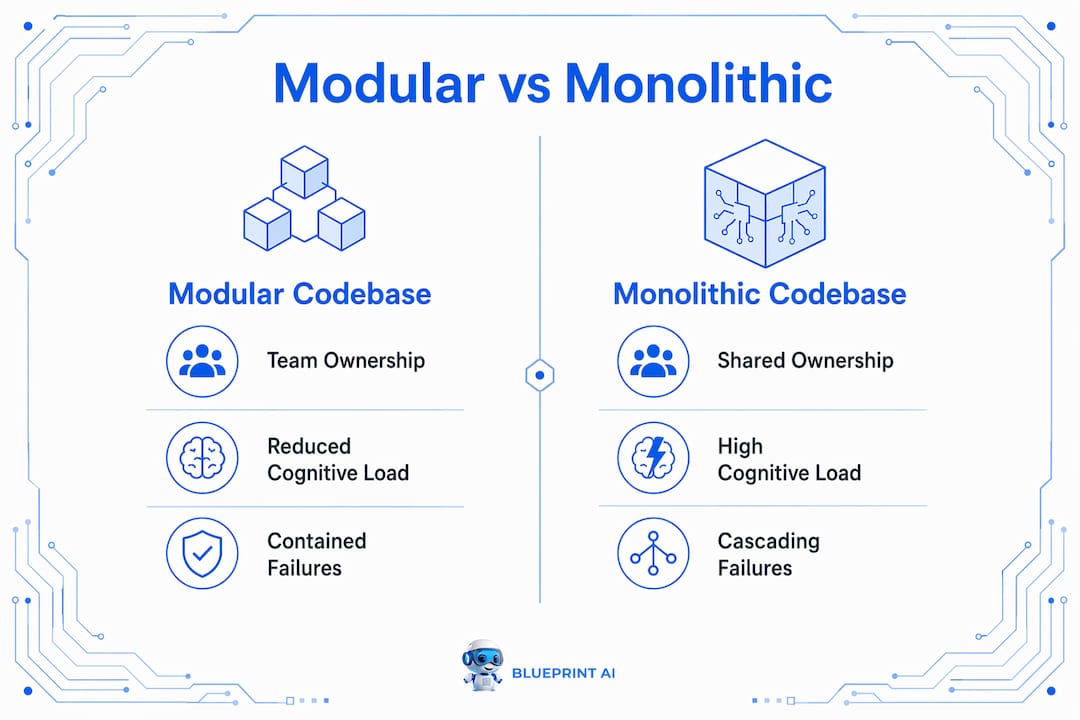
The table below compares the two approaches across the dimensions that matter most to engineering leads and product managers.
| Dimension | Modular codebase | Monolithic codebase |
|---|---|---|
| Team ownership | One team owns one module end-to-end | Ownership is shared and often unclear |
| Cognitive load per change | Low. Developer reads one module | High. Developer traces cross-cutting concerns |
| Deployment frequency | Teams deploy independently | Releases require full-system coordination |
| Onboarding time | New developers learn one module first | New developers must understand the whole system |
| Bug isolation | Defects are contained within module boundaries | Bugs propagate across shared state |
Building modular systems depends as much on team processes and communication as on technical design. A well-drawn module boundary that nobody enforces in code review is just a diagram. The cultural commitment to respecting boundaries is what makes the technical benefit real.
What is the impact of modularity on scalability and resilience?
Modular software architecture changes the economics of scaling. In a monolithic system, scaling means replicating the entire application, including the parts that are not under load. In a modular system, only the components under load are scaled, which reduces infrastructure costs directly. This is the core argument for cloud-native modular architectures, and it is why AWS and similar platforms are designed around independent, elastic service scaling.
Resilience follows the same logic. When a module fails, the failure is contained. A payment processing module going down does not take the product catalogue or the user authentication service with it. This fault isolation is what separates systems with 99.9% uptime from those that go dark entirely when one component misbehaves.
The operational data backs this up. Organisations with modular architectures show better DORA metrics across all four dimensions: higher deployment frequency, faster mean time to recovery, lower change failure rates, and shorter lead times for changes. DORA metrics are the industry standard for measuring software delivery performance, and modular teams consistently outperform monolithic teams on every measure.
| DORA metric | Modular architecture outcome | Why it improves |
|---|---|---|
| Deployment frequency | Higher. Teams ship independently | No full-system release coordination required |
| Mean time to recovery | Faster. Failures are isolated | Rollback affects one module, not the whole system |
| Change failure rate | Lower. Changes are bounded | Smaller surface area per deployment reduces risk |
| Lead time for changes | Shorter. Parallel development | No waiting for other teams to finish their work |
The trade-off between a modular monolith and a microservices architecture is worth understanding here. Modular monoliths preserve deployment simplicity while enforcing logical boundaries, which makes them a practical starting point for most teams. Microservices add network boundaries that enforce separation physically, but they also add distributed systems complexity. For most product teams, a well-disciplined modular monolith delivers 80% of the benefit at 20% of the operational overhead. You can read more about the foundational concepts behind these choices in this guide to system design for beginners.
Best practices for enforcing true modularity
The most dangerous form of modularity is the kind that exists only in folder names. Organising files into directories labelled "auth," "payments," and "notifications" does not create a modular system. It creates an illusion of separation while the code inside those folders calls each other freely. True modularity requires strict interface enforcement, code reviews that reject boundary violations, and architectural tests that fail the build when a module reaches into another module's internals.
The practical steps that separate genuine modular design from folder theatre are:
- Define explicit interfaces. Every module exposes a public API. Nothing outside that API is accessible to other modules. This is the contract that makes the boundary real.
- Hide internal implementation. The internal classes, functions, and data structures of a module are private by default. Other modules never depend on them.
- Write architectural tests. Tools like ArchUnit for Java or dependency-cruiser for JavaScript let you encode boundary rules as automated tests that run on every commit.
- Review for coupling in code review. A pull request that adds a direct dependency from one module to another's internals should be rejected, not merged and "fixed later."
- Design modules by change pattern. Group code that changes together, not code that happens to be in the same feature area. This is the insight that modular monolith boundaries require team discipline and tooling to maintain without network enforcement.
Pro Tip: Before drawing a module boundary, ask: "When this part of the system changes, what else always changes with it?" Code that changes together belongs together. Code that changes independently should be separated.
A software technical specification that documents module boundaries, interface contracts, and ownership before development begins is one of the most effective ways to prevent hidden coupling from accumulating. Teams that skip this step almost always regret it six months into the project.
Key takeaways
Modular software architecture delivers measurable gains in development speed, team autonomy, and operational resilience, but only when boundaries are enforced through interfaces, tooling, and team discipline rather than folder structure alone.
| Point | Details |
|---|---|
| Cost and speed gains are real | Modular architectures cut hidden integration costs by up to 30% and compress maintenance from weeks to hours. |
| Team ownership drives quality | Module-aligned teams carry lower cognitive load, communicate more clearly, and produce fewer defects. |
| Scalability becomes cost-effective | Scaling only the modules under load reduces infrastructure spend compared to replicating a full monolith. |
| DORA metrics improve measurably | Modular teams deploy more frequently, recover faster, and have lower change failure rates across all four DORA dimensions. |
| Enforcement is the hard part | True modularity requires interface contracts, architectural tests, and code review discipline, not just folder organisation. |
Modularity as a discipline, not a deliverable
I have reviewed enough codebases to say with confidence that the majority of teams who believe they have a modular system do not. They have a monolith with good intentions and a tidy folder structure. The coupling is still there. It is just hidden inside service calls that bypass the intended interfaces, or in shared database tables that two "independent" modules both write to.
What changed my thinking on this was watching a team at a mid-sized SaaS company spend three months untangling a codebase that had been called modular since day one. Every module had its own folder. Every module also had direct imports into every other module's internal classes. The folder names were fiction. The actual architecture was a distributed monolith with all the downsides of both worlds and the benefits of neither.
The teams I have seen get this right treat modularity as a discipline of observation. Before writing code, they look at the problem space and find the natural seams. They ask where the system will change independently, where different teams will need to move at different speeds, and where a failure in one area must not propagate to another. Modularity is a mental discipline to identify inherent boundaries in complex problem spaces before a single line of code is written.
The long-term payoff is not just technical. Teams that own well-defined modules have clearer accountability, higher morale, and faster debugging cycles. Modularity is a long-term strategic investment that makes software a competitive advantage, not just a technical implementation detail. Treat it as an ongoing commitment to managing complexity, and it will compound in your favour for years.
— Rishi
How Blueprintbot helps you design modular systems from day one
Deciding where to draw module boundaries before you write code is the highest-leverage decision in software architecture. Blueprintbot generates detailed technical blueprints that include system architecture, API designs, and module boundaries in seconds, giving your team a concrete starting point instead of a blank whiteboard.

Product managers and founders can use Blueprintbot to validate modular designs before a single developer is hired, which means investor presentations and team kick-offs start with a real architecture rather than a sketch. Engineers use it to align on boundaries early and avoid the hidden coupling that turns a clean design into a maintenance burden. See what a generated blueprint looks like in the example blueprints gallery, or explore how teams use Blueprintbot to accelerate modular software delivery.
FAQ
What is software modularity?
Software modularity is the practice of dividing a system into independent components with defined interfaces, where each component can be developed, tested, and deployed separately. The goal is to isolate change so that modifying one part of the system does not break unrelated parts.
How does modularity reduce development costs?
Modular architectures reduce hidden integration costs by up to 30% by managing dependencies through strict boundaries rather than implicit coupling. They also compress maintenance time from days or weeks to hours by isolating changes within a single module.
What is the difference between a modular monolith and microservices?
A modular monolith enforces logical boundaries within a single deployable unit, preserving operational simplicity while enabling team autonomy. Microservices enforce boundaries through network separation, which adds distributed systems complexity but allows independent scaling of individual services.
How do you enforce module boundaries in practice?
Enforcement requires explicit public interfaces, automated architectural tests that fail on boundary violations, and code review discipline that rejects direct dependencies on another module's internals. Folder structure alone does not create real modularity.
Why do modular teams have better DORA metrics?
Modular teams deploy independently, recover from failures faster because failures are isolated, and make smaller, lower-risk changes per deployment. These structural properties directly improve deployment frequency, mean time to recovery, and change failure rates across the board.