Open source architecture case studies: 5 real examples

Open source architecture case studies are documented, production-validated examples of software system design that expose the structural decisions, trade-offs, and tooling choices behind real applications. For software architects and developers, these records are far more useful than abstract frameworks. They show exactly how teams organised 15 microservices across bounded contexts, automated clash detection across 31 building levels, or chose async polling over WebSockets and why. This article examines five distinct cases, from AI-powered brand platforms to BIM renovation workflows, pulling out the patterns and decisions you can apply directly to your own system design.
1. LoRA Studio: modular microservices and brand consistency at scale
LoRA Studio is one of the most instructive open source architecture case studies available for teams building AI-powered platforms. Its architecture consists of 15 microservices organised into 5 bounded contexts using domain-driven design principles, with all services communicating exclusively via REST API and zero shared state. That constraint is deliberate. Zero shared state means each service can be deployed, scaled, and replaced independently without cascading failures across the system.

The platform enforces brand consistency through a LOCKED/UNLOCKED protocol that applies mathematical constraints to creative outputs. This is not a soft guideline enforced by human review. It is a deterministic rule baked into the architecture itself, which means brand compliance is verifiable at the system level rather than relying on downstream approval processes.
Key architectural decisions in LoRA Studio include:
- Cloud-agnostic design with AWS documented as canonical and GCP and Azure equivalents mapped explicitly, making the architecture patterns transferable across infrastructure providers
- NVIDIA GPU infrastructure integrated at the service boundary, not embedded in application logic, preserving the ability to swap hardware configurations
- Human-in-the-loop checkpoints positioned at defined workflow stages, not sprinkled arbitrarily, so the system knows exactly when to pause for verification
- Five bounded contexts separating concerns like generation, validation, storage, delivery, and administration, each with its own data ownership
Pro Tip: When reviewing backend architecture examples for your own system, check whether bounded contexts are defined by data ownership or by team structure. LoRA Studio uses data ownership, which scales better as teams grow.
The trade-off LoRA Studio accepts is coordination overhead. Fifteen services communicating via REST introduce latency and require disciplined API versioning. For a brand consistency platform where correctness matters more than raw throughput, that trade-off is justified.
2. Architecture Compiler: AI-driven architectural decision-making
The Architecture Compiler case study demonstrates how deterministic tooling can replace ad hoc architectural discussions with structured, reviewable outputs. The system leverages over 180 curated design patterns to transform project constraints into explicit architectural decisions, complete with Architecture Decision Records that capture trade-offs and cost impact.
The typical tech stack documented in this case study includes FastAPI, PostgreSQL, Redis, Auth0, and OTLP for observability. Each choice is justified in the ADR, not assumed. This matters because future maintainers can read the record and understand why Redis was chosen over a database-backed queue, or why Auth0 was selected over a self-hosted identity provider.
The Architecture Compiler approach follows a clear sequence:
- Ingest project constraints (scale requirements, budget, team capability, compliance needs)
- Match constraints against the pattern library to generate candidate architectures
- Produce ADRs for each significant decision, including the options considered and rejected
- Integrate observability at the design phase using OTLP traces and golden signal metrics, not as a post-implementation afterthought
- Output a reviewable architecture document that non-architects can interrogate
"Documenting the reasoning behind architectural choices creates future-proof blueprints that aid maintainability and cost analysis." This is the core philosophy of the Architecture Compiler, and it is what separates it from tools that generate diagrams without rationale.
The observability integration is the most underappreciated feature here. Most teams instrument their systems after deployment, when problems are already visible. The Architecture Compiler bakes OTLP traces and golden signals into the design specification, so the monitoring strategy is agreed upon before a single line of code is written. That shift alone reduces post-launch firefighting significantly.
3. TinyDOOR: asynchronous AI story-generation workflows
TinyDOOR is a cloud-native platform for AI-driven story generation, and its architecture case study is a clear model for any team building scalable async AI workflows. The system employs a workflow-first architecture that separates stable backend state from asynchronous generation processes, using serverless workers and cloud-native object storage.
The frontend is built on React and Next.js, the backend on Python and Django, and the generation pipeline runs on serverless async workers that scale independently of the web layer. This separation is the key architectural insight. The web application handles request lifecycle management and user state. The generation pipeline handles compute-intensive work. Neither layer needs to know the internal details of the other.
Key design decisions in TinyDOOR include:
- Explicit request lifecycle management with defined state transitions (pending, processing, complete, failed) that the frontend polls against, giving users accurate progress feedback without WebSocket complexity
- Cloud-native object storage for generated artefacts, decoupling storage costs from compute costs and enabling direct client downloads without routing through the application server
- Serverless async workers that scale to zero when idle, making the architecture cost-efficient for workloads with unpredictable demand spikes
Pro Tip: The choice between async polling and WebSockets is a documented trade-off in TinyDOOR's ADRs. Polling is simpler to implement, debug, and scale. WebSockets add real-time feel but introduce connection management complexity. For AI generation tasks where processing takes 10 to 60 seconds, polling is almost always the right call.
TinyDOOR also demonstrates how sanitized architecture case studies can be educational without exposing proprietary logic. The published documentation focuses on workflow patterns, state transitions, and integration boundaries rather than precise data models or business rules. This is a model worth following when you publish your own architectural documentation.
4. BIM renovation: automating complex legacy structure management
This case study moves from software systems to physical infrastructure, but the architectural principles are directly analogous. TSPC Group's renovation of Hotel Dorothea involved a 35,000 square metre building with 31 uneven levels and significant legacy alignment challenges. The team automated management of elevation differences by assigning mathematical functions as property values to BIM elements, reconciling floor levels automatically rather than manually.
The OPEN BIM workflow enabled multi-disciplinary integration across structural, mechanical, and architectural teams working in different software environments. Automated clash detection ran continuously using Solibri, catching conflicts between building systems before they became expensive on-site problems.
| Challenge | Approach | Outcome |
|---|---|---|
| 31 uneven floor levels | Mathematical functions assigned to BIM elements | Automatic elevation reconciliation |
| Multi-disciplinary coordination | OPEN BIM interoperability standards | Unified model across all disciplines |
| Clash detection at scale | Continuous Solibri analysis | Conflicts resolved before construction |
| Legacy structure alignment | Parametric property values | Reduced manual correction cycles |
The parallel to software architecture is direct. Parametric property values in BIM are analogous to configuration-driven infrastructure in software. Both approaches replace manual, error-prone processes with deterministic rules that the system enforces automatically. The benefit of automation in achieving accuracy and reducing communication overhead applies equally whether you are coordinating building systems or microservices.
5. Common themes across open source architecture case studies
Examining these architectural case studies together reveals patterns that apply regardless of domain or technology stack. The most consistent theme is modularity. LoRA Studio uses bounded contexts. TinyDOOR separates the web layer from the generation pipeline. The BIM project separates disciplines through OPEN BIM standards. Modularity is not a stylistic preference. It is the mechanism that makes systems maintainable as they grow.
The second theme is documentation of rationale. The Architecture Compiler makes this explicit through ADRs, but LoRA Studio and TinyDOOR also publish the reasoning behind key decisions. Documenting trade-offs like async polling vs WebSockets is what separates a case study from a diagram. Future maintainers need to know why a decision was made, not just what was decided.
The third theme is the shift toward explainable architecture. Tools like CodeArchy, powered by Gemma 4's dependency graph parsing, generate system architecture diagrams offline in under a minute. This represents a broader movement away from static diagrams toward dynamic, queryable architectural models that improve onboarding speed and validation accuracy. AI agents are increasingly used to infer architectural intent from existing codebases, which makes retroactive documentation feasible for the first time.
Cloud-agnostic documentation is the fourth consistent pattern. When LoRA Studio maps AWS services to GCP and Azure equivalents, it is not just being thorough. It is making the architecture portable. Any team that documents their system using generic service categories rather than provider-specific names will find it far easier to migrate or negotiate infrastructure contracts later.
The fifth theme is early observability integration. The Architecture Compiler's approach of embedding OTLP traces and golden signals at the design phase is the most forward-looking practice in these examples. Teams that plan app architecture before coding with observability in mind ship systems that are easier to operate from day one.
Key takeaways
The most transferable lesson from these open source architecture case studies is that documented rationale, not diagrams alone, is what makes an architectural record genuinely useful for future decision-making.
| Point | Details |
|---|---|
| Modularity drives maintainability | Bounded contexts and separated pipelines make systems easier to scale and replace independently. |
| ADRs capture the "why" | Documenting rejected options and cost trade-offs prevents repeated architectural debates in future sprints. |
| Cloud-agnostic documentation | Mapping proprietary services to generic equivalents makes patterns reusable across infrastructure providers. |
| Observability belongs at design time | Embedding OTLP traces and golden signals in the specification reduces post-launch monitoring gaps. |
| Sanitised case studies still teach | Publishing workflow patterns and state transitions without proprietary data creates educational artefacts that protect IP. |
Why most architecture documentation fails the next team
I have reviewed dozens of architecture documents over the years, and the majority share the same flaw. They describe what was built, not why. You get a diagram showing services and databases, maybe a tech stack list, and nothing else. The next architect inherits a system they cannot reason about because every decision looks arbitrary.
What makes the case studies examined here different is that they treat the "why" as the primary deliverable. LoRA Studio explains why zero shared state was chosen. TinyDOOR explains why polling was preferred over WebSockets. The Architecture Compiler makes ADRs the centrepiece of the entire workflow. That shift in emphasis is what turns a project artefact into a knowledge asset.
The uncomfortable truth is that most teams skip this documentation because it feels slow. It is not slow. Writing an ADR for a significant decision takes 30 minutes. Onboarding a new architect without that record takes weeks. The scalable architecture roadmap you build today is only as useful as the rationale you attach to it.
I would also push back on the idea that AI tools make human architectural judgement less necessary. CodeArchy and the Architecture Compiler are genuinely useful, but they surface patterns and generate candidates. They do not understand your organisation's risk tolerance, your team's capability gaps, or the political constraints on your infrastructure choices. Human verification remains the step that aligns system intent with business goals. Use the tools to accelerate the mechanical work, then apply your own judgement to the outputs.
— Rishi
Turn case study insights into your own software blueprint
Learning from open source design projects is most valuable when you can immediately apply those patterns to your own system. Blueprintbot generates complete software blueprints from your app idea in seconds, covering system architecture, database schemas, API designs, and development roadmaps. It is built specifically for architects and project managers who need to move from concept to documented specification without starting from a blank page.
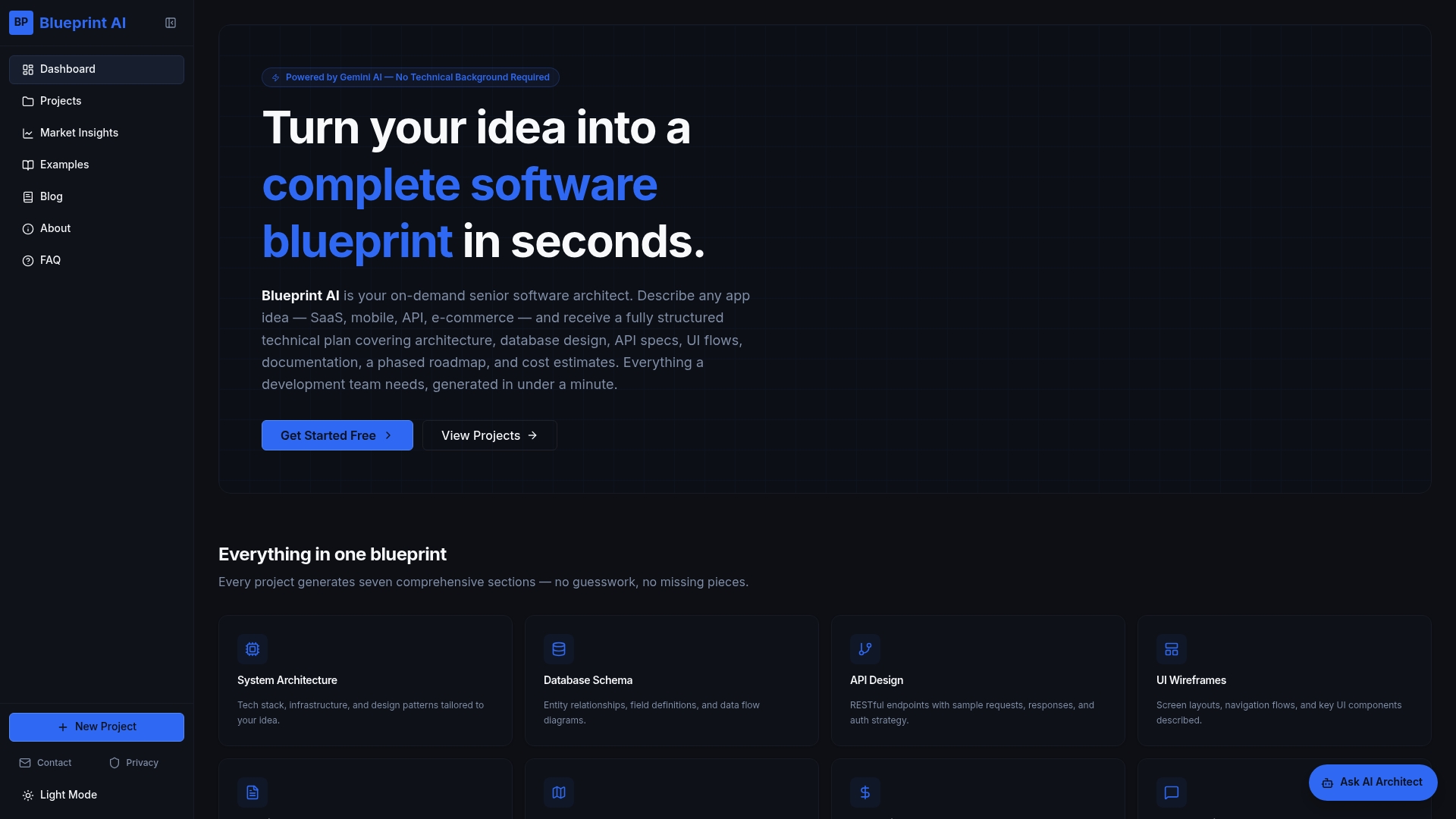
Explore complete worked blueprints that show exactly how AI generates architecture specifications across different application types. You can also use Blueprintbot's free planning tools to define your tech stack, estimate development timelines, and prioritise features before your first sprint. For teams that want to see practical applications across different project types, the use cases library maps Blueprintbot's outputs to real project scenarios.
FAQ
What are open source architecture case studies?
Open source architecture case studies are documented examples of real software system designs that expose structural decisions, trade-offs, and tooling choices. They function as educational artefacts, focusing on the reasoning behind architectural decisions rather than exposing proprietary code.
What is an Architecture Decision Record (ADR)?
An ADR is a short document that captures a significant architectural decision, the context that prompted it, the options considered, and the rationale for the choice made. ADRs from projects like the Architecture Compiler also include cost impact analysis and rejected alternatives.
Why is cloud-agnostic documentation important?
Cloud-agnostic documentation maps provider-specific services to generic equivalents, making architectural patterns reusable across AWS, GCP, and Azure. LoRA Studio uses this approach to make its design transferable without requiring a full re-architecture when infrastructure providers change.
How does async polling differ from WebSockets in AI workflow architectures?
Async polling has the client request status updates at intervals, while WebSockets maintain a persistent connection for real-time updates. TinyDOOR chose polling because AI generation tasks take 10 to 60 seconds, making the added complexity of WebSocket connection management unjustified for that use case.
Can BIM workflows inform software architecture practices?
Yes. BIM projects like the Hotel Dorothea renovation use parametric property values and automated clash detection in ways that directly parallel configuration-driven infrastructure and continuous integration testing in software. Both approaches replace manual coordination with deterministic, automated rules.