How to Create a Scalable Architecture Roadmap

A scalable architecture roadmap is a strategic, executable plan that sequences your organization's transition from its current architecture to a defined target state through measurable work packages, transition architectures, and governance structures. Technical leaders at companies like Shopify and Salesforce use this kind of plan to connect business strategy directly to architecture delivery, avoiding the "modernization by slogan" failure mode that kills most roadmap initiatives before they ship. Frameworks like TOGAF formalize this process through Phases E and F, which cover roadmap consolidation and migration planning. If you need to create a scalable architecture roadmap that actually gets funded and executed, the steps below give you a proven, structured path.
How to create a scalable architecture roadmap: core components and steps
A funded and delivered roadmap follows a consistent sequence: assess current state, define target state, conduct gap analysis, define transition architectures, and group work into prioritized packages. Skipping any of these steps produces a plan that looks strategic on a slide deck but falls apart when delivery teams try to execute it.
Step 1: Define strategic drivers and business outcomes
Start by documenting the business outcomes your architecture must support. These are not technology goals. They are revenue targets, customer experience commitments, regulatory requirements, or market expansion plans. Every architectural decision you make later must trace back to at least one of these drivers. Without this anchor, your roadmap becomes a wish list.
Step 2: Assess your current architecture honestly
Assess your current state across four domains: business, data, application, and technology. Catalog what you have, how it performs, and where it breaks under load. This is where most teams underinvest. A superficial current-state assessment produces a gap analysis full of surprises later, which causes scope creep and rework.

Step 3: Define the target architecture
Your target architecture describes the capabilities and non-functional requirements your system must meet at a defined future point. Focus on qualities like availability, throughput, latency, and fault tolerance rather than specific product choices. Product choices belong in work packages, not in the target architecture itself.
Step 4: Conduct gap analysis and identify dependencies
Map the delta between current and target state across every domain. TOGAF Phases E and F formalize this by consolidating gaps into a roadmap and finalizing migration plans aligned with portfolio management. The output is a dependency-ordered list of changes, not a flat backlog.
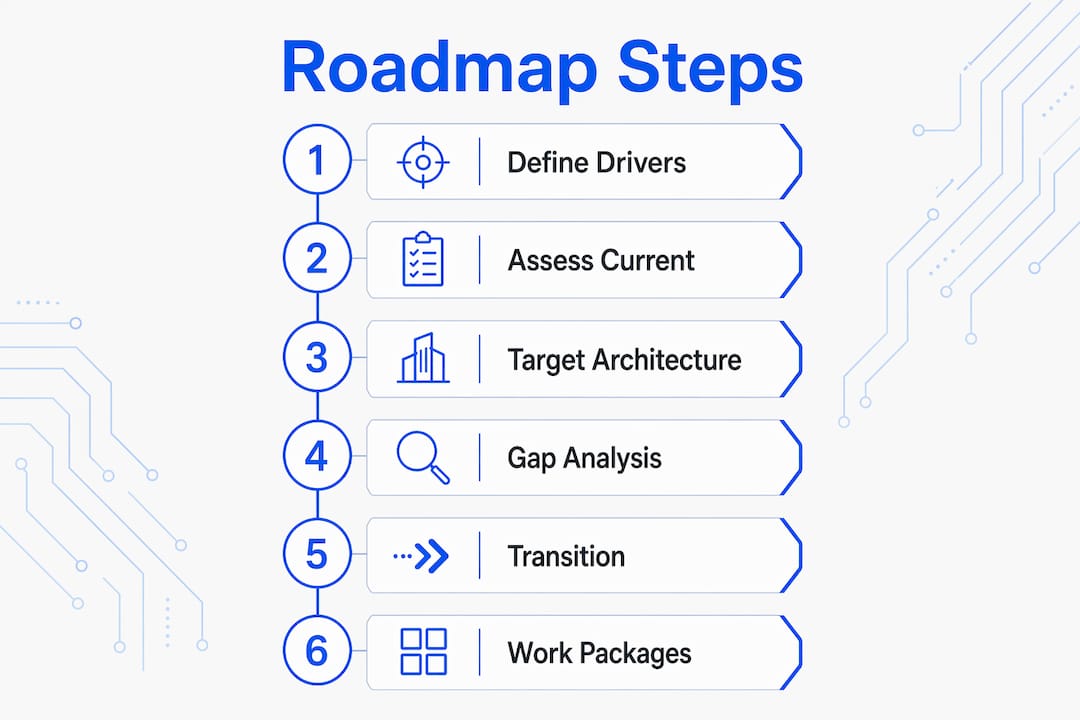
Step 5: Define transition architectures
Transition architectures must be genuine, operational states that deliver business value, not just diagrams of work in progress. Each transition architecture is a stable checkpoint your organization can run on while the next phase is being built. This reduces risk dramatically compared to big-bang migrations.
Step 6: Group changes into sequenced work packages
Work packages are architecture-level groupings of change, sized so business stakeholders can understand them and portfolio managers can fund them. Sequence them by dependency order and business value. The table below shows how the six steps map to their primary outputs.
| Roadmap step | Primary output |
|---|---|
| Define strategic drivers | Business outcome statements |
| Assess current state | Architecture inventory and risk register |
| Define target architecture | Capability model and NFR specification |
| Gap analysis | Dependency-ordered change list |
| Transition architectures | Stable intermediate operating states |
| Work packages | Funded, sequenced delivery units |
Pro Tip: Attach a measurable success criterion to every work package before it enters the roadmap. If you cannot define done, the package is not ready to be scheduled.
How to incorporate capacity planning and testing into your roadmap
Capacity planning is not a one-time forecast. HashiCorp's well-architected framework connects inadequate capacity planning directly to outages and wasted spending, and it treats load testing as a repeating calibration mechanism rather than a pre-launch checkbox. Your roadmap must embed capacity and testing activities inside each phase, not treat them as a final gate.
The core activities to include in each roadmap phase are:
- Workload profiling: Run load and stress tests to identify bottlenecks before you design for scale. Profile read/write ratios, peak concurrency, and latency distributions.
- Scaling design decisions: Choose between horizontal and vertical scaling based on your workload profile. Design autoscaling policies and load balancing rules that reflect real traffic patterns, not theoretical peaks.
- Health checks and alert thresholds: Set monitoring alerts that fire before you reach capacity limits, not after. Alert-driven autoscaling prevents both outages and over-provisioning.
- Safety margin testing: Salesforce's approach to scale testing for one million concurrent users uses production-grade environments and tests at three times expected peak load to validate system resilience. That three-times margin is a practical standard worth adopting.
- Continuous telemetry: Instrument every service with metrics that feed back into your autoscaling policies. Static thresholds set at launch become wrong within months as traffic patterns shift.
For teams planning a SaaS product, the SaaS architecture planning guide on the Blueprintbot blog covers how these capacity decisions interact with multi-tenant design constraints.
Pro Tip: Never run your scale tests against a staging environment that differs from production in CPU class, network topology, or data volume. Mismatches between test and production environments are the leading cause of surprises during peak load events.
What phased approach should technical leaders adopt for scalable roadmapping?
Scalability is a staged organizational capability built incrementally, not a problem solved in one program. Product Cognizant's 2026 architecture scalability roadmap defines four phases that map cleanly to increasing organizational maturity.
| Phase | Name | Primary focus |
|---|---|---|
| 1 | Foundation | Audit infrastructure, standardize tech stacks, define scalability KPIs |
| 2 | Modularize | Decouple monoliths, adopt microservices, event-driven design, database sharding |
| 3 | Automate | Container orchestration, Infrastructure as Code, scalable CI/CD pipelines |
| 4 | Optimize | Enterprise governance, resilience practices, multi-cloud, platform engineering |
Here is how each phase plays out in practice:
Foundation: Audit your existing infrastructure and identify where your current stack cannot meet the scalability KPIs you defined in your strategic drivers. Standardize on a technology catalog that your teams can build against consistently. This phase produces the baseline that makes every subsequent phase measurable.
Modularize: Decouple tightly coupled monoliths into independently deployable services. Adopt event-driven communication patterns where synchronous calls create bottlenecks. Apply database strategies like read replicas, sharding, or CQRS where your data layer is the constraint. The system design concepts behind modularization are worth reviewing before you start decomposing services.
Automate: Introduce container orchestration with Kubernetes, codify your infrastructure with Terraform or Pulumi, and build CI/CD pipelines that can deploy at the frequency your architecture requires. Add cost-aware autoscaling policies so your automation does not create runaway cloud spend.
Optimize: At this phase, your focus shifts from building scalability to governing it across the enterprise. Introduce platform engineering teams, multi-cloud failover strategies, chaos engineering practices, and architecture review processes that operate at portfolio scale.
How to establish governance and measurement to deliver your roadmap
Governance is what separates a roadmap that gets executed from one that gets updated annually and never shipped. Leadership funds roadmaps that connect strategy to concrete, measurable initiatives. Vague modernization statements do not secure investment or delivery commitment.
The governance model for a scalable architecture roadmap needs these components:
- Single accountable owners: Every work package needs one named owner who is accountable for delivery, not a committee. Committees produce consensus documents. Owners produce shipped software.
- Architecture review boards: Use a review board to assess new initiatives against the target architecture before they enter the roadmap. This prevents technical debt from accumulating faster than the roadmap can address it.
- Regular priority reassessment: Review roadmap priorities on a quarterly cadence at minimum. Business drivers change, and a roadmap that does not adapt becomes a liability.
- Intake and exception processes: Define how new initiatives enter the roadmap and how exceptions to the target architecture are handled. Without a formal intake process, every team bypasses the roadmap with urgent requests.
- KPIs per transition architecture: Attach measurable outcomes to each transition state. If your Phase 2 transition architecture does not improve your defined scalability KPIs, you have not completed the phase.
Architectural Decision Records (ADRs) and Request for Comments (RFC) processes give you lightweight, decentralized governance that records explicit rationale without creating bottlenecks. Case studies from T-Bank and ArchDays show that architectural decision speed scales when governance is distributed rather than centralized. Connecting each roadmap item to a specific funding line in your portfolio management system is the final step that converts a technical plan into a business commitment.
Pro Tip: Write every ADR before the decision is made, not after. ADRs written retrospectively capture what was decided but not why alternatives were rejected, which is the information that prevents the same debate from recurring six months later.
Key takeaways
A scalable architecture roadmap succeeds when it combines honest current-state assessment, stable transition architectures, phased delivery, and governance structures that connect every work package to a measurable business outcome.
| Point | Details |
|---|---|
| Start with strategic drivers | Every architecture decision must trace back to a defined business outcome or it lacks funding justification. |
| Transition architectures reduce risk | Each intermediate state must be operational and deliver business value, not just a diagram of work in progress. |
| Capacity planning is continuous | Use load testing as a repeating calibration mechanism, not a one-time pre-launch gate. |
| Phase your maturity deliberately | Progress from Foundation through Modularize, Automate, and Optimize rather than attempting all four simultaneously. |
| Governance requires named owners | Every work package needs a single accountable owner and a measurable KPI to drive delivery accountability. |
Why most architecture roadmaps stall before they ship
I have reviewed dozens of architecture roadmaps over the years, and the pattern that kills most of them is not technical complexity. It is abstraction. Teams spend months producing beautifully formatted documents full of capability heat maps and maturity matrices, then hand them to delivery teams who have no idea what to build first.
The roadmaps that actually ship share one characteristic: every work package is concrete enough that a delivery team can write a sprint plan from it. "Migrate to microservices" is not a work package. "Extract the order management domain from the monolith, deploy it as an independent service behind an API gateway, and validate at 2x current peak load" is a work package.
The second pattern I see consistently is skipping transition architectures to save time. Teams jump from current state to target state and discover halfway through that the intermediate system is unusable. Shopify's guidance on measurable milestones exists precisely because this failure mode is so common. Every stable intermediate state you define is insurance against a half-finished migration that neither the old nor the new system can support.
The third issue is treating governance as overhead. ADRs and review boards feel slow until you experience the alternative: the same architectural debate happening in five different teams simultaneously, each reaching a different conclusion. Lightweight governance, as documented in the architecture decisions at scale research, is faster than no governance once your organization reaches more than three or four delivery teams.
— Rishi
How Blueprintbot accelerates your architecture roadmap
Technical leaders and project managers often spend weeks producing the initial architecture blueprints that feed a roadmap. Blueprintbot eliminates that delay by generating detailed technical blueprints from your app concept in seconds, covering system architecture, API designs, and cost estimates.
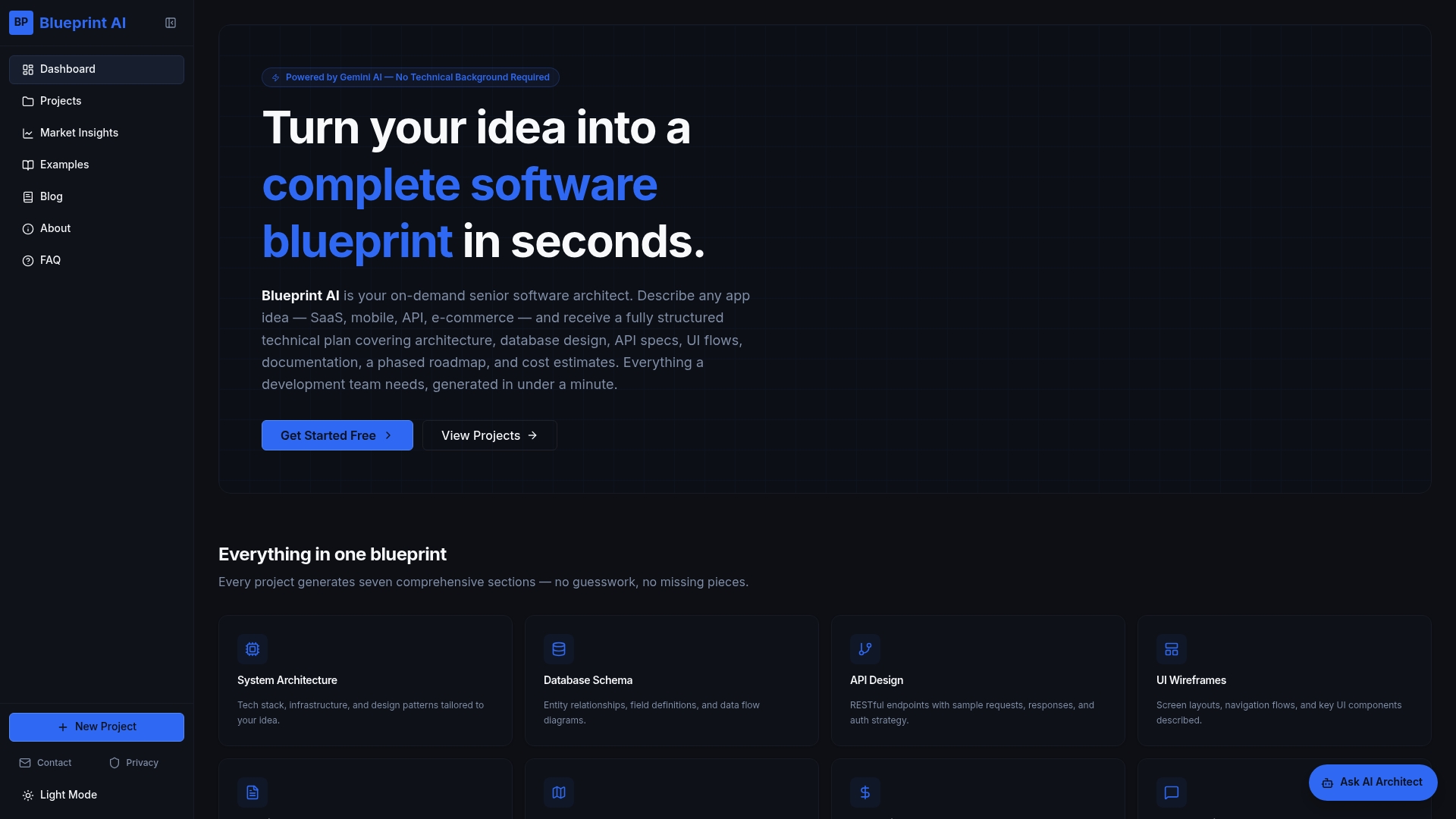
You can explore AI-generated architecture examples to see how Blueprintbot structures scalable system designs before you commit to a roadmap direction. When you are ready to move from concept to plan, the Blueprintbot platform gives you a starting blueprint your team can refine and sequence into work packages immediately. That is weeks of architecture discovery time returned to your delivery schedule.
FAQ
What is a scalable architecture roadmap?
A scalable architecture roadmap is a strategic plan that sequences an organization's transition from its current system state to a defined target architecture through phased work packages, transition states, and governance structures. It connects business outcomes to specific, measurable technical changes.
How long does it take to create an architecture roadmap?
Initial roadmap creation typically takes four to eight weeks for organizations using a structured framework like TOGAF ADM, covering current-state assessment, gap analysis, and work package sequencing. Roadmaps are then maintained on a quarterly review cadence.
What framework should I use for scalable architecture planning?
TOGAF is the most widely adopted framework for enterprise architecture roadmaps, with Phases E and F covering roadmap consolidation and migration planning specifically. HashiCorp's well-architected framework provides complementary guidance for operational scalability and capacity planning.
How do I test whether my architecture is actually scalable?
Run load and stress tests at three times your expected peak load in a production-grade environment, as Salesforce's scale testing practice demonstrates. Set autoscaling policies and alert thresholds based on these results, then recalibrate them continuously as traffic patterns change.
Who should own the architecture roadmap?
Each work package needs a single named owner accountable for delivery. An architecture review board governs the overall roadmap, assesses new initiatives against the target architecture, and manages exceptions. Connecting roadmap items to portfolio funding lines ensures executive accountability.