What is a software development agency in 2026?

A software development agency is a professional company that designs, builds, and delivers custom software solutions for clients under a formal contractual engagement. Unlike hiring a single developer, you get a cross-functional team covering engineering, design, quality assurance, and project management from day one. This article explains what these firms do, how they compare with freelancers and in-house teams, and what to look for when choosing one for your project.
What is a software development agency and what does it do?
A software development agency is a specialised firm that takes a software concept from initial discovery through to a deployed, production-ready product. The agency model exists because building software at any meaningful scale requires more than code. It requires architecture decisions, user experience design, testing discipline, and ongoing maintenance, all coordinated under a single accountable entity.
Typical client engagements range from a startup building its first mobile application to a mid-market company replacing a legacy internal system. In both cases, the agency provides a defined scope of work, a delivery timeline, and a contract that protects both parties. Tools like Jira manage sprint planning and task tracking, GitHub hosts version-controlled code, and frameworks like Django or React are selected based on project requirements. The client receives a working product, full documentation, and in most cases a handover or ongoing support agreement.

The term "software development agency" is the common search phrase, but the recognised industry term is software development firm or software consultancy. Both refer to the same model: a business that sells software delivery as a managed service rather than as a product.
What services do software development agencies provide?
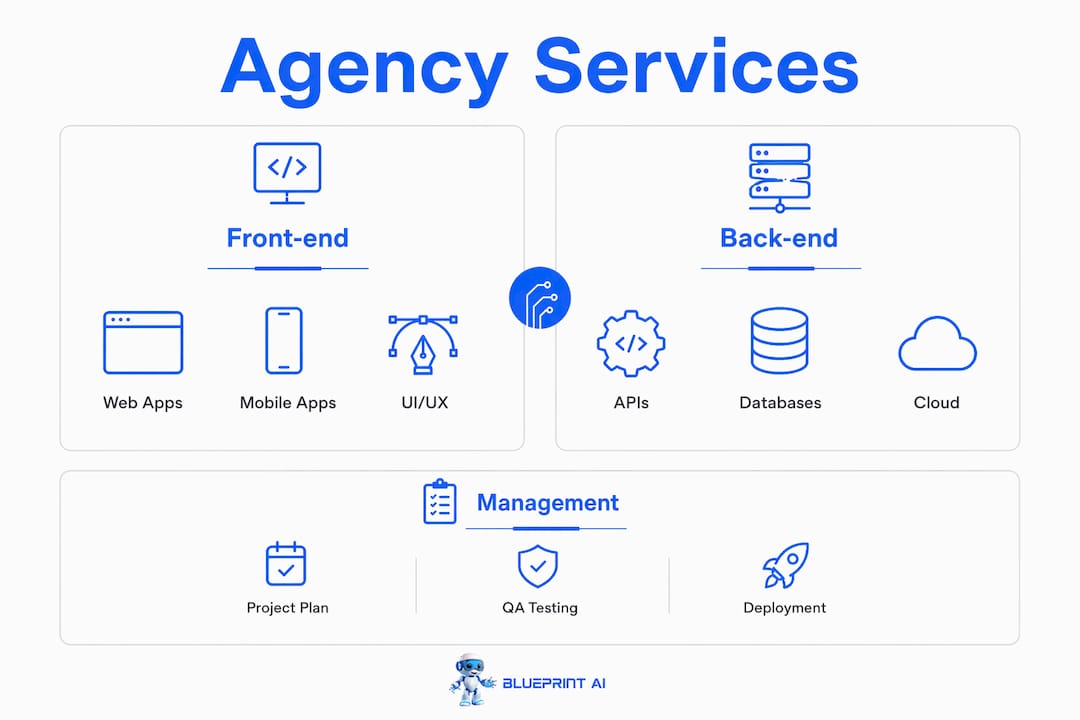
Software development services from an established agency cover the full product lifecycle, not just the coding phase. Understanding this scope helps you set realistic expectations before signing a contract.
The typical service catalogue includes:
- Discovery and requirements analysis: A paid discovery phase of two to three weeks defines the project scope, user stories, and system architecture. This phase reduces misalignment and prevents costly refactoring later.
- System architecture and technical design: Senior engineers design the data models, API structures, and infrastructure before a single line of production code is written.
- Front-end and back-end development: Cross-functional teams build the user interface and server-side logic in parallel, using frameworks suited to the project's performance and scalability requirements.
- Quality assurance and testing: Dedicated QA engineers run automated and manual tests throughout development, not just at the end. Agencies typically plan a 5% to 15% rework allowance internally, which reduces end-of-project surprises for clients.
- Deployment and DevOps: The agency configures cloud infrastructure, CI/CD pipelines, and monitoring before handing over a live environment.
- Post-launch support and maintenance: Most agencies offer retainer-based support contracts covering bug fixes, security patches, and feature iterations.
Project management runs across all of these phases. Slack handles day-to-day communication, Jira tracks sprint velocity, and weekly status calls keep clients informed without requiring deep technical involvement.
Pro Tip: Ask any agency you evaluate to walk you through their discovery phase deliverables. A firm that cannot describe what you will receive after week two is not ready to manage your project.
Agency vs. freelancer vs. in-house: which model fits your project?
The right development model depends on project complexity, duration, and how much management capacity you have internally. Each option carries a distinct cost and risk profile.
| Factor | Agency | Freelancer | In-house team |
|---|---|---|---|
| Hourly rate | €80–150/hr (blended) | €50–90/hr | Salary equivalent |
| Management overhead | Low (2–4 hrs per sprint) | High (client coordinates all work) | High (full HR and technical oversight) |
| Continuity risk | Low (team knowledge is shared) | High (single point of failure) | Medium (depends on retention) |
| Time to start | 2–4 weeks | 1–2 weeks | 6–9 months to full velocity |
| Best suited for | Complex builds over 4 weeks | Short, well-defined tasks | Long-term product ownership |
Agencies charge more per hour than freelancers, but the total cost of engagement is often comparable once you account for management time. Clients managing agencies spend roughly 2 to 4 hours per sprint on oversight, compared with significantly more time coordinating multiple freelancers individually. For a six-to-nine-month project, that difference in internal management effort translates to roughly $15,000 in saved overhead.
In-house teams offer the deepest product alignment over time, but the 6 to 9 months required to recruit, onboard, and reach peak velocity makes them impractical for projects with near-term deadlines. Hybrid models are increasingly common: an agency builds the initial product, then a smaller in-house team or a freelancer handles ongoing maintenance. This approach optimises both cost and control across the product lifecycle.
The agency approach is optimal for complex product builds longer than four weeks where architectural discipline is critical. Freelancers remain the better choice for short, well-defined tasks with clear deliverables and no interdependencies.
Pro Tip: Use Blueprintbot's free app development time estimator to gauge whether your project scope warrants an agency engagement or a simpler arrangement.
What are the key benefits of hiring a software development agency?
The benefits of software agencies extend well beyond access to developers. The structural advantages of the agency model address the most common failure points in software projects: unclear requirements, poor code quality, and abandoned projects when a key person leaves.
Speed to mobilisation is the most immediate benefit. Agencies can start projects within 2 to 4 weeks, assembling a team with the right skill mix for your specific stack. No job postings, no probation periods, no ramp-up delays.
Architectural discipline reduces technical debt from the outset. Every piece of code in an established agency is reviewed by a second senior engineer before it is merged. This peer review standard produces higher code quality than most freelancer or early-stage in-house workflows can sustain.
Risk continuity protects your project when individuals change. Agencies maintain documented processes and shared knowledge bases, so the project does not stall if a developer leaves mid-engagement. Freelancers represent a single point of failure with no structural backup.
Legal and contractual protection matters more than most clients realise before they need it. Agencies provide formal contracts covering intellectual property ownership, confidentiality, liability, and support obligations. Conducting due diligence on contract terms before signing protects you from disputes over code ownership or scope creep.
Scalability allows you to increase or reduce team size as the project evolves. Adding a second front-end developer for a critical sprint is a scheduling conversation with an agency. With an in-house team, it is a hiring process.
Non-technical firms in particular benefit from shifting software management risks to an agency, freeing leadership to focus on the business rather than engineering oversight. The agency becomes the accountable party for delivery, not just a vendor supplying labour.
How to choose the right software development agency
Selecting the right firm requires more than reviewing a portfolio. The following criteria separate agencies that deliver from those that look good in a sales call.
Domain relevance: Confirm the agency has delivered projects in your industry or with your technology stack. A fintech product has different compliance and architecture requirements than a consumer mobile app. Ask for two or three case studies from comparable projects.
Delivery track record: Request client references and ask specifically about how the agency handled scope changes and delays. Every project encounters problems. What matters is how the agency communicated and resolved them.
Discovery phase quality: A credible agency will propose a paid discovery phase before committing to a full project estimate. Agencies that skip this step and quote a fixed price from a brief conversation are underestimating complexity or planning to renegotiate later.
Contract terms and IP ownership: Verify that the contract assigns full intellectual property rights to you upon payment. Confirm maintenance terms, data handling obligations, and what happens if the engagement ends early.
Communication and project management approach: Ask which tools the agency uses for client communication and how frequently you will receive progress updates. Agencies using Jira or equivalent tools with client-facing dashboards provide more transparency than those relying on email summaries.
Pricing model and transparency: Fixed-price contracts suit well-defined projects. Time-and-materials contracts suit projects where requirements will evolve. Understand which model the agency is proposing and why. A mid-complexity project in the US typically costs around $400,000 for 2,000 development hours at blended rates of $150 to $250 per hour. That benchmark helps you identify quotes that are unrealistically low.
Warning signs to avoid: Agencies that cannot name their senior engineers, refuse to provide references, or present a proposal without a discovery phase are worth avoiding. Vague statements about "agile methodology" without specifics on sprint cadence and review processes signal process immaturity.
Pro Tip: Before your first agency meeting, use Blueprintbot's software cost estimator to generate a ballpark budget. Walking in with a number prevents you from anchoring on whatever figure the agency presents first.
Key takeaways
A software development agency delivers the most value when architectural discipline, risk continuity, and managed delivery matter more than minimising the hourly rate.
| Point | Details |
|---|---|
| Agency definition | A firm providing end-to-end custom software delivery under a formal contract with a cross-functional team. |
| Speed advantage | Agencies mobilise teams in 2 to 4 weeks versus 6 to 9 months for in-house hiring. |
| Cost context | Mid-complexity US projects cost approximately $400,000 at blended rates of $150 to $250 per hour. |
| Risk protection | Documented processes and peer code review reduce continuity risk and technical debt. |
| Selection criteria | Prioritise domain experience, discovery phase quality, and clear IP ownership in the contract. |
Why the agency model deserves more credit than it gets
Most of the criticism I hear about software development agencies comes from clients who hired the wrong one and concluded the model itself was flawed. That is like blaming the restaurant category because one kitchen gave you food poisoning.
The honest reality is that the agency model is the most structurally sound way to build complex software if you are not a technology company. You are buying process maturity, not just developer hours. The architectural oversight, the peer review culture, the documented handovers: these are the things that prevent a $400,000 project from turning into a $700,000 rescue operation twelve months later.
What I find underappreciated is how much agencies protect non-technical founders and business leaders from themselves. Clients often arrive with a feature list when what they actually need is a product strategy. A good agency pushes back on that in the discovery phase. A freelancer, who is paid by the hour, rarely does.
The trend toward hybrid models is genuinely worth watching. More companies are using agencies for the initial build and architecture, then transitioning to a small in-house team or a freelancer for maintenance. This is smart. It captures the agency's process rigour at the stage where it matters most, then reduces ongoing cost once the architecture is stable and documented.
If you are evaluating an agency right now, the single most revealing question you can ask is: "What will you deliver at the end of the discovery phase?" The answer tells you everything about how seriously they take requirements, architecture, and your success.
— Rishi
Plan your project before you brief an agency
Understanding what a software development agency does is the first step. Arriving at your first agency meeting with a clear technical blueprint is what separates founders who get accurate quotes from those who get surprised by scope changes six weeks in.
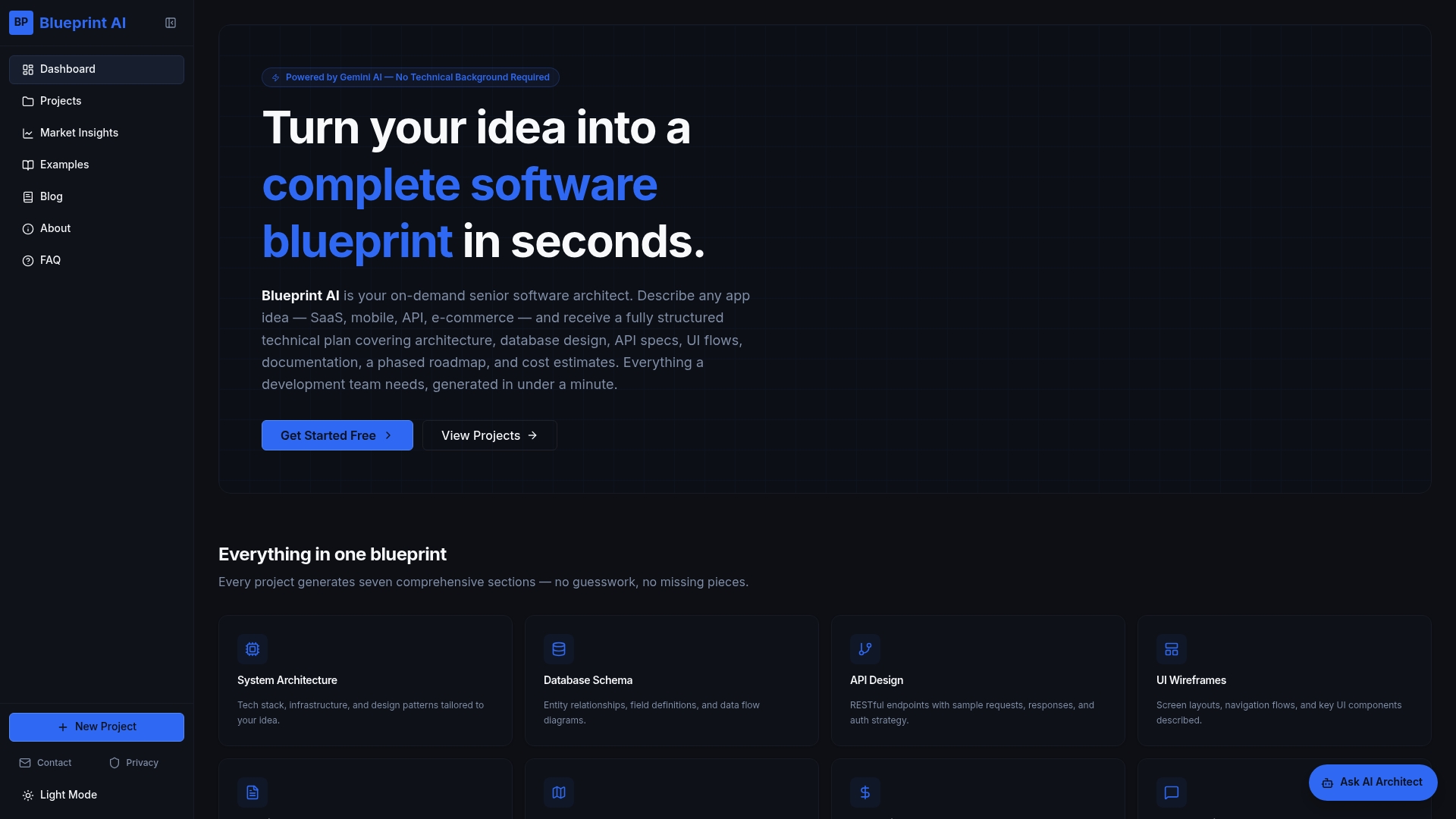
Blueprintbot transforms your app idea into a detailed technical blueprint in seconds, covering system architecture, API designs, and cost estimates without requiring any technical background. You can explore example software blueprints to see exactly what a well-structured development plan looks like before you brief an agency. When you walk into that meeting with a documented architecture and a realistic budget range, the conversation shifts from "what do you want?" to "here is how we build it." That is the difference between a project that starts well and one that stalls in discovery.
FAQ
What is a software development agency?
A software development agency is a company that designs, builds, and delivers custom software for clients under a formal contract. It provides a cross-functional team covering engineering, design, QA, and project management as a managed service.
How much does a software development agency cost?
In the US, blended agency rates typically range from $150 to $250 per hour, with mid-complexity projects costing approximately $400,000 for 2,000 development hours. Rates vary significantly by region and project type.
When should I hire an agency instead of a freelancer?
The agency model is the better choice for complex builds lasting longer than four weeks, where architectural discipline and team continuity are critical. Freelancers suit short, well-defined tasks with clear deliverables and limited interdependencies.
What services do software development agencies offer?
Most agencies provide discovery and scoping, system architecture, front-end and back-end development, QA testing, deployment, and post-launch support. The full lifecycle approach is what distinguishes agencies from individual contractors.
How do I evaluate a software development agency before hiring?
Assess domain-relevant case studies, request client references, review contract terms for IP ownership, and confirm the agency proposes a formal discovery phase before committing to a full project estimate. Agencies that skip discovery are a significant risk.