What Is Capacity Planning Software? A 2026 Guide

Capacity planning software is defined as a system that forecasts future demand and automatically aligns available resources to meet that demand, covering workload analysis, performance prediction, financial modeling, and management reporting. For IT teams managing cloud infrastructure and operations managers running production floors, this category of tools replaces spreadsheet guesswork with repeatable, data-driven decisions. Platforms like Broadcom Capacity Planner, Pepperdata, Parallax, and Forecast.app each approach the problem differently, but they share one goal: making sure you never run out of capacity at the wrong moment, and never overpay for capacity you do not need.
What is capacity planning software and how does it work?
Capacity planning software operates as an end-to-end pipeline that moves through five distinct stages: telemetry ingestion, forecasting, constraint application, provisioning, and validation. Each stage feeds the next, and the output of the final stage loops back to refine the first. This architecture is what separates modern capacity management tools from static spreadsheet models.
Here is how that pipeline works in practice:
- Telemetry ingestion. The software collects metrics, logs, and billing data from servers, cloud APIs, application performance monitors, and ERP systems. Without clean, continuous telemetry, every downstream forecast is unreliable.
- Forecasting engine. Statistical models and machine learning algorithms process historical telemetry to project future demand. Tools like Forecast.app use machine learning for demand prediction, while Broadcom Capacity Planner offers both trend and what-if analysis modes so planners can model baseline growth and test scenario impacts before committing resources.
- Constraint and policy management. Budget ceilings, service level objectives (SLOs), and compliance rules are applied as guardrails. The software flags any forecast that would breach a constraint rather than silently generating an infeasible plan.
- Provision planning and automation. Based on the constrained forecast, the system recommends or automatically executes resource allocation decisions, scaling cloud nodes, adjusting staffing models, or updating production schedules.
- Validation and feedback loop. Load testing, real-world performance data, and cost actuals are compared against the forecast. Deviations update the model, keeping predictions accurate over time.
Pro Tip: Set your feedback loop cadence to match your planning horizon. A team managing weekly sprint capacity needs daily telemetry reconciliation, while infrastructure teams planning quarterly cloud budgets can run weekly model updates.
How capacity planning methodologies differ across industries
Not all capacity planning solutions work the same way, and the methodology you need depends heavily on your industry. Manufacturing, IT, and digital agencies each face distinct resource constraints and planning horizons.

Manufacturing: RCCP vs. CRP
Manufacturing uses two layered methods. Rough Cut Capacity Planning (RCCP) validates the master production schedule at a high level, checking whether key resources like machinery and labor can handle planned output over a medium to long-term horizon, typically weeks to months. Capacity Requirements Planning (CRP) goes deeper, examining detailed resource loads operation by operation to detect short-term gaps in the MRP plan. RCCP catches strategic infeasibility early; CRP prevents shop-floor surprises. Oracle's Capacity module implements both, calculating capacity load ratios to surface overloads and underloads before they become missed shipments.
IT and cloud: forecasting vs. real-time optimization
Cloud-native capacity planning splits into two distinct modes. Forecasting tools project future infrastructure demand based on growth trends and scheduled workloads. Real-time optimization tools, like Pepperdata Capacity Optimizer, act on live scheduler data to repack workloads and right-size resources continuously. Successful tools integrate both because forecasting without real-time correction drifts, and real-time optimization without a forecast reacts rather than plans.
Digital agencies: pipeline-aligned resource planning
Agencies face a different problem. Their capacity constraint is human hours, not server nodes. Tools like Parallax connect the sales pipeline directly to resource capacity, so when a new client deal closes, the system immediately flags whether the delivery team has bandwidth. Forecast.app adds AI-driven scenario planning so agency managers can model the impact of hiring, contractor use, or project delays before they happen.
| Industry | Primary method | Planning horizon | Example tools |
|---|---|---|---|
| Manufacturing | RCCP and CRP | Weeks to months | Oracle Capacity |
| IT and cloud | Forecasting plus real-time optimization | Hours to quarters | Pepperdata, Broadcom |
| Digital agencies | Pipeline-aligned resource planning | Days to months | Parallax, Forecast.app |
Pro Tip: If you are building or selecting a SaaS product that requires capacity planning, review a SaaS architecture guide before finalizing your tool selection. Architecture decisions made early determine which telemetry signals are even available to your planning software.
What are the benefits of capacity planning software?
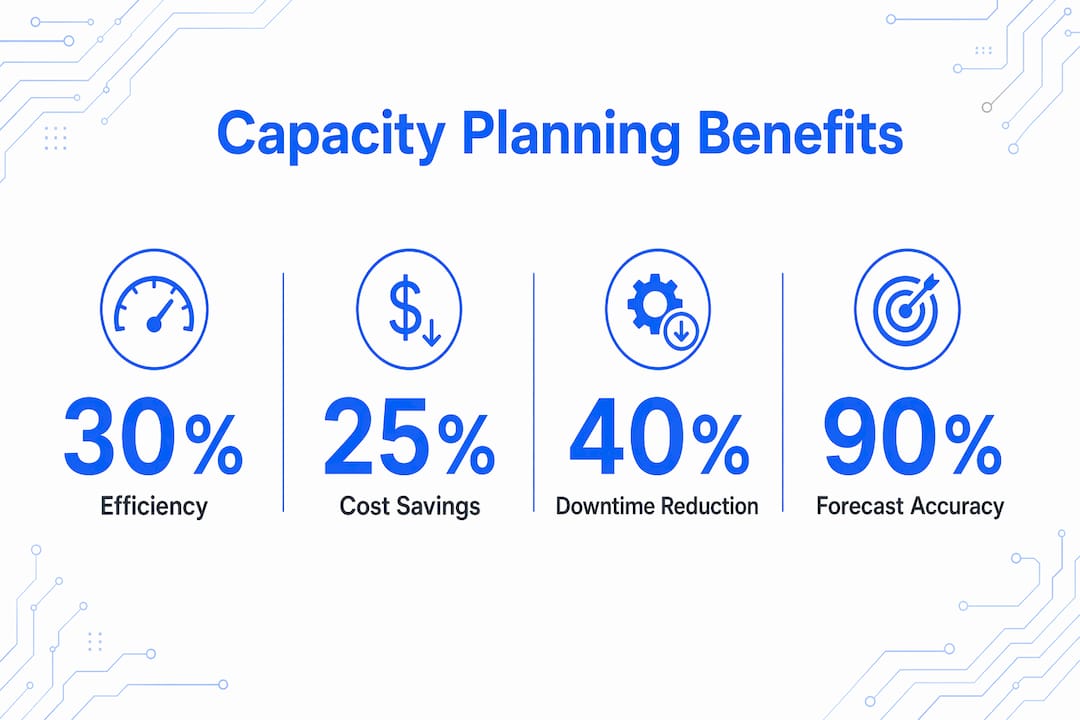
The benefits of capacity planning extend well beyond avoiding outages or missed deadlines. When implemented correctly, capacity planning software changes how organizations make financial and operational decisions.
- Improved resource forecasting accuracy. Capacity planning software replaces gut-feel estimates with models built on actual workload data. Broadcom's approach structures this into workload characterization and forecasting phases, which means forecasts reflect real consumption patterns rather than historical averages.
- Significant cost reduction. Pepperdata Capacity Optimizer reports up to 75% cloud spend reduction and 80% more containers per node with no manual tuning. That is not a marginal efficiency gain. It represents a structural change in how cloud budgets are consumed.
- Better project delivery. When resource availability is visible before a project starts, teams stop over-committing. Forecast.app's AI-driven resource allocation gives project managers a real-time view of who is available, at what utilization rate, and for how long, reducing the late-stage scrambles that derail timelines.
- Financial forecasting alignment. Capacity data feeds directly into budget models. When your infrastructure team can show finance exactly how cloud spend scales with user growth, budget conversations become evidence-based rather than negotiation-based.
- Risk reduction through scenario modeling. What-if analysis lets teams stress-test plans before committing. If a major client doubles their usage, does your infrastructure hold? If a key engineer leaves, does the sprint still deliver? Scenario planning answers these questions before they become crises.
The cumulative effect is an organization that spends less time reacting to capacity failures and more time executing against a plan it actually trusts.
How to choose the right capacity planning software
Selecting from the available capacity planning solutions requires matching tool capabilities to your specific operational context. A cloud-native startup and a discrete manufacturer have almost nothing in common in terms of what they need from this software category.
Start with these selection criteria:
- Industry fit. Manufacturing teams need MRP integration and capacity load ratio calculations. IT teams need cloud API connectors and real-time scheduler visibility. Agencies need CRM and project management integrations. A tool built for one context rarely performs well in another.
- Forecasting accuracy and methodology. Ask vendors how their forecasting engine handles seasonality, sudden demand spikes, and data gaps. Tools that only use linear regression will fail in volatile environments. Look for platforms that combine statistical methods with machine learning.
- Integration depth. Capacity planning software that cannot read your existing telemetry is useless. Confirm native connectors for your cloud provider (AWS, Azure, Google Cloud), your ERP or PSA tool, and your monitoring stack before evaluating any other feature.
- Scenario planning and dashboards. Customizable dashboards and scenario planning are not optional features. They are the primary interface through which non-technical stakeholders consume capacity data and make decisions.
- Automation capabilities. The best tools move beyond reporting into automated provisioning. If your team is still manually executing every recommendation the software generates, you are capturing only a fraction of the available value.
Common implementation failures follow a predictable pattern. Teams deploy the software, configure the dashboards, and then stop. They treat it as a reporting tool rather than a continuous planning system. The continuous feedback loop where observed behavior refines forecasts and policy is what prevents plans from going stale. Build that loop into your operating rhythm from day one.
Understanding software development cost estimation is also worth doing before you finalize your tool budget. Capacity planning software licensing costs vary widely, and the total cost of ownership includes integration work, training, and ongoing model maintenance.
Key takeaways
Capacity planning software works because it combines continuous telemetry, machine learning forecasting, constraint management, and automated provisioning into a single repeatable system that keeps resource supply aligned with demand.
| Point | Details |
|---|---|
| Core function | Capacity planning software forecasts demand and aligns resources across workload, financial, and performance dimensions. |
| Industry-specific methods | Manufacturing uses RCCP and CRP; IT uses forecasting plus real-time optimization; agencies use pipeline-aligned planning. |
| Cost impact | Tools like Pepperdata report up to 75% cloud spend reduction through automated workload rightsizing. |
| Selection priority | Match the tool to your industry, integration stack, and forecasting methodology before evaluating any other feature. |
| Continuous improvement | A feedback loop that updates models with real-world data is what separates effective capacity planning from static reporting. |
Why most teams underuse capacity planning software
I have watched teams spend significant budget on capacity planning tools and then use them as glorified dashboards. The software runs, the charts update, and nothing changes in how decisions get made. That is the real failure mode, and it is far more common than a bad tool selection.
The mistake is treating capacity planning as a quarterly exercise rather than a continuous operating practice. When I look at teams that actually capture the cost and performance benefits, they share one habit: they have built the feedback loop into their weekly rhythm. Forecast deviations get reviewed. Model assumptions get challenged. Constraint policies get updated when business conditions shift. The software is only as good as the discipline around it.
The other thing I would push back on is the assumption that more automation is always better. Real-time optimization tools like Pepperdata are genuinely powerful, but they require human oversight on constraint policies. An automated system that right-sizes your cloud workloads without understanding your SLO commitments will optimize for cost in ways that create performance problems you did not anticipate. Automation should execute decisions, not make them unilaterally.
The trend I find most significant heading into the next few years is the convergence of capacity forecasting with financial planning. The teams getting the most value from these tools are the ones where engineering and finance share the same capacity model. That alignment changes budget conversations from estimates to evidence, and it changes capacity decisions from technical calls to business decisions.
My practical recommendation: before you evaluate any software, document your current planning process in writing. If you cannot describe how you characterize workloads, apply constraints, and validate forecasts today, no tool will fix that gap. The software amplifies a process. It does not replace one.
— Rishi
How Blueprintbot helps you plan capacity from the start
Capacity planning decisions made late in a project cost far more to fix than those built into the original architecture. Blueprintbot generates detailed technical blueprints that include system architecture, API designs, and resource cost estimates before a single line of code is written. That means your capacity assumptions are explicit and reviewable from day one, not buried in a developer's head.
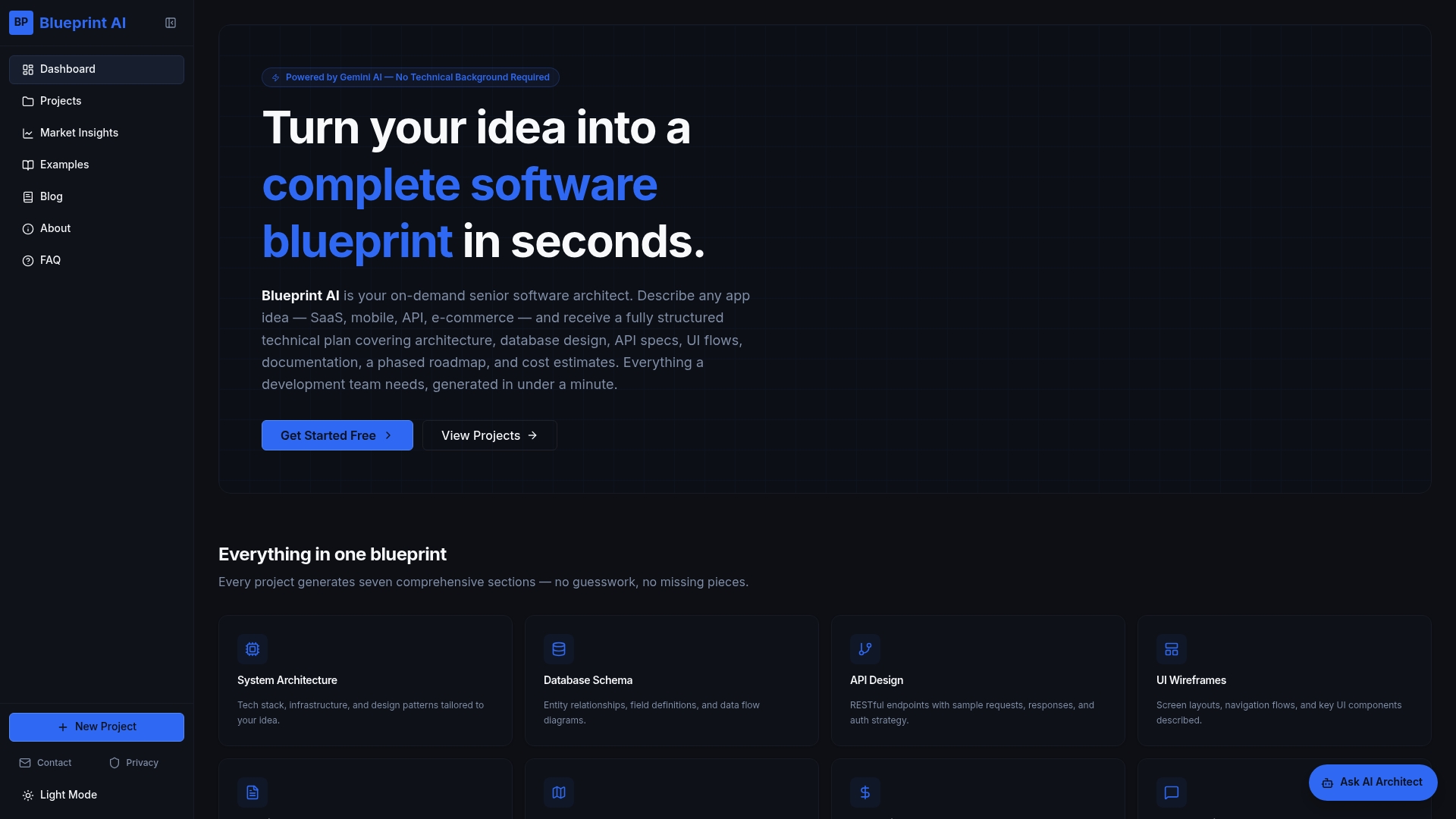
If you are a founder, product manager, or IT lead trying to align your team around a resource plan, explore the AI-generated blueprint examples to see how Blueprintbot structures capacity and architecture decisions into a format your whole team can act on. You can also visit Blueprintbot directly to generate your own blueprint in seconds, no technical background required.
FAQ
What is capacity planning software used for?
Capacity planning software is used to forecast future resource demand and align available capacity to meet it, covering infrastructure, staffing, and financial planning. It applies across IT, manufacturing, and service industries to prevent both over-provisioning and resource shortfalls.
How does capacity planning software work?
The software ingests telemetry data, runs forecasting models, applies business constraints like budgets and SLOs, generates provisioning recommendations, and validates outcomes against real performance. This continuous pipeline refines itself over time as new data feeds back into the forecasting engine.
What is the difference between RCCP and CRP?
RCCP validates the master production schedule at a high level using key resources over a medium to long-term horizon, while CRP examines detailed operation-level resource loads to identify short-term gaps. Both methods are used in manufacturing capacity planning, with RCCP catching strategic infeasibility and CRP preventing shop-floor execution failures.
What are the best capacity planning software options for IT teams?
Pepperdata Capacity Optimizer is strong for cloud workload rightsizing, Broadcom Capacity Planner covers mainframe and enterprise environments, and Forecast.app serves digital and project-based teams with AI-driven resource allocation. The best choice depends on your infrastructure type, integration requirements, and planning horizon.
What is the biggest benefit of capacity planning software?
The primary benefit is replacing reactive resource management with a proactive, data-driven system that reduces costs, improves project delivery accuracy, and aligns engineering decisions with financial forecasts. Pepperdata's reported 75% cloud spend reduction illustrates the scale of impact possible when the software is implemented with proper automation and constraint policies.