Software development outsourcing: a 2026 guide for business owners

Software development outsourcing is defined as the practice of delegating software projects, or parts of them, to an external provider rather than building an in-house team. Business owners and project managers use it to cut costs, access specialised skills, and ship products faster. The two most common engagement models are project-based and staff augmentation, and choosing the wrong one is one of the most common reasons projects fail. Compliance frameworks like GDPR, HIPAA, and SOC 2 add another layer of complexity that the right outsourcing partner must address from day one. This guide covers every stage of the process, from picking a model to protecting your intellectual property.
What is software development outsourcing and how does it work?
Software development outsourcing means hiring an external service provider to handle design, engineering, QA, or maintenance work that your internal team cannot or should not do alone. The practice is not new, but the range of available delivery models has expanded significantly. Organisations now use outsourcing to accelerate digital products by tapping into mature delivery processes and cross-functional specialists who would be difficult to hire locally.
SponsoredCheck out today's featured offer →
The term IT outsourcing is sometimes used interchangeably with software development outsourcing, but they are not identical. IT outsourcing often covers infrastructure, support, and managed services. Software development outsourcing refers specifically to building, testing, and maintaining software products. Knowing the difference helps you write a sharper scope of work and find the right type of vendor.
What outsourcing models and geographic options are available?
Two engagement models dominate the market. Project-based outsourcing hands full delivery responsibility to an external team. Staff augmentation adds individual specialists to your existing team on a contract basis. Confusing these two models is a leading cause of project failure because each one requires a completely different management approach.
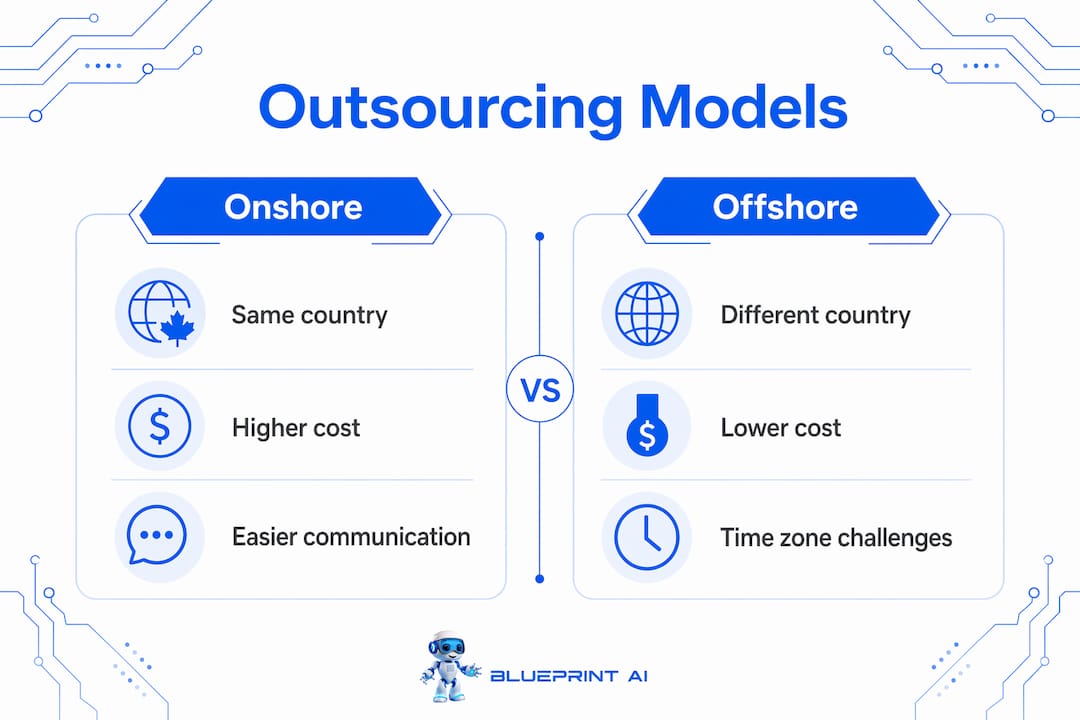
Geographic classification adds another dimension to the decision.
| Model | Definition | Best for | Trade-off |
|---|---|---|---|
| Onshore | Same country as your business | Regulatory alignment, easy collaboration | Highest cost |
| Nearshore | Adjacent region or time zone | Balanced cost and communication | Moderate cost |
| Offshore | Different continent | Lowest cost, large talent pool | Time zone gaps, cultural differences |
| Project-based | Full delivery to external team | Fixed scope, defined outcomes | Less day-to-day control |
| Staff augmentation | Contractors join your team | Flexible capacity, specific skills | Requires active management |
Offshore regions popular with North American companies include India, the Philippines, Poland, Ukraine, and Romania. Each offers a different mix of cost, English proficiency, and technical specialisation. Eastern European teams, for example, tend to attract strong backend and systems engineering talent, while South Asian markets offer large pools of full-stack and mobile developers.
Pro Tip: Before choosing a geographic model, map your project's compliance requirements first. A healthcare app subject to HIPAA may need a nearshore or onshore partner to simplify data residency obligations.
What does the software development outsourcing lifecycle look like?
A well-run outsourced project follows a predictable sequence of stages. Skipping any of them creates gaps that show up as budget overruns or missed deadlines later.
- Discovery and business analysis. The vendor works with you to define goals, user needs, and technical constraints. This stage produces a scope document that both sides sign off on before any code is written.
- System architecture and design. Engineers design the database schema, API structure, and system components. This is where compliance requirements like GDPR and SOC 2 get embedded into the architecture rather than bolted on later.
- Development and QA. Developers build features in sprints, typically two weeks long. QA runs in parallel, not after. Agile sprint methods maintain visibility and give you a chance to course-correct before problems compound.
- Deployment. The team releases the product to production, manages infrastructure setup, and monitors for launch issues. A clear deployment checklist reduces the risk of downtime or data loss.
- Post-launch maintenance. Bugs surface after real users arrive. A maintenance agreement with defined response times protects you from being left without support after go-live.
Pro Tip: Ask every vendor candidate how they handle scope changes mid-sprint. Their answer tells you more about their process maturity than any case study will.
The compliance layer deserves its own emphasis. Regulatory alignment with frameworks like GDPR, HIPAA, and SOC 2 must be built into the discovery stage, not treated as a legal checkbox at the end. Vendors who treat compliance as an afterthought create liability for your business.
What are the key benefits and challenges of outsourcing software projects?
The advantages of outsourcing are real, but they come with conditions. The benefits materialise when the engagement is set up correctly. The risks appear when it is not.
Top benefits:
- Cost savings from lower labour rates in offshore or nearshore markets
- Access to specialised skills in areas like AI integration, mobile development, or cloud architecture that are hard to hire locally
- Faster time-to-market by starting immediately rather than recruiting and onboarding an internal team
- Flexibility to scale a team up or down as project phases change
- Exposure to mature delivery processes that your internal team can learn from
Common pitfalls:
- Scope misalignment between what you expect and what the vendor delivers
- Communication barriers caused by time zone gaps or language differences
- Vendor lock-in when a supplier retains code ownership or withholds documentation
- Intellectual property risk when contracts do not explicitly assign ownership to you
- Hidden costs from scope creep, rework, or poor initial estimates
IP protection is often underestimated until a project ends badly. Contracts must mandate full code access, repository ownership, and complete documentation from day one. Waiting until a dispute arises to address ownership is far too late.
Understanding how to estimate software development costs before you engage a vendor gives you a baseline to evaluate proposals and spot inflated quotes.
What are the best practices for managing outsourced software development?
Managing an outsourced team well is a skill. The project managers who get the best results treat their vendor as a delivery partner, not a black box. These practices separate successful engagements from expensive failures.
- Define scope before you sign. A vague brief produces a vague product. Write user stories, acceptance criteria, and a prioritised feature list before the contract is finalised.
- Use agile feedback loops. Projects fail more often due to scope misalignment than technical skill gaps. Sprint reviews and weekly check-ins keep both sides calibrated.
- Communicate with structure. Establish a single point of contact on each side, agree on communication tools, and set response time expectations. Blueprintbot's guide on communicating with your software team covers this in practical detail.
- Retain IP from day one. Contracts should assign all code, documentation, and assets to your organisation. Never accept a vendor arrangement where the supplier retains repository access after the engagement ends.
- Embed compliance and security controls early. GDPR, SOC 2, and HIPAA requirements belong in the architecture, not the legal review at the end.
- Incorporate AI into the development process. AI-augmented development improves governance, reduces defects, and lowers technical debt. Vendors who use AI-assisted testing and code review deliver more reliable outputs.
Pro Tip: Use a feature prioritiser before your first vendor meeting. Walking in with a MoSCoW-ranked feature list signals to the vendor that you are a serious client and reduces the risk of scope inflation.
Perspective: what I've learned from watching outsourcing projects succeed and fail
The single biggest mistake I see business owners make is treating outsourcing as a staffing problem rather than a product delivery problem. They hire for capacity, add developers to a vague backlog, and wonder why nothing ships on time. The vendors who deliver consistently are the ones given a clear outcome to work toward, not just a list of tasks.
The second pattern I keep seeing is IP negligence. Founders get excited about building and skip the legal groundwork. Six months later, they discover the vendor owns the repository or has not documented a single architectural decision. Contractual emphasis on IP and documentation access is not a legal formality. It is the difference between owning a product and renting one.
The projects that work well share one trait: the business owner shows up to sprint reviews. Not to micromanage, but to give feedback while the cost of changing direction is still low. Outsourcing does not remove the need for product leadership. It amplifies it.
AI integration is also shifting what good outsourcing looks like. Vendors who embed AI into testing, code review, and documentation are delivering faster and with fewer defects. If a vendor's process looks the same as it did in 2020, that is a signal worth paying attention to.
— Rishi
How Blueprintbot helps you plan outsourced software projects
Entering an outsourcing engagement without a technical plan is the fastest way to overpay and underdeliver. Blueprintbot generates complete software blueprints from your app idea in seconds, covering system architecture, database schemas, API designs, user interface flows, and development roadmaps. You do not need to write a line of code to produce a document your vendor can actually build from.
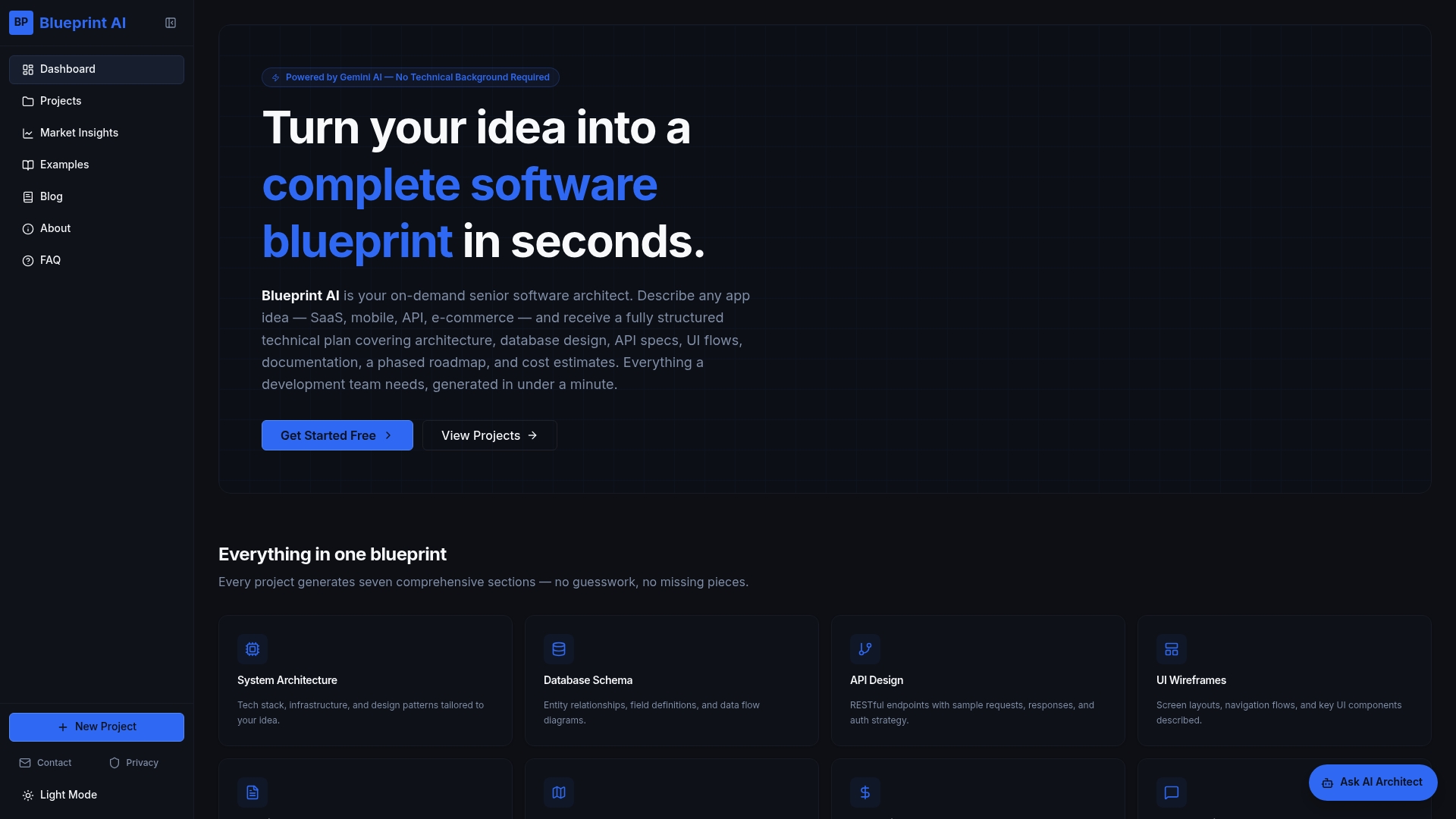
The app development time estimator gives you a realistic timeline before you request vendor quotes, so you can evaluate proposals against an independent baseline. The MVP feature prioritiser helps you walk into vendor conversations with a ranked feature list rather than a wish list. Together, these tools reduce ambiguity, protect your budget, and give your outsourced team the clarity they need to deliver.
Key takeaways
Software development outsourcing succeeds when you choose the right model, protect your IP from day one, and stay actively involved through structured agile feedback loops.
| Point | Details |
|---|---|
| Choose the right model | Project-based suits fixed outcomes; staff augmentation suits flexible capacity needs. |
| Protect your IP early | Contracts must assign full code ownership and documentation access to you from day one. |
| Embed compliance in architecture | GDPR, HIPAA, and SOC 2 requirements belong in the design phase, not the legal review. |
| Use agile feedback loops | Sprint reviews prevent scope misalignment, which causes more failures than technical skill gaps. |
| Plan before you engage | A detailed technical blueprint reduces vendor ambiguity and protects your budget. |
FAQ
What is software development outsourcing?
Software development outsourcing is the practice of hiring an external provider to handle software design, engineering, QA, or maintenance. Organisations use it to reduce costs, access specialised skills, and ship products faster than an internal hire would allow.
What is the difference between staff augmentation and project-based outsourcing?
Staff augmentation adds contract specialists to your existing team, while project-based outsourcing delegates full delivery responsibility to an external vendor. Each model requires a different management approach, and confusing them is a common cause of project failure.
How do I protect my intellectual property when outsourcing?
Your contract must explicitly assign all code, documentation, and assets to your organisation from day one. Never accept an arrangement where the vendor retains repository access or withholds documentation after the engagement ends.
What geographic outsourcing models exist?
Onshore, nearshore, and offshore are the three geographic categories. Offshore markets like India, Poland, and the Philippines offer the lowest costs, while onshore and nearshore options provide easier compliance alignment and time zone overlap.
How does Blueprintbot support outsourced software projects?
Blueprintbot generates detailed software blueprints, time estimates, and feature prioritisation outputs that give outsourced teams a clear, unambiguous plan to build from, reducing rework and protecting your budget.