Role of APIs in modern apps: 2026 developer guide

APIs are defined as the communication contracts that connect software components, enabling modern applications to share data, trigger actions, and integrate services across platforms. Every time a user pays through Stripe, logs in with Google, or sees a map inside an app, an API is doing the work. The role of APIs in modern apps has grown far beyond simple connectivity. APIs now define system boundaries, govern how teams build in parallel, and determine whether a product can scale. Standards like OpenAPI, JSON, and XML give these contracts a shared language that any team or platform can read.
How APIs shape modularity and scalable architecture
APIs are the foundational building blocks of modular software, not just connectors between services. When a team designs an API before writing any code, they are defining the boundary between two systems. That boundary is what makes parallel development possible. One team can build the payment service while another builds the user interface, because the API contract tells both sides exactly what to expect.
SponsoredCheck out today's featured offer →This approach has a name: API-first development. The API-first philosophy involves finalising API contracts during the system architecture phase, which allows multiple teams to work simultaneously without blocking each other. The result is faster delivery and fewer integration surprises at the end of a project.
The shift to microservices architecture depends entirely on this principle. Each microservice exposes an API, and the system as a whole is just a network of those contracts. APIs define system boundaries, enable scalability, and are central to how products evolve over time. That is why treating an API as a product, not a technical afterthought, changes how teams build.

Governance and versioning are what keep this architecture from collapsing. Without versioning, a change to one service can break every other service that depends on it. Without documentation, new developers cannot onboard without reading source code. A stable API contract requires rigorous treatment, including versioning, documentation, and a clear deprecation policy.
Pro Tip: Lock your API contracts before writing implementation code. Teams that finalise their API design first report far fewer integration conflicts during testing.
- Define API contracts in OpenAPI format before any code is written
- Version every API from day one, even if you only have one version
- Publish documentation automatically from your OpenAPI spec using tools like Swagger UI or Redoc
- Treat breaking changes as a release event, not a routine update
- Assign an API owner who reviews changes the same way a product manager reviews features
What are the core benefits of using APIs in app development?
The most direct benefit of APIs in software development is speed. Leveraging established APIs for core features can reduce development cycles from months to days. That is not a marginal improvement. It means a product team can ship a working payment flow in an afternoon instead of spending weeks building one from scratch.
Consider what a typical modern app needs: authentication, payments, mapping, notifications, and analytics. Each of those capabilities exists as a mature, well-tested API. Integrating Stripe for payments, Twilio for SMS, or Google Maps for location takes hours. Building any of those from scratch takes months and introduces security risks that established providers have already solved.
- Faster time to market. Reusing existing API services eliminates redundant development work. Teams ship features in days rather than months.
- Richer user experiences. APIs give apps access to capabilities they could never build alone, from real-time weather data to AI-generated content.
- Business automation. APIs automate business processes without human intervention, freeing teams to focus on complex problems rather than repetitive tasks.
- Competitive agility. Rapid prototyping and agile development are accelerated by APIs through the reuse and integration of existing functionality.
- Ecosystem reach. APIs let your product connect to partner platforms, data providers, and AI services without rebuilding your core system.
The automation point deserves attention. When an API handles a task automatically, such as triggering an invoice, updating a CRM record, or sending a notification, a developer does not need to write custom logic for every workflow. That efficiency compounds across a product. A team of five can operate a system that would otherwise require a team of fifteen.
Pro Tip: Before building any new feature, check whether a mature API already solves the problem. The development time savings from reuse almost always outweigh the cost of integration.
Best practices for API design and management in 2026
API-first design is now a formal standard, not just a best practice among experienced teams. The U.S. Department of Defense mandates an API-first approach requiring design before implementation, with adherence to open standards including OpenAPI, XML, and JSON. When a defence organisation enforces this at policy level, it signals that API-first is the baseline expectation for any serious software project.
The table below compares two common approaches to API design and their practical trade-offs.
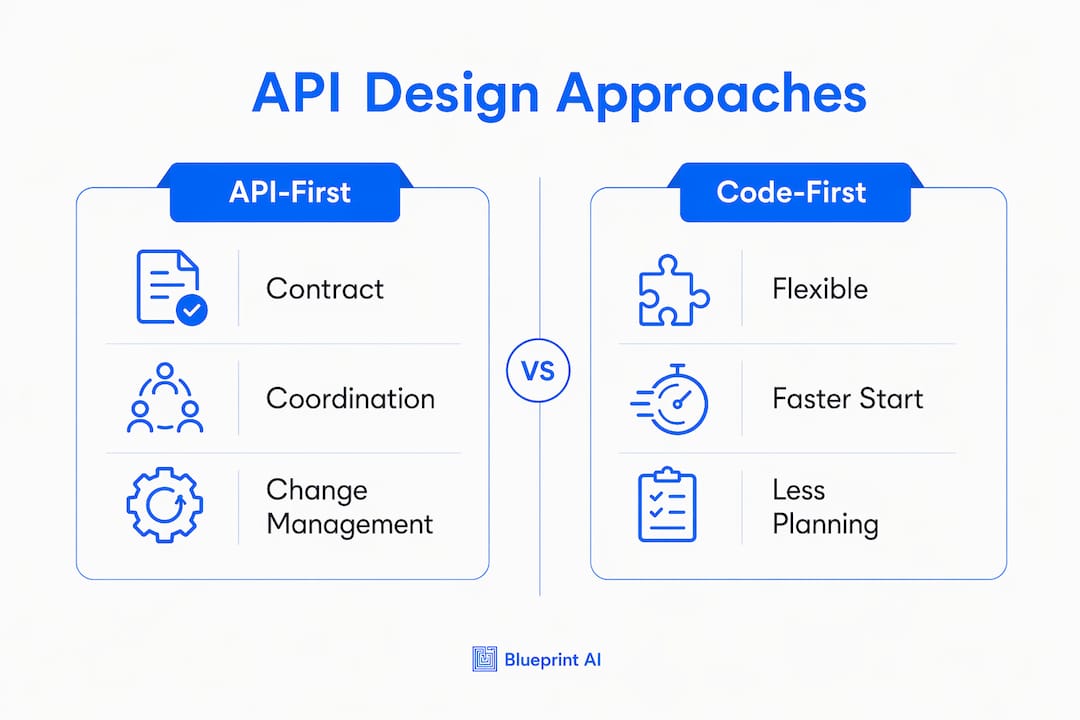
| Approach | Design phase | Team coordination | Change management |
|---|---|---|---|
| API-first | Contract defined before code | Parallel development across teams | Breaking changes managed through versioning |
| Code-first | API generated from existing code | Sequential, teams wait on each other | Changes often break consumers without warning |
Security is the area where most teams underestimate the work required. APIs are essential tools for AI agents but require strict governance to prevent unauthorised access and actions. As AI workflows increasingly rely on APIs to read data, trigger processes, and call external services, a poorly governed API becomes a wide attack surface. Permissions must be scoped tightly. Every API call should be authenticated, logged, and rate-limited.
Lifecycle management is the other discipline teams skip until it causes pain. An API that has no deprecation plan will eventually hold your architecture hostage. Consumers will depend on old behaviour, and you will be unable to change it without breaking them. A clear versioning policy, communicated in your documentation, gives consumers time to migrate and gives your team the freedom to evolve.
Pro Tip: Use an API gateway, such as Kong or AWS API Gateway, to enforce authentication, rate limiting, and logging at the infrastructure level rather than inside each individual service.
For teams building their first API-driven architecture, API design best practices and REST API implementation guides provide a structured starting point grounded in current standards.
What are the most common API integration pitfalls?
The most damaging API integration mistake is treating the API as a stable dependency when it is not. External APIs change. Providers deprecate endpoints, alter response formats, and introduce new authentication requirements. A team that builds tightly against a specific API version without an abstraction layer will face brittle code that breaks without warning.
Rigorous API governance is the primary defence against dependency problems in distributed systems. Without governance, a system accumulates dozens of direct API dependencies, each with its own authentication method, error format, and rate limit. That complexity becomes unmanageable quickly.
- Brittle interfaces. Hard-coding API responses without validation means any upstream change breaks your app silently.
- Dependency accumulation. Adding APIs without a registry or catalogue creates invisible dependencies that no one tracks.
- Inadequate error handling. APIs fail. A timeout, a 429 rate limit response, or a 503 outage must be handled gracefully, not allowed to crash the user experience.
- Security gaps. Storing API keys in source code, skipping token rotation, or granting overly broad permissions are the most common causes of API-related security incidents.
- No contract testing. Teams that skip contract tests discover breaking changes in production rather than in their test pipeline.
The fix for most of these problems is the same: treat your API integrations as first-class components of your architecture. Document them. Test them. Monitor them. When a third-party API changes, you want to know before your users do.
Key takeaways
APIs are the infrastructure layer of modern software, and treating them as products with contracts, versioning, and governance determines whether a system can scale or will collapse under its own complexity.
| Point | Details |
|---|---|
| APIs as infrastructure | APIs define system boundaries and scalability, not just connections between services. |
| API-first design | Finalising contracts before writing code enables parallel team development and fewer integration conflicts. |
| Development speed | Integrating established APIs reduces feature development from months to days. |
| Security and governance | Strict permissions, authentication, and rate limiting are non-negotiable, especially for AI-driven workflows. |
| Treat APIs as products | Versioning, documentation, and lifecycle management prevent breaking changes from halting your architecture. |
APIs are infrastructure, not plumbing
I have worked with enough product teams to know where the thinking usually goes wrong. Most teams treat APIs as plumbing. They wire things together, ship the feature, and move on. The API has no owner, no versioning policy, and no documentation beyond a few comments in the code. That works until it does not, and when it breaks, it breaks badly.
The shift I have seen in teams that build well is treating every API as a product with a contract. That means someone owns it. That means consumers are notified before it changes. That means the documentation is accurate because it is generated from the spec, not written by hand and forgotten.
The other thing I would push back on is the idea that API governance is only for large organisations. I have seen two-person startups create dependency tangles that took months to untangle, simply because no one tracked what was calling what. A simple API catalogue and a versioning convention costs almost nothing to set up and saves enormous pain later.
The future of APIs is not simpler. As AI agents begin calling APIs autonomously, the governance requirements get stricter, not looser. A poorly scoped API key given to an AI agent is a security incident waiting to happen. The teams that will build well in this environment are the ones who already treat their APIs as infrastructure worth managing carefully.
— Rishi
Plan your API architecture before you write a line of code
Product teams that skip the planning phase pay for it during development. Blueprintbot generates complete software blueprints from your app idea in seconds, covering system architecture, API designs, database schemas, and technical documentation. You get a structured output that your development team can act on immediately, without weeks of back-and-forth.

Blueprintbot is built for founders, product managers, and development teams who need to move from concept to specification without ambiguity. The platform produces API design outlines, development roadmaps, and cost estimates as part of every blueprint. If you are planning an API-first product, Blueprintbot gives your team a shared technical foundation before a single line of code is written. Explore the free planning tools to get started.
FAQ
What is the role of APIs in modern apps?
APIs are the communication contracts that connect software components, enabling apps to share data, trigger actions, and integrate external services. They define system boundaries and are the primary mechanism for building modular, scalable applications.
Why is API-first development important?
API-first development finalises contracts before implementation, allowing teams to build in parallel and reducing integration conflicts. The U.S. Department of Defense mandates this approach, citing interoperability and modularity as the core benefits.
How do APIs speed up software development?
Integrating established APIs for features like payments, authentication, and mapping reduces development cycles from months to days. Teams reuse tested, maintained services rather than building equivalent functionality from scratch.
What are the biggest risks in API integration?
The most common risks are brittle interfaces that break when upstream APIs change, inadequate error handling, and security gaps from poorly scoped permissions or exposed API keys. Governance and contract testing address all three.
How do APIs support AI-driven applications?
AI agents rely on APIs to read data, trigger processes, and call external services. Strict governance, including scoped permissions, authentication, and rate limiting, is required to prevent unauthorised access in AI-driven workflows.