How software cost estimation works: a founder's guide

Software cost estimation is the process of quantifying the anticipated resources, time, and budget required to develop a software product. Most founders and product managers encounter this process under pressure, when a developer quotes a number that feels arbitrary or a project blows past budget. Understanding how software cost estimation works gives you the tools to ask better questions, set realistic expectations, and protect your project from the most common planning failures. Methods like COCOMO II, Planning Poker, and PERT exist precisely because gut-feel estimates fail at scale.
What are the primary software cost estimation methods?
Software cost estimation methods fall into five main categories. Each one trades off precision for speed, and choosing the wrong one for your project stage is one of the most common budgeting mistakes founders make.
SponsoredCheck out today's featured offer →Bottom-up estimation decomposes a project into individual user stories, tasks, and modules. Each piece gets estimated separately, then summed with overhead. Bottom-up estimation delivers approximately ±15% variance for fixed-scope projects. That precision comes at a cost: it requires a well-defined scope before you begin, which is rarely available in early-stage planning.

Top-down analogous estimation works by comparing your project to a similar one your team has already delivered. It is faster and useful for early investor pitches, but variance can reach ±30% or higher. Use it to set a budget range, not a contract price.
Parametric models, specifically COCOMO II, use mathematical formulas with 15–17 effort multipliers covering product reliability, team capability, and schedule pressure. When properly calibrated, COCOMO II reduces variance to 10–15% for large enterprise platforms exceeding one million lines of code. It is overkill for a 12-week MVP but invaluable for multi-year platform builds.
Three-point estimation (PERT) captures uncertainty by defining three scenarios: optimistic, most likely, and pessimistic. The weighted average produces a more realistic single figure. Paired with Monte Carlo simulation, PERT generates probabilistic distributions rather than false-precision point estimates.
Planning Poker is a team-based technique where developers simultaneously reveal independent estimates using Fibonacci-sequence cards. Planning Poker prevents anchoring bias by eliminating the sequential influence that skews estimates when one senior voice speaks first.
| Method | Typical Variance | Best Use Case |
|---|---|---|
| Bottom-up | ±15% | Fixed scope, detailed requirements |
| Top-down analogous | ±30% or more | Early pitches, rough budgeting |
| COCOMO II (parametric) | ±10–15% (calibrated) | Large enterprise platforms |
| Three-point PERT | Varies by scenario spread | Uncertain or novel components |
| Planning Poker | Depends on team calibration | Agile sprint planning sessions |
Pro Tip: Never rely on a single estimation method. Triangulate bottom-up estimates for well-understood modules with PERT for uncertain components. That combination consistently outperforms any single approach.
What factors drive software cost estimation accuracy?
Knowing the methods is only half the picture. The factors that inflate or compress your estimates matter just as much as the technique you choose.
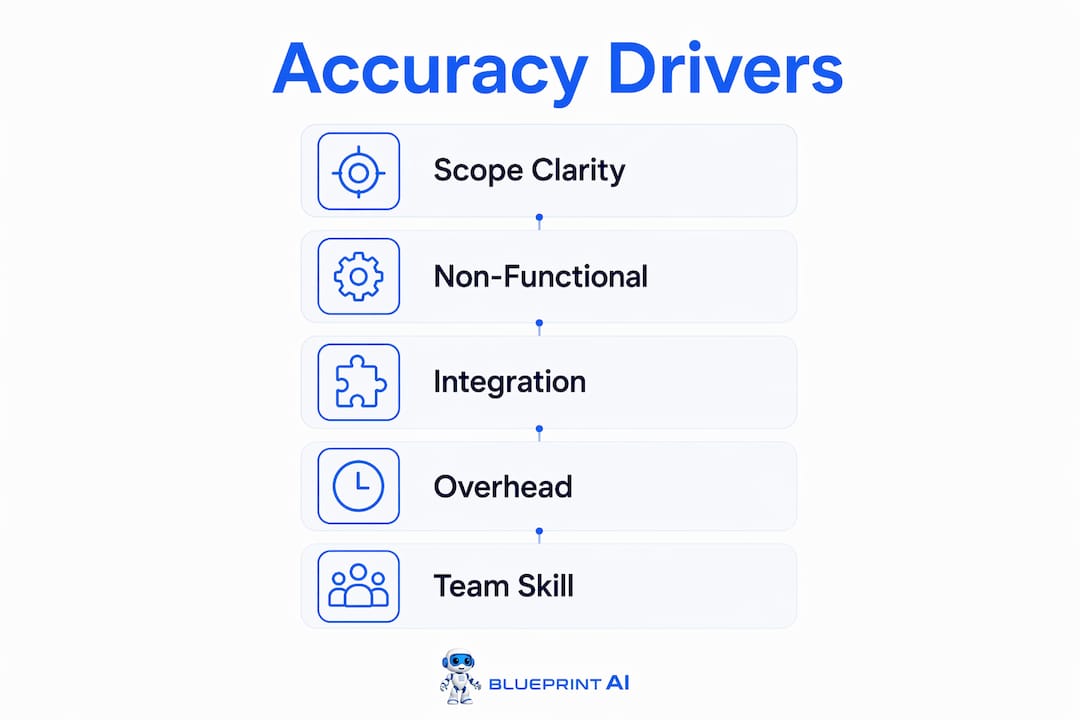
Scope clarity is the single largest variable. Vague requirements produce vague estimates. A project described as "a marketplace app" could cost $40,000 or $400,000 depending on what "marketplace" actually means in terms of features, user roles, and integrations.
Non-functional requirements (NFRs) are the silent budget killers. Performance targets, security compliance, accessibility standards, and uptime guarantees all require engineering effort. Most early-stage estimates omit them entirely, then scramble to fund them mid-project.
Integration complexity with third-party APIs, legacy systems, or external authentication providers adds non-linear cost growth. Integration work typically carries a 30–40% contingency specific to those scope elements. Greenfield development is more predictable; integration work is where budgets quietly collapse.
Non-code overhead is another category that founders routinely underestimate. CI/CD pipelines, cloud infrastructure, and compliance audits can account for 30–50% of total project budget. For a medium-complexity SaaS product, initial infrastructure setup alone can run from £3,000 to £8,000, with ongoing monthly costs on top of that.
Team capability has a measurable impact on effort. A high-capability team using the right tools can reduce estimated effort by more than 40% compared to a less experienced team on the same scope. COCOMO II encodes this directly through its team capability multipliers.
| Cost Driver | Impact on Estimate |
|---|---|
| Vague or open scope | High variance, often ±50% or more |
| Missing NFRs | Underestimate by 15–30% |
| Third-party integrations | Add 30–40% contingency per integration |
| Non-code overhead (CI/CD, cloud) | 30–50% of total budget |
| Low team capability | Effort increases by up to 40% |
Pro Tip: Build contingency into your budget by category, not as a single lump sum. Assign 10–20% for well-understood scope, and up to 50% for components with high uncertainty or novel technology.
How do you apply cost estimation during project planning?
Understanding the theory is one thing. Applying it in a real project, under time pressure, with incomplete information, is another challenge entirely.
Start with a discovery phase before any formal estimate. Funding a discovery engagement costing roughly £2,000–£6,000 reduces estimate variance to ±10–15%. That investment pays for itself the first time it prevents a six-figure scope misalignment. Estimating an open scope before discovery is the most reliable way to produce a number that will embarrass you later.
Sequence your methods deliberately. Begin with a top-down analogous estimate to establish a budget range for stakeholder conversations. Once your scope is defined, layer in bottom-up estimates for known modules and PERT three-point estimates for uncertain ones. Triangulating these methods produces a more defensible number than any single approach.
Treat your estimate as a living document, not a contract. Estimates validated after every sprint improve in accuracy over time as actual versus estimated comparisons reveal where your assumptions were wrong. This is what good sprint planning practice looks like in execution.
Present estimates to stakeholders as ranges, not single figures. Use P50 (50% confidence) and P80 (80% confidence) intervals to show the realistic spread. A stakeholder who understands that a project has a P50 cost of $180,000 and a P80 cost of $240,000 is far better prepared than one who was told "$200,000" with no context.
Here is a practical sequencing approach for your next project:
- Define the problem and user goals before touching any estimation tool.
- Run a discovery phase to map requirements, integrations, and NFRs.
- Apply top-down analogous estimation to set a budget range.
- Decompose scope into user stories and apply bottom-up estimation.
- Use PERT for any module with significant uncertainty.
- Add explicit contingency lines by risk category.
- Present ranges with confidence intervals to stakeholders.
- Validate and update estimates after each sprint or milestone.
What common pitfalls undermine software cost estimation?
Even experienced teams make predictable mistakes. Recognising them before they hit your project is the practical advantage of understanding this process.
- Estimating before discovery. Open-scope estimation produces numbers that are essentially fiction. The estimate feels official, but it has no reliable foundation.
- Ignoring non-functional requirements. Security, performance, and compliance are not features. They are constraints that require engineering time and budget, and they are almost always missing from first-draft estimates.
- Anchoring bias in team sessions. When a senior developer names a number first, the rest of the team anchors to it. Planning Poker mitigates this by requiring simultaneous, independent reveals.
- Underestimating integration work. Connecting to a payment gateway, a CRM, or a legacy database always takes longer than expected. Budget for it explicitly with a 30–40% contingency on those line items.
- Treating estimates as fixed. The biggest governance failure is producing one estimate at project kickoff and never updating it. Estimates that do not evolve with the project are not estimates. They are wishes.
"The estimate is not the plan. It is the starting hypothesis. Every sprint gives you new data to test it against."
Pro Tip: Keep a risk register alongside your estimate. For every integration, novel technology, or unclear requirement, log the risk and assign a cost reserve. This makes your contingency defensible rather than arbitrary.
Key takeaways
Accurate software cost estimation requires combining multiple methods, accounting for hidden overhead, and treating estimates as living documents that evolve with the project.
| Point | Details |
|---|---|
| Match method to project stage | Use top-down for early ranges; switch to bottom-up and PERT once scope is defined. |
| Budget for non-code overhead | CI/CD, cloud, and compliance can consume 30–50% of total project budget. |
| Run discovery before estimating | A discovery phase reduces estimate variance to ±10–15% and prevents costly scope surprises. |
| Present ranges, not point estimates | Use P50 and P80 confidence intervals so stakeholders understand the realistic cost spread. |
| Update estimates every sprint | Comparing actual versus estimated costs after each sprint is the most reliable way to improve accuracy. |
The uncomfortable truth about software estimates
Most founders treat a cost estimate like a quote from a contractor. They expect it to be a commitment. That expectation is the root cause of most budget overruns I have seen.
Software estimation is a forecasting discipline, not a pricing exercise. The number your team produces on day one is based on assumptions, many of which will turn out to be wrong. The question is not whether your estimate will change. It will. The question is whether you have built a process that catches those changes early and adjusts before they become crises.
The teams I have seen manage this well do three things consistently. They invest in discovery before they commit to a number. They use multiple methods and present ranges rather than false-precision figures. And they update their estimates after every sprint, treating the gap between actual and estimated as useful data rather than an embarrassment.
The teams that struggle do the opposite. They produce a single number under investor pressure, defend it past the point of reason, and then scramble when reality arrives. Investor pressure to produce an optimistic estimate is real, but a number you cannot defend six months later does more damage to your credibility than an honest range ever would.
If you take one thing from this: the estimate is not the deliverable. The process of estimating, validating, and revising is the deliverable. Get that process right and the numbers will follow.
— Rishi
Plan your software project with Blueprintbot
Blueprintbot makes the estimation process concrete from day one. The platform generates detailed software blueprints covering architecture, database schemas, API designs, and development roadmaps, giving you the structured scope definition that every reliable cost estimate depends on.
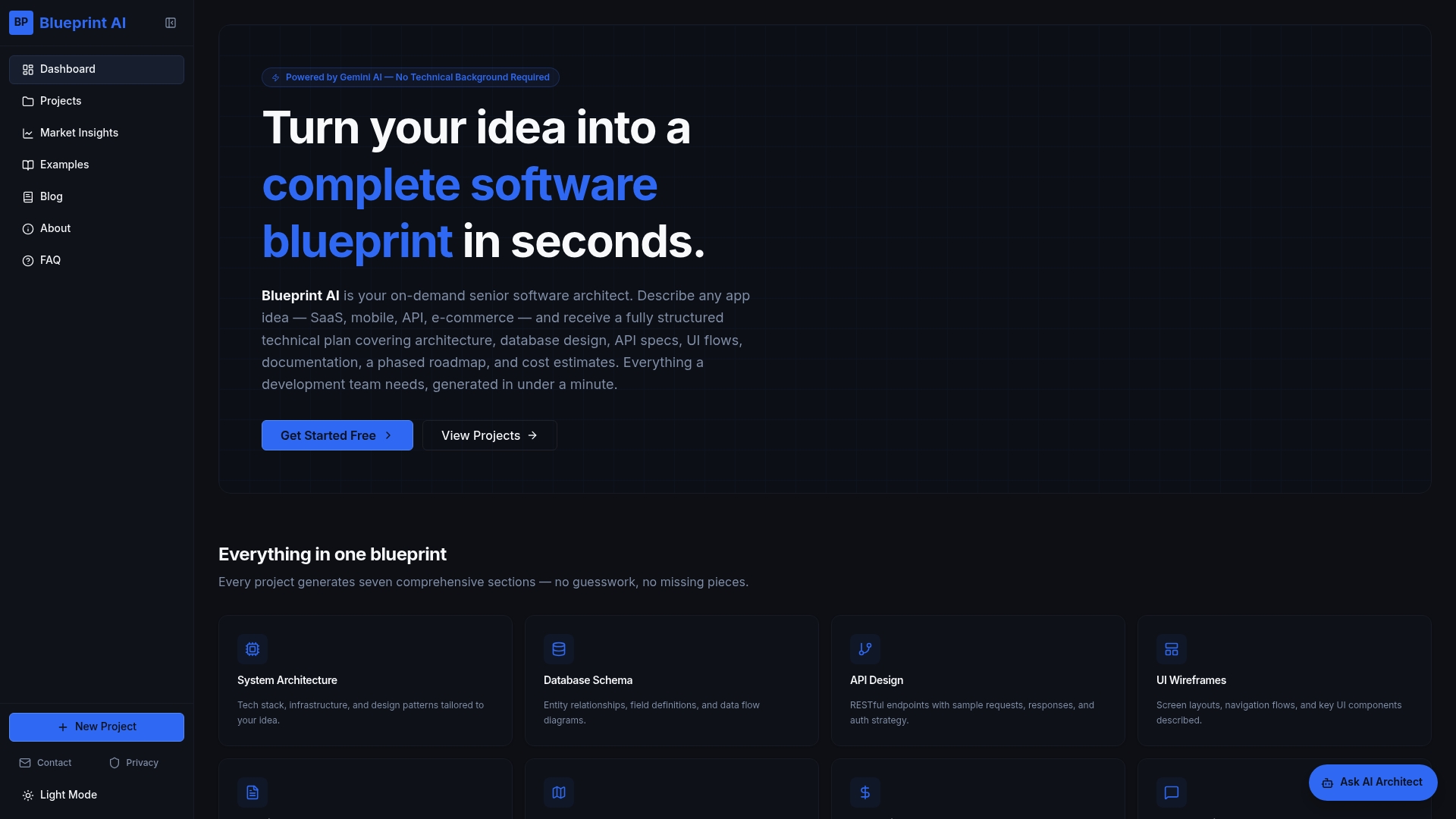
Blueprintbot's free software cost estimator and app development time estimator let you run estimates directly from your blueprint output. The MVP feature prioritiser and tech stack finder help you scope and sequence work before you commit to a budget. When your scope is clear, your estimates get sharper. Blueprintbot gives you that clarity in minutes.
FAQ
What is software cost estimation?
Software cost estimation is the process of calculating the expected effort, time, and budget required to build a software product. It uses methods like bottom-up decomposition, COCOMO II, and PERT to produce defensible budget figures.
Which estimation method is most accurate?
Bottom-up estimation is the most precise, with approximately ±15% variance for fixed-scope projects. It requires detailed requirements, so it works best after a discovery phase has defined the scope clearly.
How much contingency should i add to a software estimate?
Add 10–20% contingency for well-understood projects and up to 50% for projects with high uncertainty or novel technology. Budget contingency by risk category rather than as a single lump sum.
Why do software projects overrun their budgets?
The average IT project overruns its budget by approximately 75%. The leading causes are vague scope, missing non-functional requirements, underestimated integration complexity, and treating the initial estimate as a fixed commitment rather than a living document.
How often should a software estimate be updated?
Estimates should be updated after every sprint or major milestone. Comparing actual costs to estimated costs at each interval is the most reliable way to improve accuracy and catch scope drift before it becomes a budget crisis.