Service-oriented architecture: a practical technical guide

What is service-oriented architecture?
Service-oriented architecture (SOA) structures software as a collection of independent, modular services, each performing a specific business function and communicating over a network using standardised protocols. Rather than building one large, tightly coupled application, SOA breaks functionality into discrete units that can be developed, deployed, and updated separately.
Each service in an SOA system behaves as a self-contained black box. It exposes a well-defined interface, accepts requests, and returns results without revealing its internal logic. Other services or applications interact with it purely through that interface, which is what makes the whole system composable and maintainable over time.
The essential characteristics of SOA:
- Modularity: each service handles one business capability, such as authentication, payment processing, or inventory lookup
- Reusability: a single service can be called by multiple applications across an enterprise
- Abstraction: consumers of a service see only its interface, not its implementation
- Network communication: services exchange messages over standard protocols such as HTTP, SOAP, or REST
- Discovery: a service registry lets applications locate available services dynamically at runtime
The Open Group's SOA Source Book frames it well: service is the essential concept of SOA, and it is not originally a technical idea at all. The business world already understood services long before software architects adopted the term.
What are the real benefits of adopting SOA?
The practical case for SOA comes down to four things that matter to any engineering team: speed, maintainability, scale, and the ability to work with what you already have.
Key benefits include:
- Faster time-to-market: teams reuse existing services rather than rebuilding common functions from scratch, cutting development time on new features
- Independent maintenance: updating a payment service does not require touching the authentication service or the reporting layer; each component evolves on its own schedule
- Targeted scaling: a service under heavy load, say a search function during peak traffic, can be scaled independently without provisioning resources for the entire application
- Interoperability: SOA wraps legacy systems as network-accessible services, preserving existing investments while connecting them to modern applications
- Reduced information silos: The Open Group's SOA Source Book notes that wrapping legacy assets as services lets organisations modernise without discarding what already works
Pro Tip: Define services in business terms first, not technical ones. IBM's guidance on SOA emphasises that the most effective implementations align services with business capabilities, so developers and business analysts share a common vocabulary from day one.
A governance framework matters here too. Without clear rules for service versioning and registry publishing, the benefits of agility erode quickly as the number of services grows.
Core principles that make SOA work
SOA is not just a pattern; it is a set of design commitments. Violate enough of them and you end up with a distributed monolith rather than a genuinely service-oriented system.
The foundational principles are:
- Abstraction: a service hides its internal logic entirely; consumers interact only with its published interface
- Loose coupling: services are aware of each other's existence but not each other's internals, so a change in one does not cascade through the system
- Interoperability: standardised interfaces mean services written in different languages or running on different platforms can communicate without custom adapters
- Granularity: services should be sized around a coherent business capability, neither so fine-grained that they multiply overhead nor so broad that they become mini-monoliths
- Autonomy: each service controls its own functionality at design time and runtime
- Statelessness: services return a result or raise an exception and then release resources, rather than holding session state between calls
- Reusability: logic is divided so that the same service can be called from multiple contexts without modification
Granularity deserves particular attention. Service proliferation, where a system accumulates dozens of tiny, overlapping services, creates management overhead that can outweigh the architectural benefits. Coarse-grained, business-aligned services tend to stay stable longer and integrate more cleanly.
Key components that make up an SOA system
Understanding SOA components means understanding the roles different parts play, not just the services themselves.
- Services: the core units, each a self-contained program performing a repeatable business activity with a formally defined interface
- Service providers: the systems or applications that host and expose services to the network
- Service consumers: applications or other services that call a provider's service to accomplish a task
- Service registry: a directory where providers publish service descriptions and consumers discover available services at runtime; the Universal Description, Discovery and Integration (UDDI) standard was an early formalisation of this concept
- Service contracts: the formal agreements, often expressed in Web Services Description Language (WSDL) for SOAP-based services, that define what a service accepts, what it returns, and how to call it
- Enterprise Service Bus (ESB): an optional but common infrastructure layer that handles message routing, protocol translation, and transformation between services; it is particularly useful when integrating heterogeneous legacy systems
The ESB is worth understanding in context. Traditional SOA often relies on one for enterprise-wide integration, whereas newer microservices architectures deliberately avoid it, pushing communication logic into the services themselves. Neither approach is universally correct; the choice depends on the complexity of the integration problem you are solving.

Where does SOA actually get used?
SOA is not an abstract ideal. It shows up in systems you interact with daily, often without realising it.
Common applications include:
- Universal login: a single authentication service handles sign-in across multiple applications in an enterprise, so every product team reuses the same identity logic rather than building their own
- Payment processing: a payment service exposes one interface that any application, web, mobile, or point-of-sale, can call without knowing anything about the underlying payment gateway
- Legacy system integration: a bank wraps its decades-old mainframe transaction system as a network service, making it callable from a modern mobile app without rewriting the core
- Scalable enterprise platforms: large organisations compose complex workflows, such as order management or HR onboarding, by chaining together discrete services, each owned by a different team
Pro Tip: When evaluating whether something belongs as its own service, ask whether it represents a repeatable business activity with a clear, specifiable outcome. A process that cannot be described independently of the application it lives in is a poor candidate for extraction.
The real-world architecture of enterprise systems almost always reflects SOA thinking at some level, even when teams do not use the term explicitly.
How Blueprintbot supports SOA architecture planning
Designing an SOA system from scratch involves a lot of moving parts: defining service boundaries, specifying APIs, mapping data flows, and producing documentation that a development team can actually build from. That planning phase is where most projects lose time.
Blueprintbot automates that phase. Feed it your app idea and it generates a complete software blueprint covering system architecture, database schemas, API designs, user interface flows, technical documentation, and a development roadmap, all within seconds. For a founder or product manager trying to communicate an SOA-based design to a development team, that output replaces weeks of back-and-forth.
The platform is built for the people who need architecture clarity most: startups validating an idea before committing to a build, freelancers scoping a client project, and product teams aligning on a technical direction before sprint planning begins. An AI chat assistant lets you refine the blueprint interactively, drilling into specific service boundaries or API contracts as needed.
Pro Tip: Use Blueprintbot's generated architecture as a starting point for service boundary discussions with your team. The blueprint surfaces assumptions early, before they become expensive decisions mid-build.
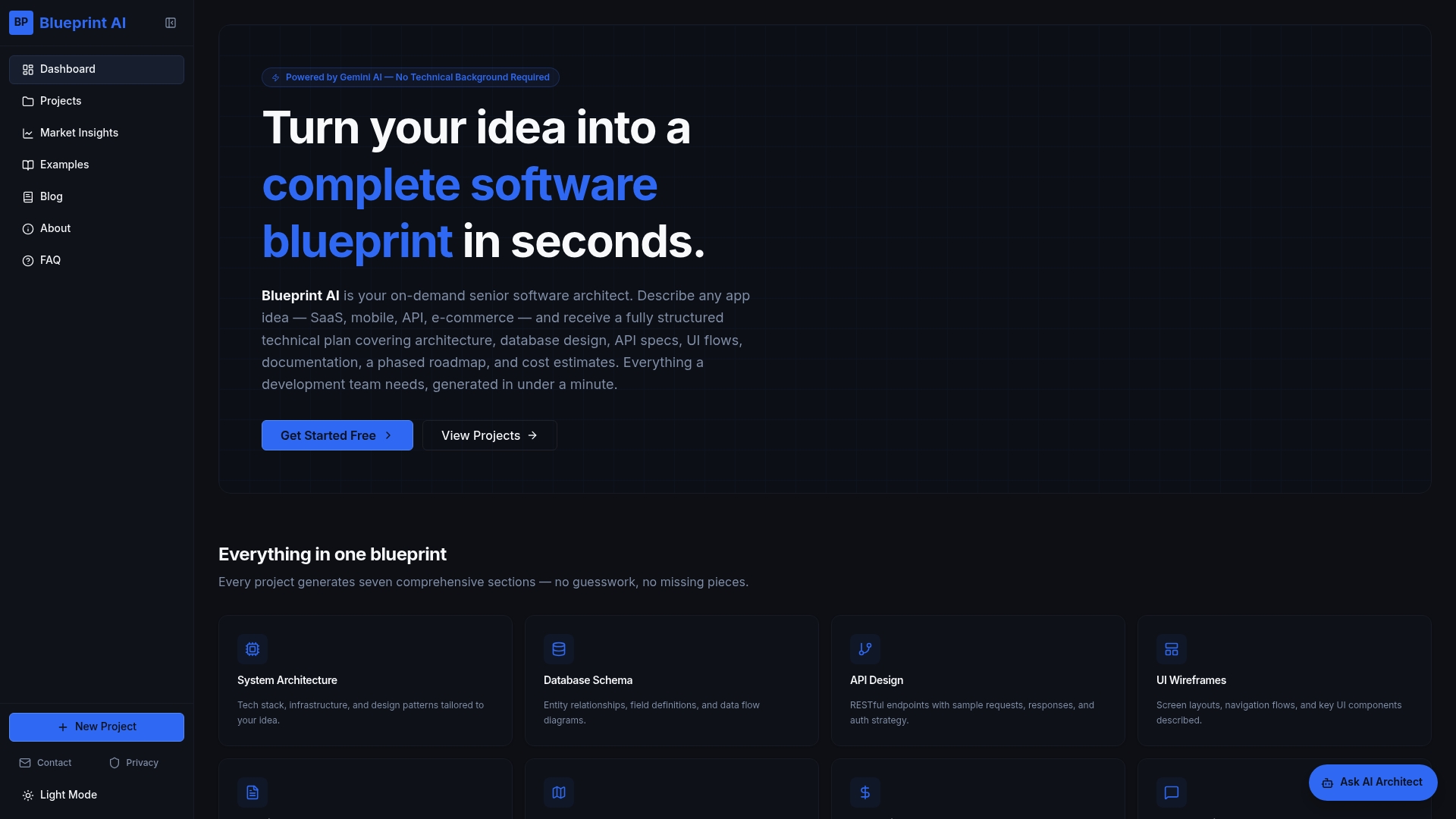
Start with a worked example at Blueprintbot's blueprint library to see how a modular, service-oriented design gets translated into a concrete technical specification.
How SOA layers its architecture
SOA systems are typically organised into four logical layers, each with a distinct responsibility.
Consumer layer: the front-end applications, web portals, mobile apps, or third-party systems that initiate service calls. This layer knows nothing about how services are implemented; it only knows their interfaces.
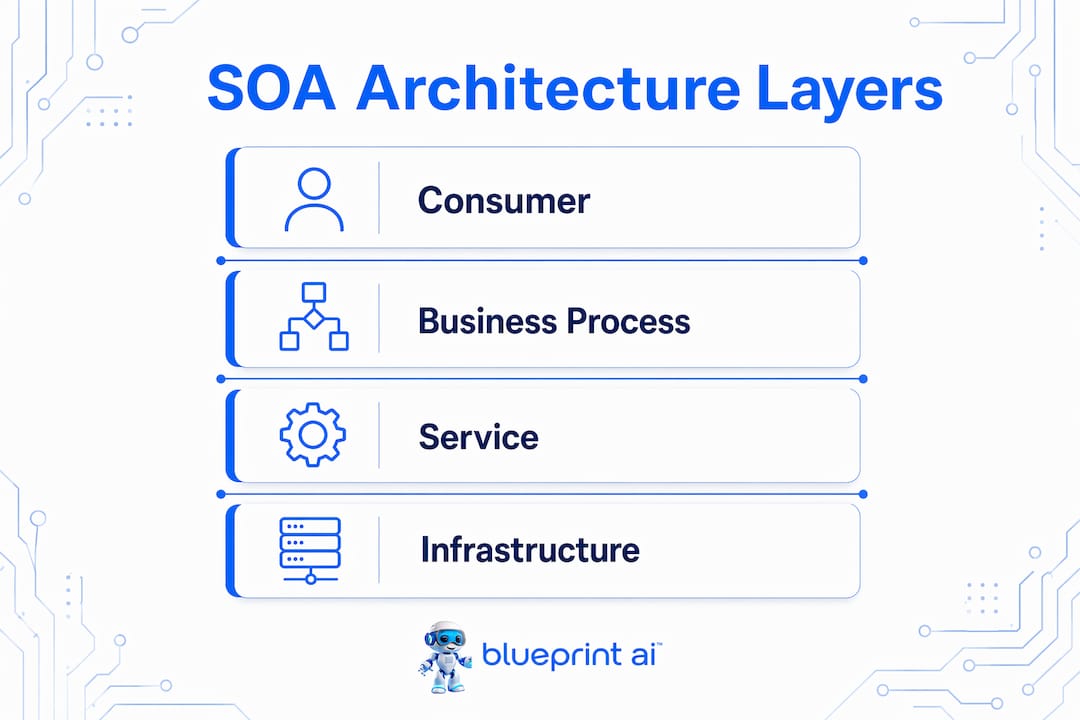
Business process layer: orchestration logic that chains individual services together into end-to-end workflows. A "place order" workflow, for example, might call inventory, payment, and notification services in sequence. Business Process Execution Language (BPEL) was designed specifically for this layer.
Service layer: the individual services themselves, each exposing a defined interface and encapsulating its own data and logic. This is the heart of the architecture.
Infrastructure layer: the underlying messaging, security, and transport mechanisms, including the ESB when one is present, that carry messages between services reliably. This layer also handles concerns like logging, authentication, and rate limiting so individual services do not have to.
The layered model is what gives SOA its software modularity advantages. Changes in the infrastructure layer, swapping a message broker, for instance, do not ripple up into the service or business process layers.
Challenges you will face implementing SOA
SOA solves real problems, but it introduces its own set of difficulties that teams often underestimate.
Governance overhead: as the number of services grows, managing versioning, deprecation, and registry entries becomes a full-time concern. Without a governance framework, teams end up with duplicate services, broken contracts, and no clear owner for shared components.
Performance costs: every service call crosses a network boundary. In a monolithic application, a function call takes microseconds; in SOA, the same operation involves serialisation, network latency, and deserialisation. For latency-sensitive paths, this adds up.
Distributed system complexity: debugging a failure that spans five services is fundamentally harder than debugging a single application. Distributed tracing tools help, but the cognitive load is real.
Organisational alignment: SOA works best when services map to business capabilities, which means teams need to agree on those boundaries before writing code. That conversation is often harder than the technical work.
Testing complexity: integration testing across service boundaries requires test environments that mirror production topology, which is expensive to maintain.
The dedicated IT support that enterprise SOA implementations typically require is not just about keeping servers running. It is about maintaining the governance, monitoring, and coordination that keep a distributed service ecosystem coherent.
Best practices for designing and implementing SOA
The teams that get SOA right share a few habits that are worth adopting from the start.
Design services around business capabilities, not technical functions. A "customer" service that owns all customer data and operations is more stable than separate services for "read customer," "write customer," and "delete customer" that must be coordinated constantly.
Version your service contracts explicitly and maintain backwards compatibility until consumers have migrated. Breaking a contract silently is the fastest way to lose trust in a shared service.
Invest in a service registry early. Discovering services through documentation or word-of-mouth does not scale past a handful of teams. A registry, whether UDDI-based or a modern service mesh directory, makes the architecture self-documenting.
Keep services stateless wherever possible. Stateless services are easier to scale, easier to restart after failure, and simpler to test in isolation.
Define ownership clearly. Every service should have a team responsible for its availability, versioning, and documentation. Shared ownership with no clear accountability produces neglected services.
Use API design standards consistently across all services. Inconsistent interfaces force consumers to write custom adapters, which defeats the interoperability goal.
Tools and technologies commonly used in SOA
The SOA toolchain has evolved considerably, but several categories remain consistent across implementations.
Communication protocols: SOAP (Simple Object Access Protocol) with WSDL contracts was the dominant choice in early enterprise SOA. REST over HTTP has largely replaced it for new services due to its simplicity, though SOAP persists in financial and government systems where formal contracts matter.
Enterprise Service Bus: products like IBM MQ, Apache ServiceMix, and MuleSoft Anypoint Platform handle message routing, transformation, and protocol mediation in traditional SOA deployments.
Service registries: Apache ZooKeeper and Consul are widely used for service discovery in modern environments, while older UDDI registries still appear in legacy enterprise contexts.
Orchestration engines: Apache ODE and Oracle BPEL Process Manager handle workflow orchestration at the business process layer.
Monitoring and observability: tools like Jaeger for distributed tracing and Prometheus for metrics collection are now standard in any production SOA environment, addressing the visibility gap that plagued earlier implementations.
API gateways: Kong, AWS API Gateway, and similar products sit at the consumer layer, handling authentication, rate limiting, and routing before requests reach individual services.
The co-managed IT services model suits SOA environments well, since the operational complexity of managing multiple services, registries, and buses often exceeds what a single internal team can handle alone.
How SOA changes the software development lifecycle
SOA does not just change how software is built; it changes how teams organise around building it.
Parallel development: because services have defined interfaces, teams can develop against a contract before the implementation exists. One team builds the payment service while another builds the checkout flow that calls it, using a mock or stub in the interim.
Independent deployment: a service can be released on its own schedule without coordinating a full application release. This shortens release cycles and reduces the risk of any single deployment.
Clearer ownership: service boundaries map naturally to team boundaries. The team that owns the inventory service owns its availability, its API contract, and its data model. Accountability is unambiguous.
Reuse across projects: once a service exists and is published to the registry, any new project can call it. The software development lifecycle shortens with each reusable service added to the portfolio.
Comparison with microservices: SOA and microservices share the modularity goal but differ in scope. SOA typically integrates diverse systems across an enterprise, often using an ESB for mediation. Microservices break a single application into independently deployable components and avoid the ESB entirely, pushing integration logic into lightweight APIs. SOA is the right frame for enterprise-wide integration; microservices suit teams building a single product that needs to scale its components independently.
Key takeaways
Service-oriented architecture organises software as independent, reusable services communicating over standard protocols, enabling teams to build, scale, and maintain complex systems without the fragility of a monolithic design.
| Point | Details |
|---|---|
| SOA definition | Software structured as independent, reusable services communicating over standardised network protocols. |
| Core principles | Abstraction, loose coupling, interoperability, granularity, statelessness, and autonomy govern effective SOA design. |
| Primary benefits | Faster delivery through service reuse, independent scaling, and interoperability between legacy and modern systems. |
| SOA vs. microservices | SOA integrates enterprise-wide systems, often via an ESB; microservices decompose a single application without one. |
| Governance is critical | Service versioning rules and registry publishing standards prevent complexity from accumulating as services multiply. |