Software development lifecycle: a complete 2026 guide

The software development lifecycle (SDLC) is a standardized seven-phase framework used to manage software creation from concept to retirement. It gives teams a repeatable roadmap for building software that meets business goals, stays within budget, and satisfies stakeholder requirements. Without it, projects drift, costs balloon, and teams lose alignment fast. Understanding what is software development lifecycle is the first step toward shipping software that actually works.
What is the software development lifecycle?
The SDLC is the structured process that takes a software idea from a blank page to a working product and beyond. It covers every stage: planning, building, testing, releasing, and maintaining. Each phase has distinct objectives and deliverables that feed into the next, forming a clear chain of accountability. Teams that skip phases or treat them as optional tend to discover expensive problems late, when fixing them costs far more.
SponsoredCheck out today's featured offer →The SDLC is not a single tool or product. It is a discipline. Think of it as the architectural plan for a building. You would not pour a foundation before you had drawings, and you would not hand over the keys before an inspection. The same logic applies to software. The framework exists precisely because software projects are complex, involve many people, and carry real financial and operational risk.

What are the seven phases of the software development lifecycle?
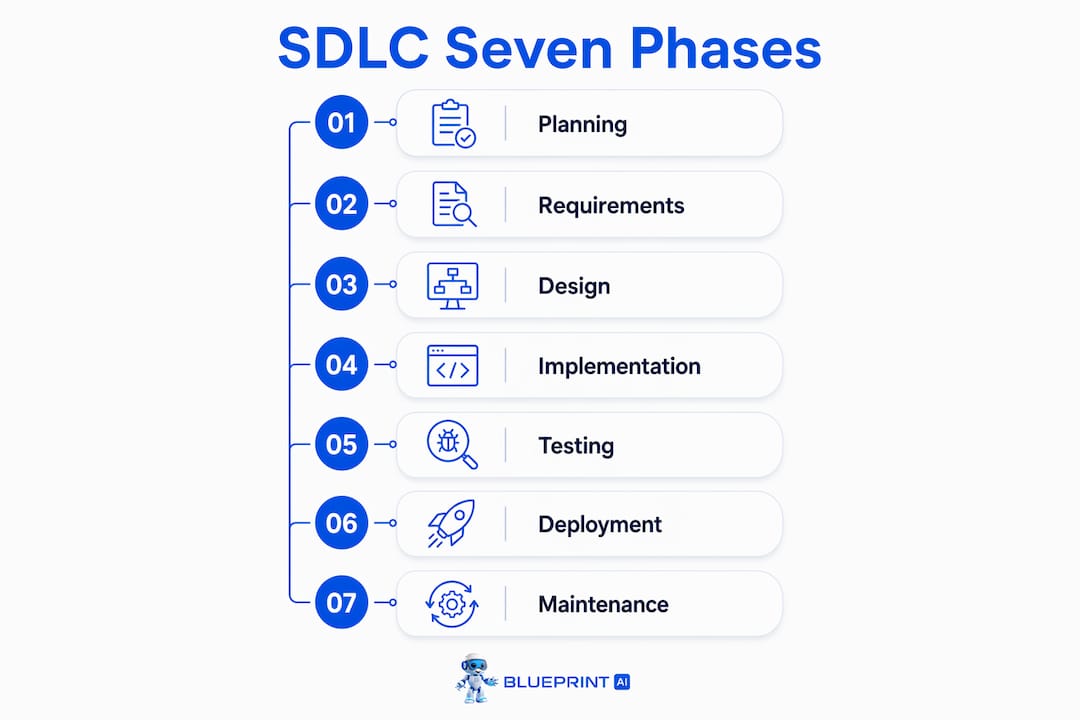
The seven SDLC phases form a complete roadmap from idea to ongoing support. Each phase has a specific purpose and a defined set of outputs.
- Planning: Teams define the project scope, assess feasibility, estimate resources, and identify risks. A solid software development plan at this stage prevents scope creep and budget surprises later.
- Requirements analysis: Developers and analysts gather detailed needs from users and stakeholders. The output is a requirements document that every subsequent phase depends on.
- Design: Architects translate requirements into a system design. This covers software architecture, database schemas, API structures, and user interface flows. Decisions made here shape every line of code written next. Strong software design principles at this stage reduce rework downstream.
- Implementation (coding): Developers write the actual code according to the design specifications. This is the phase most people picture when they think of software development, but it is only one of seven.
- Testing: Quality assurance teams validate functionality, performance, and security. They identify defects before the product reaches users.
- Deployment: The software is released to users through a phased rollout or a full launch. Deployment strategies vary by project size and risk tolerance.
- Maintenance: The team provides ongoing support, patches security vulnerabilities, and adapts the software as user needs evolve.
Pro Tip: Document the outputs of each phase formally, even on small projects. A one-page summary per phase gives future team members context and reduces onboarding time significantly.
The maintenance phase deserves special attention. Maintenance accounts for 50–80% of total software lifecycle costs, covering bug fixes, security patching, and infrastructure scaling. Most teams underestimate this at the planning stage and then struggle to fund it later.
How do Waterfall and Agile differ as SDLC methodologies?
A common misconception is that SDLC and Agile are competing approaches. They are not. SDLC is the "what" of software phases; methodologies like Agile define the "how" those phases are executed. Every software project follows SDLC phases in some form. The methodology determines the order, pace, and structure of the work within those phases.
Waterfall is a sequential, phase-gated model. One phase must be fully complete before the next begins. Over 60% of development teams still use Waterfall, particularly in traditional enterprise settings and regulated industries where contractual rigour and audit trails are required. Waterfall suits projects where requirements are stable and well understood from the start.
Agile compresses the full SDLC into short, repeatable iterations called sprints, typically two to four weeks long. Each sprint delivers a working increment of the software. Agile suits projects where requirements are likely to change, user feedback is needed early, or speed to market is a priority.
| Dimension | Waterfall | Agile |
|---|---|---|
| Structure | Sequential, phase-gated | Iterative, incremental |
| Best fit | Stable requirements, regulated sectors | Evolving requirements, product-focused teams |
| Documentation | Heavy upfront documentation | Lightweight, updated continuously |
| Feedback timing | End of project | Every sprint |
| Risk profile | Higher risk of late-stage surprises | Lower risk through frequent validation |
Experienced teams tailor their methodology to project requirement certainty and complexity. Applying Agile to a fixed-scope government contract creates friction. Applying Waterfall to a consumer app with shifting user needs creates a product nobody wants. The mismatch between project type and methodology is one of the most common causes of software project failure.
Pro Tip: If your requirements are likely to change after month one, default to Agile. If your client has signed off on a fixed specification and penalties apply for scope changes, Waterfall gives you the paper trail you need.
Why does early testing and documentation reduce costs?
Treating SDLC stages as isolated silos is the most expensive mistake a team can make. Integrating testing and security early, during design and coding phases, is essential. This practice is called "shifting left," and it exists because defects found early cost a fraction of what they cost post-deployment.
Early defect detection during requirements or design phases is significantly less expensive than post-deployment discoveries. Late corrections can exceed original budgets by 10x or more. That figure is not a scare tactic. It reflects the real cost of reworking code, retraining users, patching live systems, and managing reputational damage.
Four practices that reduce late-stage costs:
- Write a detailed requirements document before any design work begins. Ambiguous requirements are the root cause of most rework.
- Create a software technical specification during the design phase. This document aligns developers, testers, and stakeholders on exactly what is being built.
- Run automated tests from the first sprint. Do not wait until a dedicated testing phase to find out whether the core logic works.
- Conduct security reviews during coding, not after deployment. Retrofitting security into a live system is costly and often incomplete.
"Good documentation and transparency during requirements and design phases facilitate efficient pivots and reduce costly rework." — GitHub Engineering Insights
Successful SDLC usage demands transparency and documentation so teams can adapt efficiently when requirements shift. The teams that skip documentation to move faster almost always slow down later.
How can teams implement SDLC effectively?
Effective SDLC implementation starts with choosing the right methodology for the project, not the one the team is most comfortable with. Predictive models suit stable projects; adaptive models fit evolving requirements. Getting this decision right at the start prevents a cascade of problems through every subsequent phase.
Effort estimation is a practical skill that separates well-run projects from chaotic ones. Frameworks like COCOMO II help teams estimate project effort during planning, reducing budget overruns and mitigating risk. COCOMO II (Constructive Cost Model II) uses project size, complexity, and team capability to produce effort and schedule estimates. Teams that skip formal estimation tend to discover they are behind schedule only when it is too late to recover.
Practical steps for effective implementation:
- Tailor the methodology to project size, complexity, and regulatory requirements. A two-person startup app does not need the same governance as a hospital records system.
- Plan for maintenance costs explicitly. Budget at least 20% of initial development costs annually for ongoing maintenance, and revisit that figure after the first year of operation.
- Use incremental releases to validate assumptions with real users before committing to the full build.
- Maintain a living requirements document that is updated as the project evolves, not archived after the requirements phase ends.
- Review open source architecture case studies to understand how real teams have structured their systems before committing to a design.
Pro Tip: Before writing a single line of code, generate a full technical blueprint covering architecture, database schema, and API design. Blueprintbot produces this output in seconds from a plain-language app description, giving your team a concrete starting point for every SDLC phase.
The teams that implement SDLC well share one trait: they treat the framework as a communication tool, not just a project management checklist. Every phase output is a document that someone else depends on. That dependency chain is what makes the whole system work.
Key takeaways
The SDLC is a seven-phase framework where methodology choice, early testing, and thorough documentation determine whether a project ships on time, on budget, and to specification.
| Point | Details |
|---|---|
| Seven defined phases | SDLC covers planning through maintenance, with each phase producing outputs the next phase depends on. |
| Methodology choice matters | Match Waterfall to stable requirements and Agile to evolving ones; mismatches cause project failure. |
| Shift testing left | Catching defects during design costs a fraction of fixing them post-deployment. |
| Maintenance dominates costs | Budget 50–80% of lifecycle costs for post-deployment maintenance, not just initial development. |
| Documentation enables adaptation | Detailed requirements and design documents let teams pivot efficiently without costly rework. |
Where rigid SDLC thinking goes wrong
I have seen teams treat the SDLC as a bureaucratic checklist rather than a thinking framework, and the results are predictable. They complete each phase document, tick the box, and move on without asking whether the output actually serves the next phase. The planning document gets filed. The requirements document gets archived. By the time testing begins, nobody can remember why certain decisions were made.
The SDLC works when teams use it to communicate, not just to comply. The design phase is not about producing a diagram for a project manager to approve. It is about creating a shared mental model that every developer, tester, and stakeholder can reference. When that model is clear, decisions in later phases are faster and cheaper.
Agile within an SDLC framework reduces failure risk precisely because it forces teams to revisit that shared model every sprint. You cannot drift for six months and then discover the product is wrong. The feedback loop is too short. That is the real value of Agile, not the speed of individual sprints, but the frequency of reality checks.
My honest advice: do not choose a methodology because your team likes it. Choose it because it fits the project. And whatever methodology you choose, invest in documentation during the first two phases. The teams I have seen recover from late-stage crises almost always had good requirements documents to fall back on. The ones that did not had nothing to anchor the recovery conversation.
— Rishi
Blueprintbot and the SDLC planning phase
The planning and design phases of the SDLC are where most projects win or lose. Getting the architecture, database schema, and API design right before coding begins is the single highest-return investment a team can make.
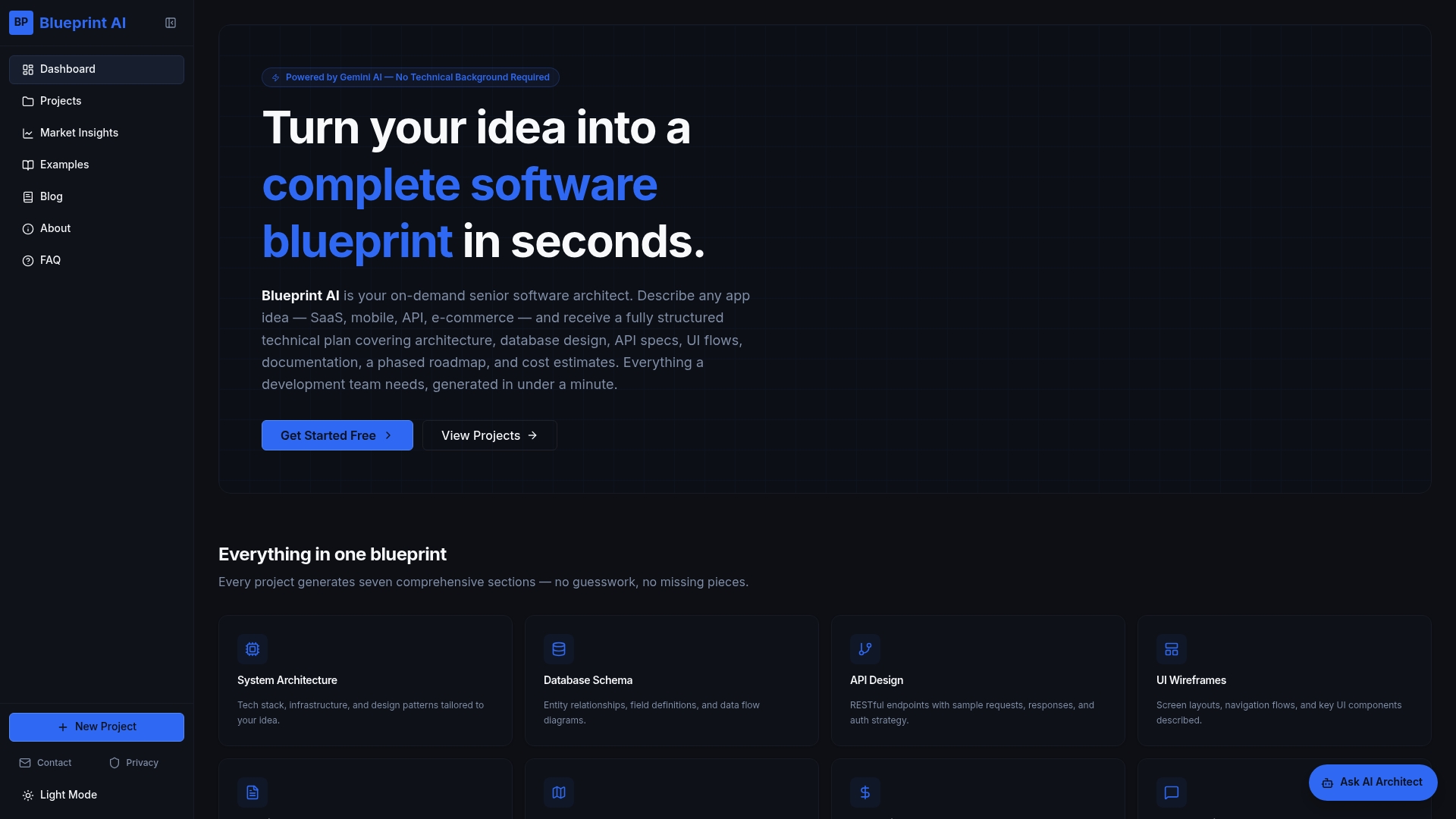
Blueprintbot generates complete software blueprints from a plain-language app description, covering system architecture, database schemas, API designs, user interface flows, and development roadmaps in seconds. Teams can also use Blueprintbot's free planning tools to estimate timelines, prioritise features using the MoSCoW method, and generate technical specifications without needing a senior architect on call. For teams starting a new project, these resources cut the ambiguity out of the first two SDLC phases and give developers a concrete, well-structured foundation to build from.
FAQ
What is the software development lifecycle in simple terms?
The software development lifecycle (SDLC) is a structured seven-phase process that guides teams from the initial idea for a software product through to its ongoing maintenance after release.
How many phases does the SDLC have?
The SDLC has seven phases: planning, requirements analysis, design, implementation, testing, deployment, and maintenance. Each phase produces specific outputs that the next phase depends on.
What is the difference between SDLC and Agile?
SDLC is the framework defining what phases a software project goes through; Agile is a methodology that defines how those phases are executed through short, iterative sprints rather than a sequential flow.
Why does the maintenance phase cost so much?
Maintenance accounts for 50–80% of total software lifecycle costs because it includes ongoing bug fixes, security patches, and infrastructure scaling that continue for the full life of the product.
When should a team use Waterfall instead of Agile?
Teams should use Waterfall when project requirements are stable and fully defined upfront, particularly in regulated industries where sequential documentation and contractual rigour are required.