Why software design principles matter for your project

Software design principles are foundational rules that govern how software systems are structured to achieve efficiency, adaptability, and reduced technical debt. Every team that skips them pays later, in rewrites, broken features, and frustrated developers. Understanding why software design principles matter is not an academic exercise. It is a practical decision that shapes every line of code, every product release, and every conversation between your developers and product managers. Principles like SOLID, Separation of Concerns, and Cognitive Load Theory give teams a shared framework for building software that survives contact with reality.
Why software design principles matter for code quality
Software design principles are the difference between code that ages well and code that collapses under its own weight. Without them, complexity grows unchecked, and teams spend more time untangling problems than building features.
The core purpose of these principles is to keep software understandable. Human working memory is limited to 4–7 chunks of information at once, a limit confirmed by Miller's 1956 research and Sweller's Cognitive Load Theory. That limit means a developer reading a 2,000-line class with mixed responsibilities will make mistakes, miss edge cases, and slow down. Design principles solve this by forcing code into smaller, focused units.
There are two types of complexity in software: essential complexity, which is the inherent difficulty of the problem, and accidental complexity, which is the mess teams create through poor decisions. Design principles directly target accidental complexity. Separation of Concerns, for example, requires each module to handle one distinct responsibility. That single rule eliminates entire categories of tangled, hard-to-debug code.
Pro Tip: When onboarding a new developer, measure how long it takes them to make their first change without breaking something. That time is a direct signal of your codebase's cognitive load.
The importance of software design shows up most clearly when a team tries to add a feature six months after launch. If the original code followed clear principles, the change is contained. If it did not, one small update can cascade into a dozen broken tests and a week of unplanned work.
What happens when you ignore design principles?
Poor design decisions do not stay hidden. They surface as increased cost and schedule risk, rising support tickets, and expensive rewrites before a product even reaches its first anniversary. These are not theoretical risks. They are the predictable outcomes of skipping the fundamentals.
The most visible damage shows up in user-facing behaviour. Inconsistent interface patterns confuse users and drive up support volume. Drop-offs in onboarding funnels often trace back to design decisions made in the first sprint, not the last. By the time a team notices the problem, the cost of fixing it has multiplied.
Common consequences of neglecting software design best practices include:
- Cascading failures: A change in one module breaks unrelated features because components are tightly coupled.
- Slow onboarding: New developers take weeks to become productive because the codebase has no clear structure.
- Feature creep: Without clear boundaries, new features get bolted onto existing modules, increasing fragility.
- Expensive rewrites: Teams eventually reach a point where patching is slower than starting over.
- Rising support costs: Poor interface consistency generates avoidable user confusion and tickets.
Coupling between components increases the blast radius of every change. That means a single bug fix can require touching dozens of files. Design principles reduce coupling, which directly reduces the cost and risk of every future change. For product managers and entrepreneurs, that translates to faster delivery and fewer budget surprises. Understanding how to estimate software development costs becomes far more reliable when your architecture follows clear principles from the start.
Key design principles compared: SOLID, separation of concerns, and more
The benefits of design principles become concrete when you examine what each one actually prevents. The table below summarises the most widely applied principles, what they do, and the pitfall each one guards against.

| Principle | Core benefit | Common pitfall it prevents |
|---|---|---|
| Single Responsibility (SRP) | Each class handles one job | Bloated classes that are impossible to test |
| Open/Closed (OCP) | Add features without modifying existing code | Regression bugs from editing stable code |
| Liskov Substitution (LSP) | Subtypes behave like their parent types | Unexpected failures when swapping implementations |
| Interface Segregation (ISP) | Clients only depend on what they use | Forced dependencies on irrelevant methods |
| Dependency Inversion (DIP) | High-level modules do not depend on low-level details | Rigid systems that resist change |
| Separation of Concerns | Each module owns one domain | Tangled logic that is hard to debug or reuse |
| DRY (Don't Repeat Yourself) | Single source of truth for every piece of logic | Inconsistent behaviour from duplicated code |
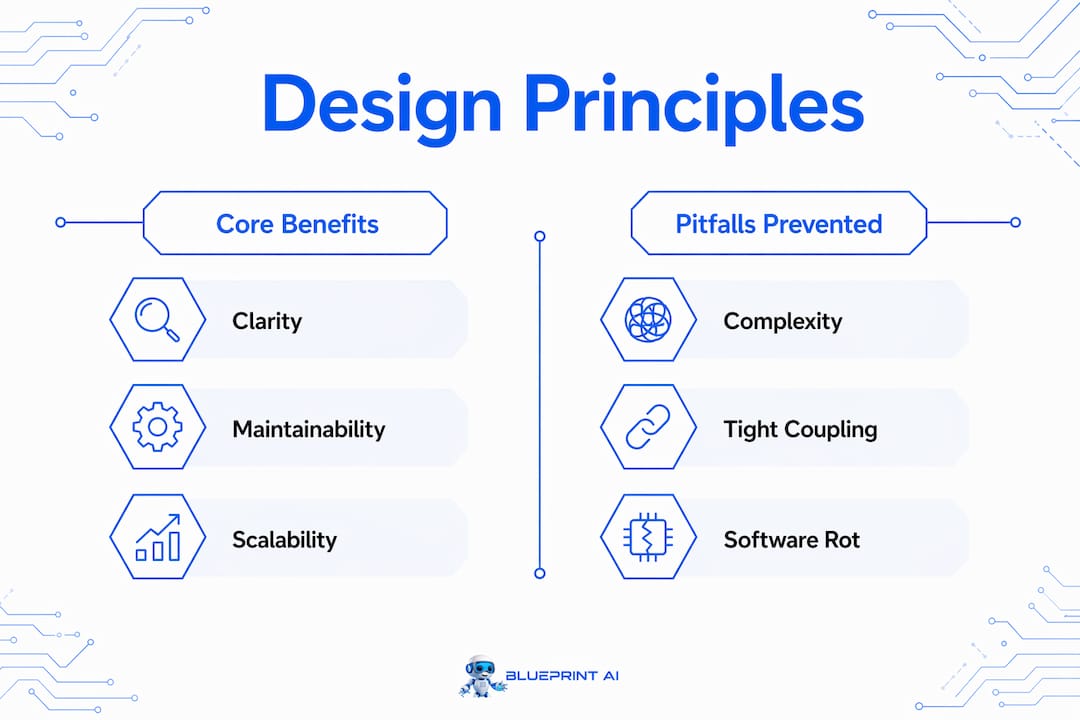
Robert C. Martin's principles focus specifically on making changes safe and cheap. That focus matters because the dominant cost in software is not initial implementation. It is every change made afterward. Principles like Open/Closed and Dependency Inversion exist precisely to protect existing, working code from the side effects of new requirements.
Software rot is what happens when a codebase gradually becomes harder to change. Each shortcut adds a little friction. Over time, that friction compounds until even small changes require heroic effort. Design principles are the primary defence against that decay. Software modularity is one of the clearest expressions of these principles in practice, keeping systems adaptable as they grow.
Pro Tip: Do not apply every principle to every situation. Principles overlap and sometimes contradict each other. Use them as a checklist during code review, not as a rigid rulebook. Context always determines which principle takes priority.
How design principles improve team communication
Design principles are not just technical tools. They are a shared technical vocabulary that lets product managers, developers, and stakeholders discuss code quality without devolving into opinion-based arguments. That shared language is one of the most underrated benefits of design principles.
Without principles, conversations about code quality become subjective. One developer says the code is "fine." Another says it is "messy." Neither has a framework for proving their point. With principles, the conversation shifts. Instead of opinions, teams discuss measurable outcomes: coupling, cohesion, test coverage, and change frequency. Those are engineering facts, not preferences.
Principles also protect teams from scope creep. When a stakeholder requests a feature that would violate the Single Responsibility Principle or create tight coupling, a developer can explain the risk in concrete terms. That explanation is far more persuasive than "it feels wrong." Learning to communicate with your software team effectively becomes much easier when everyone shares the same design vocabulary.
The communication benefits extend across the full project lifecycle:
- Faster code reviews: Reviewers apply consistent criteria instead of personal preferences.
- Clearer requirements: Product managers frame requests around system boundaries, reducing ambiguity.
- Reduced conflict: Objective principles replace taste-based debates about implementation choices.
- Better risk assessment: Teams can quantify the impact of a change before committing to it.
Establishing a quality floor through principles lets teams focus their creativity on meaningful problems. Without that floor, every meeting risks sliding into debates about fundamentals that should have been settled at the start of the project. For entrepreneurs working with external development teams, this shared vocabulary is the difference between a project that delivers and one that drifts.
Key takeaways
Software design principles are the primary mechanism for controlling complexity, reducing change costs, and aligning teams around measurable quality standards throughout the full software lifecycle.
| Point | Details |
|---|---|
| Cognitive load is real | Human working memory handles 4–7 chunks; principles keep code within that limit. |
| Poor design costs money | Neglecting principles leads to rewrites, support tickets, and missed deadlines. |
| SOLID prevents software rot | Principles like Open/Closed and Dependency Inversion make future changes safe and cheap. |
| Principles create shared language | Teams shift from opinion-based debates to measurable engineering discussions. |
| Design is ongoing | Principles apply throughout testing and maintenance, not just at project kickoff. |
Design principles as a living decision framework
Most teams treat design principles as something you apply at the start of a project and then forget. That is the wrong model entirely. Design is a dynamic decision-making process that continues through testing, maintenance, and every feature release. The teams that get the most value from principles are the ones that use them as an ongoing filter, not a one-time checklist.
What I have found, working across projects of very different sizes, is that principles matter most at the moments of pressure. When a deadline is close and a shortcut is tempting, the question "does this violate Separation of Concerns?" is the fastest way to assess the real cost of that shortcut. Most of the time, the shortcut costs far more than it saves.
Principles also serve as a filter against harmful feature requests. When a stakeholder pushes for a feature that would require tight coupling across three modules, you do not need to argue about product vision. You can point to the principle, explain the blast radius, and let the data make the case. That is a much more productive conversation.
The other thing I would push back on is the idea that principles should be applied rigidly. Design principles overlap and contradict each other, and applying them well requires judgment, not compliance. A junior developer who follows DRY to the point of creating absurd abstractions is not applying the principle well. The goal is always the outcome: code that is easy to change, easy to understand, and easy to hand off. Principles are the map. Judgment is the navigation.
— Rishi
Start your next project with design built in from day one
Applying design principles from the first line of planning is far easier than retrofitting them after a codebase has grown. Blueprintbot generates complete software blueprints that embed architecture decisions, API designs, database schemas, and system boundaries directly into your project plan. Those blueprints reflect the kind of structural thinking that design principles demand, giving your team a clear foundation before a single line of code is written.

Blueprintbot is built for founders, product managers, and development teams who want to move from idea to structured plan without ambiguity. The platform produces technical specifications in seconds, covering system architecture, user interface flows, and development roadmaps. Explore the free planning tools to see how structured planning translates directly into better software outcomes.
FAQ
What are software design principles?
Software design principles are established rules that guide how software systems are structured to remain maintainable, testable, and adaptable over time. Examples include the SOLID principles, Separation of Concerns, and DRY (Don't Repeat Yourself).
Why do design patterns matter for long-term projects?
Design patterns provide reusable solutions to common structural problems, reducing the risk of software rot and making future changes cheaper and safer. Robert C. Martin's work shows that the dominant cost in software is change, not initial creation.
How do design principles help product managers?
Design principles give product managers a shared vocabulary with developers, shifting conversations from subjective opinions to measurable engineering outcomes like coupling, cohesion, and change risk.
What is the impact of ignoring software architecture principles?
Ignoring architecture principles leads to tightly coupled systems where a single change can break unrelated features, driving up costs, delaying releases, and often forcing expensive rewrites before a product matures.
When should design principles be applied in a project?
Design principles apply throughout the full software lifecycle, from initial planning through testing and ongoing maintenance. Treating them as a one-time upfront exercise misses most of their value.