What is the layered architecture pattern?

The layered architecture pattern is defined as a software design approach that organises an application into horizontal layers, each with a distinct responsibility and strict downward dependencies. Also called the N-tier architecture pattern in enterprise contexts, it is the de facto standard for many enterprise applications due to its simplicity, familiarity, and ease of hiring. The four standard layers are presentation, business, persistence, and database. Each layer communicates only with the layer directly beneath it, creating a clean separation of concerns that makes testing, maintenance, and onboarding far more predictable. If you are designing your first production system or evaluating whether your current architecture holds up, understanding this pattern is the right place to start.
What is the layered architecture pattern and its standard layers?
The four standard layers in layered architecture each carry a specific responsibility, and keeping those responsibilities separate is the entire point of the pattern.
- Presentation layer: Handles all user interaction, UI rendering, and input processing. This is the only layer that the end user ever touches directly.
- Business layer: Contains core domain rules, validations, and workflows. No database calls live here. Logic that defines how your application behaves belongs in this layer.
- Persistence layer: Manages data access. It translates between business objects and the storage format, acting as a bridge between domain logic and the database.
- Database layer: The actual data store, whether relational (PostgreSQL, MySQL) or non-relational (MongoDB). This layer holds no application logic.
Smaller applications sometimes merge the business and persistence layers into a single layer to reduce overhead. Larger, more complex systems often add additional layers, such as a dedicated service layer or an API gateway layer, to handle cross-cutting concerns. The pattern is flexible enough to accommodate both ends of the spectrum.
The table below summarises each layer's primary responsibility and a typical technology example:
| Layer | Primary responsibility | Typical technology |
|---|---|---|
| Presentation | UI rendering and user input | React, Angular, server-side templates |
| Business | Domain rules and workflows | Java Spring services, C# domain classes |
| Persistence | Data access and object mapping | Hibernate, Entity Framework, repositories |
| Database | Data storage and retrieval | PostgreSQL, MySQL, MongoDB |
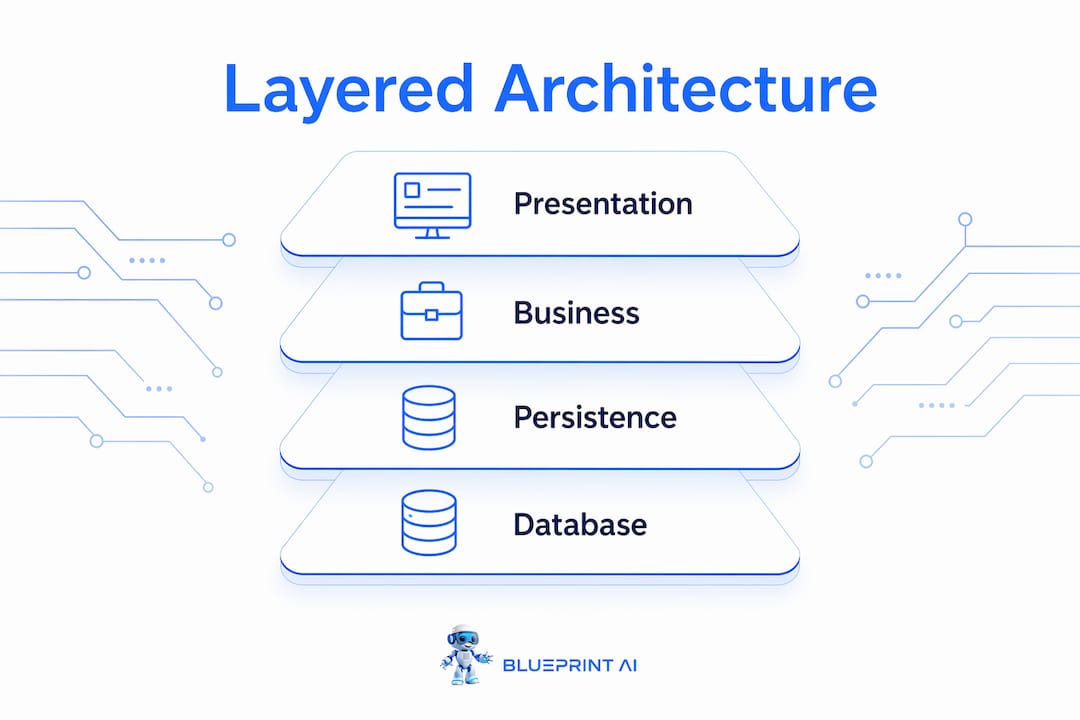
Understanding this structure is the foundation for everything else. Once you know what each layer does, the dependency rules that govern them make immediate sense.

How does the dependency rule govern layered architecture design?
The dependency rule is the single most important constraint in layered architecture. A layer must depend only on the layer directly beneath it, creating a strict one-way dependency chain. That constraint is what makes the pattern testable and maintainable.
In a closed layering model, every request travels through each layer in sequence. The presentation layer calls the business layer. The business layer calls the persistence layer. The persistence layer calls the database layer. No layer skips another, and no layer calls upward. This predictability is what makes the codebase easy to reason about.
An open (relaxed) layering model allows a layer to bypass the one directly beneath it and call a lower layer directly. This is sometimes used for shared utility layers, such as a common logging or security module. Open layers add flexibility but reduce the isolation that makes testing straightforward. Use them deliberately, not by default.
Allowed and disallowed dependencies look like this in practice:
- Allowed: Presentation calls Business. Business calls Persistence. Persistence calls Database.
- Disallowed: Presentation calls Database directly. Business calls Database directly. Any layer calls upward.
Violating these rules creates tight coupling. A change in the database schema then ripples through the business layer and into the presentation layer, turning a small fix into a large refactoring effort.
Pro Tip: When you find yourself tempted to let the presentation layer call the database directly "just this once," treat it as a signal that your business layer is missing a method. Add the method there instead.
The dependency rule also governs how you evolve the architecture over time. A system with clean layer boundaries can be refactored one layer at a time. A system where layers bleed into each other requires a full rewrite to change anything fundamental.
What are the benefits and common challenges of layered architecture?
Layered architecture earns its widespread adoption through concrete, practical advantages. Testability is a primary benefit: isolating business logic from infrastructure and database code enables comprehensive unit testing and raises overall system reliability. That isolation means you can test your domain rules without spinning up a database, which speeds up your test suite significantly.
The pattern also delivers:
- Simplicity: The structure is immediately recognisable to most developers, reducing the learning curve on any new project.
- Maintainability: Changes to one layer do not cascade unpredictably into others when dependency rules are respected.
- Onboarding efficiency: New team members can navigate the codebase without a lengthy orientation because the structure follows a known convention.
- Hiring ease: Simplicity and familiarity drive widespread adoption, which means the talent pool familiar with the pattern is large.
The challenges are real, though, and ignoring them is how teams end up with a mess.
The Architecture Sinkhole anti-pattern is the most common failure mode in layered systems. It occurs when layers simply pass requests through to the layer below without adding any meaningful processing. The result is added overhead and complexity with no corresponding value. Every layer must justify its existence by doing real work.
Layered architecture can also trend toward monolithic deployments if teams are not deliberate about module boundaries. Well-factored layered architecture with clean interfaces can scale and be split into modular deployables, but that outcome requires discipline. It does not happen automatically. Tight coupling between layers, caused by skipping the dependency rule, is the most common reason a layered system becomes hard to change.
How to implement layered architecture and avoid anti-patterns
Correct implementation starts before you write a single line of code. Starting without a plan leads to Accidental Architecture, a situation where tightly coupled, hard-to-maintain code grows organically without any guiding structure. The fix is upfront discipline.
Follow these steps to implement the pattern correctly:
- Define layer interfaces first. Write the contracts between layers before writing implementations. This forces you to think about what each layer needs from the one below it.
- Apply dependency inversion. Higher layers should depend on abstractions, not concrete implementations. This makes swapping out a database or a third-party service a one-layer change.
- Distinguish layers from tiers. Layers are logical code separations; tiers are physical deployment boundaries. Multiple layers can and often do live within a single deployment tier. Confusing the two leads to over-engineering your infrastructure.
- Use vertical slicing by domain. Within each layer, organise code by domain feature rather than by technical type. A "users" folder inside the business layer is more maintainable than a flat list of 200 service classes.
- Write tests at each layer boundary. Unit tests cover the business layer in isolation. Integration tests cover the persistence layer against a real or in-memory database. End-to-end tests cover the presentation layer. This three-level testing strategy is a direct product of clean layer separation.
Pro Tip: Before adopting a more complex architecture pattern, build a layered version first. The discipline of defining clean interfaces at each layer is the same discipline you will need for microservices, event-driven systems, or hexagonal architecture. Layered architecture is the best training ground for architectural thinking.
Reviewing backend architecture examples from real-world systems shows how the pattern adapts across different domains, from e-commerce platforms to financial services APIs.
How does layered architecture affect onboarding and maintainability?
A predictable codebase structure directly reduces the cost of bringing new developers up to speed. Onboarding a new developer typically takes six weeks and costs over $75,000 in lost productivity. A well-structured layered architecture shortens that timeline because the developer already knows where to look for any given piece of logic.
That figure is significant. It means that a team of ten that hires two developers per year is spending over $150,000 annually on onboarding alone. A codebase that follows a recognisable pattern cuts that cost by reducing the time a new developer spends asking "where does this go?" or "why is this here?"
Maintainability compounds over time. A layered system that respects its dependency rules stays navigable as it grows. A system without clear layer boundaries becomes progressively harder to change, because every modification requires understanding a wider and wider web of dependencies. Good documentation practices for developers compound this benefit further, giving teams a shared reference that keeps the architecture's intent visible.
Layered architecture also supports team scaling. When multiple developers work on the same codebase, clear layer boundaries reduce merge conflicts and make code reviews faster. A reviewer who understands the pattern can spot a violation immediately, without needing deep familiarity with the specific feature being changed. That pattern recognition is a genuine productivity multiplier on larger teams.
For a broader view of how architecture choices affect developer efficiency, the types of software architecture patterns guide covers how layered design compares to event-driven, microservices, and other approaches in practice.
Key takeaways
Layered architecture is the most practical starting point for most software projects because its strict dependency rules produce testable, maintainable, and navigable codebases that reduce both onboarding costs and long-term technical debt.
| Point | Details |
|---|---|
| Four standard layers | Presentation, business, persistence, and database each hold a distinct responsibility. |
| Strict downward dependencies | Each layer depends only on the layer directly beneath it, preventing tight coupling. |
| Testability advantage | Isolating business logic from infrastructure enables unit testing without a live database. |
| Onboarding cost reduction | A predictable structure shortens the six-week onboarding curve and reduces the $75,000 productivity cost. |
| Anti-patterns to avoid | Architecture Sinkhole and Accidental Architecture both result from skipping upfront interface planning. |
Layered architecture: a pattern worth defending
I have seen teams abandon layered architecture prematurely, convinced that microservices or event-driven systems would solve problems that were actually caused by poor discipline within their existing layers. The pattern itself was not the problem. The missing interface contracts and the skipped dependency rules were.
Layered architecture is not glamorous, and that is precisely its strength. It is a pattern that a developer joining your team on day one can understand and contribute to without a week of orientation. That predictability has real monetary value, as the onboarding cost data makes clear.
My honest advice: use layered architecture as your default until you have a specific, measurable reason to move to something more complex. When you do move, the discipline you built defining clean layer interfaces will transfer directly. Microservices are just layered architecture with network boundaries instead of method calls. Get the fundamentals right first.
When a layered system does start to show strain, the answer is usually vertical slicing by domain, not a full architectural replacement. Reorganise within the pattern before you abandon it. Most systems that "outgrew" layered architecture were actually suffering from poor implementation, not from a fundamental limitation of the pattern itself.
— Rishi
How Blueprintbot helps you plan layered architecture from day one
Defining clean layer boundaries before writing code is the single highest-leverage decision in any software project. Blueprintbot generates complete software blueprints that include system architecture diagrams, API designs, database schemas, and development roadmaps, all structured around proven patterns like layered architecture.

If you are starting a new project or evaluating your current system design, Blueprintbot produces a detailed technical specification in seconds. That specification gives your team a shared reference point before a single line of code is written, which is exactly the upfront discipline that prevents Accidental Architecture. You can also explore the free planning tools to map out your layer structure and feature priorities before committing to an implementation path.
FAQ
What is the layered architecture pattern in simple terms?
The layered architecture pattern organises software into horizontal layers, each with a specific responsibility, where each layer depends only on the layer directly beneath it. The four standard layers are presentation, business, persistence, and database.
Is layered architecture the same as N-tier architecture?
Layered architecture and N-tier architecture describe the same structural concept. "N-tier" typically refers to the physical deployment of those layers across separate servers or processes, while "layered" refers to the logical code organisation.
What is the Architecture Sinkhole anti-pattern?
The Architecture Sinkhole anti-pattern occurs when layers pass requests through to the layer below without adding any meaningful processing, creating overhead and complexity with no value. Every layer in a well-designed system must perform real work on the data or request passing through it.
How does layered architecture differ from microservices?
Layered architecture organises code into logical layers within a single deployable unit, while microservices split functionality into independently deployable services. A well-factored layered system can be incrementally decomposed into microservices when scale demands it.
When should you consider moving away from layered architecture?
Consider moving away from layered architecture when independent deployment of specific features becomes a hard business requirement, or when team size makes a single codebase a coordination bottleneck. Most systems benefit from starting with layered architecture and evolving from there.