Design your first web application architecture

Web application architecture is the structural blueprint that defines how a system's components, including the frontend, backend, database, and APIs, connect and communicate to deliver a working product. Getting this structure right before you write a single line of code is the single most important decision you will make. Ten hours of upfront planning can prevent more than 100 hours of refactoring later. For aspiring developers, entrepreneurs, and product managers, learning to design your first web application architecture is the difference between a product that scales and one that collapses under its own weight.
What does web application architecture actually include?
Web application architecture is the set of decisions that govern how your system's layers are organised and how they talk to each other. Most first-time builders underestimate how many distinct layers exist before a user ever sees a screen.
SponsoredCheck out today's featured offer →The core layers are:
- Frontend (client layer): The interface the user interacts with, built with HTML, CSS, and JavaScript frameworks like React or Vue.
- Backend (server layer): The engine that processes requests, enforces rules, and returns data. This is where all business logic lives.
- Database layer: The persistent store for your application's data, whether relational (PostgreSQL, MySQL) or non-relational (MongoDB).
- API layer: The contract between frontend and backend, defining how data is requested and returned.
- Infrastructure layer: The servers, cloud services, and deployment pipelines that keep everything running.
Authentication and user roles sit across all of these layers. A user logging in touches the frontend form, the backend validation, the database record, and the API token system simultaneously. Understanding this interaction is what separates a well-designed system from a fragile one.
Monolith vs. microservices: what to choose first
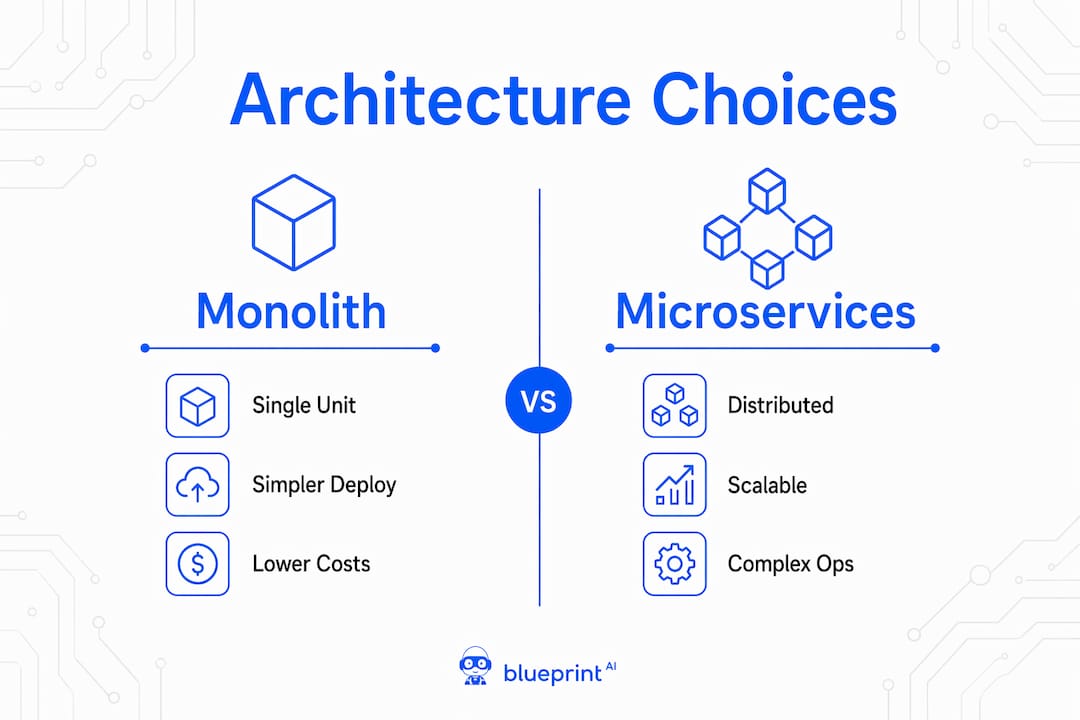
Almost all new applications should start as a monolith rather than a microservices architecture. Microservices add deployment complexity, inter-service communication overhead, and distributed tracing requirements that a small team simply does not need on day one. A monolith lets you move fast, iterate quickly, and keep infrastructure costs low.
The smarter path is a modular monolith: a single deployable unit where code is organised into clearly separated modules. When one module, such as an AI processing worker or a payment service, proves it needs independent scaling, you extract it then. Architecture decisions made early differ significantly from those made after a year of real traffic, so building with clean module boundaries from the start gives you that flexibility without premature complexity.
Why is data modelling the most critical early step?
The data model is the hardest part of your application to change after launch. Prioritising entities and relationships early is not optional. Errors in your data model cause costly fixes that ripple through every layer of the system.
Before choosing a framework or writing any backend code, map out your core entities. For a typical web app, these include:
- Users: Attributes like email, password hash, role, and created date.
- Resources: The primary objects your app manages, such as orders, posts, or projects.
- Relationships: How entities connect, for example, one user has many orders, one order has many line items.
- State transitions: How a record moves through statuses, such as an order going from pending to fulfilled to refunded.
Skipping this step is the most common mistake first-time builders make. They start with the UI, build screens that look good, and then discover the database cannot support the queries those screens need. The result is a complete backend rewrite weeks into development.
Pro Tip: Draw your entity relationship diagram (ERD) before writing any code. Free tools like dbdiagram.io let you map tables, columns, and foreign keys visually in minutes. A solid ERD is your single source of truth for database schema design throughout the project.
Data model design supersedes technology choices in importance for long-term application health. The framework you choose matters far less than whether your tables and relationships accurately reflect how your business actually works.
How should you design backend logic and API communication?
Business logic must reside exclusively in the backend to maintain security and prevent what architects call "logic leakage." Logic leakage happens when validation rules, permission checks, or calculation logic end up in the frontend. The frontend becomes unreliable, and any user who inspects network traffic can bypass your rules entirely.

The backend's job is to receive a request, validate it, apply business rules, interact with the database, and return a structured response. The frontend's job is to display data and collect user input. Keep these responsibilities strictly separated.
For API design, follow these steps:
- Choose your API style. REST is the right default for a first application. It is well-documented, widely understood, and supported by every major framework. GraphQL suits complex data-fetching needs but adds query parsing overhead and schema management that beginners do not need yet.
- Version your API from day one. Use a prefix like
/api/v1/in every route. This protects existing clients when you make breaking changes later. - Design around resources, not actions. A REST endpoint like
GET /api/v1/ordersis correct. An endpoint likeGET /api/v1/getOrderListis not. - Return consistent error shapes. Every error response should include a status code, an error code string, and a human-readable message. Inconsistent errors make frontend error handling a nightmare.
- Handle authentication at the API gateway level. Use JSON Web Tokens (JWT) or session tokens validated on every protected route, not just at login.
Pro Tip: For API design best practices, treat your API as a product that other developers, including your future self, will consume. Write it as if a third party will integrate with it tomorrow.
ORMs speed early development but often degrade performance at scale. Once your application handles real traffic, replace ORM queries on critical read and write paths with raw SQL to recover throughput. Plan for this from the start by keeping your database access layer in one place, not scattered across your codebase.
How do you plan your web app architecture before coding?
Architectural planning is not a single meeting. It is a sequence of decisions documented before development starts. The most effective planning process covers five areas:
| Planning activity | Output |
|---|---|
| Requirements mapping | A list of user stories and system constraints |
| Entity relationship diagram | A visual map of all data entities and their relationships |
| Component diagram | A drawing showing how frontend, backend, database, and third-party services connect |
| API contract | A list of endpoints, request shapes, and response shapes |
| Infrastructure plan | A decision on hosting, CI/CD pipeline, and environment strategy |
This documentation does not need to be formal. A whiteboard photo or a shared Figma file works. The goal is that every person on the team, or every developer you hire later, can read these documents and understand the system without asking you.
Common architectural mistakes to avoid:
- Skipping environment separation. You need at least a development environment and a production environment from day one. Deploying untested code directly to production is how data gets corrupted.
- Ignoring failure modes. Thinking in systems means anticipating failures in distributed components and designing for graceful degradation. Ask yourself: what happens if the database goes down? What happens if a third-party API times out?
- Over-engineering the first version. A caching layer, a message queue, and a CDN are all valid tools. They are not valid tools for version one of an unproven product.
Pro Tip: Use Blueprintbot to generate a complete software blueprint from your app idea before writing a line of code. It produces system architecture diagrams, database schemas, API designs, and development roadmaps in seconds, giving you a structured starting point for planning app architecture without needing deep technical expertise.
No perfect architecture exists. Every design involves trade-offs between consistency, availability, and speed. The right architecture for a two-person startup is not the right architecture for a 50-engineer team. Make decisions based on your current team size and user load, and document the trade-offs you accepted so you can revisit them later.
Key takeaways
Designing a solid web application architecture requires clear data modelling, strict backend logic separation, and a modular monolith structure that you can scale incrementally as real usage demands grow.
| Point | Details |
|---|---|
| Start with a modular monolith | A single deployable unit with clean module boundaries is faster and cheaper than microservices for first apps. |
| Prioritise your data model | Map entities, relationships, and state transitions before choosing any framework or writing backend code. |
| Keep business logic in the backend | Frontend should display data only; all validation and rules belong in the backend to prevent security gaps. |
| Plan before you code | Produce an ERD, component diagram, and API contract before development starts to prevent costly rewrites. |
| Accept trade-offs deliberately | Document every architectural compromise so your team can revisit decisions as scale and requirements change. |
What I've learned from watching first-time architects make the same mistakes
The most consistent pattern I see is builders who treat architecture as something to figure out later. They ship a prototype, get early users, and then spend the next six months rewriting the parts they skipped. The rewrite is always more painful than the planning would have been.
The second pattern is premature sophistication. A founder reads about microservices, event-driven architecture, and CQRS, and decides their todo-list app needs all three. Managing trade-offs between consistency, availability, and speed is genuinely hard. Adding complexity before you have real traffic data to justify it makes those trade-offs invisible until they hurt you.
My honest advice: start with a modular monolith, get your data model right, and keep your backend logic strictly separated from your frontend. Those three decisions will carry you further than any framework choice or infrastructure trend. When a specific module proves it needs to scale independently, extract it then, with real metrics to guide the decision. Splitting modules only when proven resource demands exist is not laziness. It is discipline.
Architecture flexibility comes from clean boundaries, not from complexity. If your modules are well-separated and your API contracts are documented, you can swap out a database engine, migrate a service, or onboard a new developer without a crisis. Build for that flexibility from day one, and the system will reward you.
— Rishi
Blueprintbot turns your app idea into a structured architecture plan
Translating an app idea into a technical architecture is where most non-technical founders and first-time developers get stuck. Blueprintbot removes that barrier by generating a complete software blueprint from a plain-language description of your idea.
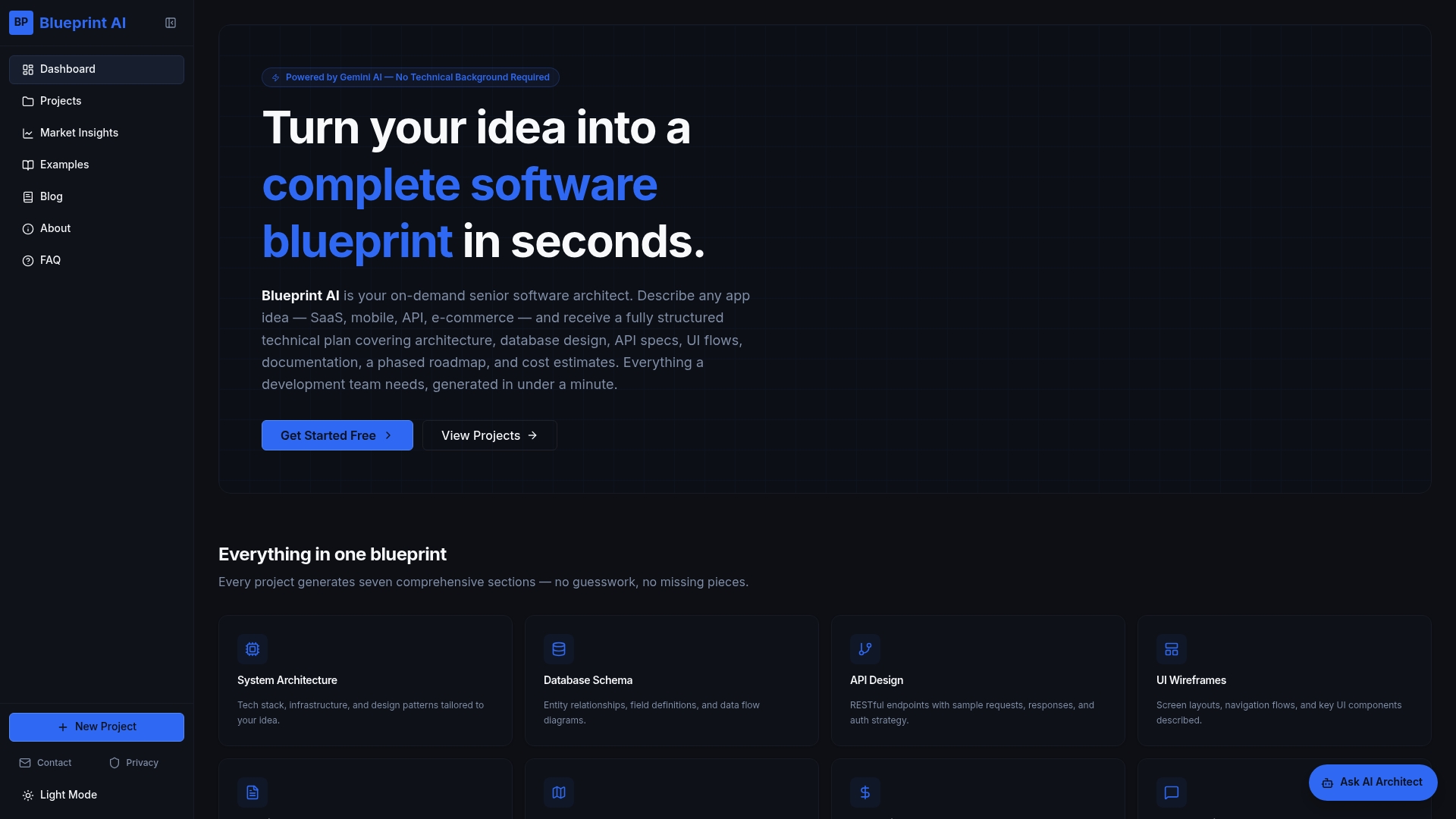
The platform produces system architecture diagrams, database schemas, API designs, user interface flows, and development roadmaps in seconds. You get a structured, documented starting point that you can hand directly to a development team or use to guide your own build. Explore worked architecture examples to see what a complete blueprint looks like, or use the free planning tools to start mapping your own app's structure today.
FAQ
What is web application architecture?
Web application architecture is the structural design that defines how a system's frontend, backend, database, and API layers connect and communicate. It determines how the application handles requests, stores data, and scales under load.
Should my first web app use microservices or a monolith?
Start with a monolith. Almost all new applications benefit from a monolith because it reduces infrastructure costs and speeds up early development. Extract services only when specific modules show proven scaling needs.
Why does the data model matter so much?
The data model is the hardest part of an application to change after launch. Errors in your entity relationships and state transitions create bugs and rewrites that affect every layer of the system.
What is the difference between REST and GraphQL?
REST organises API communication around resources and HTTP methods, making it simpler to learn and debug. GraphQL allows clients to request exactly the data they need, which suits complex frontends but adds schema management overhead that most first apps do not need.
How much time should I spend on architecture planning before coding?
Spend enough time to produce an entity relationship diagram, a component diagram, and an API contract before writing code. Ten hours of planning prevents more than 100 hours of refactoring later.