Define system architecture early stage: a founder's guide

System architecture is defined as the structural blueprint of your software, specifying how data flows, how services communicate, and how your application handles users at scale. When you define system architecture at the early stage, you are making deliberate decisions about data models, service boundaries, and authentication before a single line of production code is written. These choices compound quickly. A data model change can take five months to reverse, and a poorly chosen tenancy model can stall your entire product roadmap. Tools like PostgreSQL, Row-Level Security (RLS), and Infrastructure as Code (IaC) frameworks are not advanced concepts reserved for later. They are foundational choices that belong in your earliest planning conversations.
What does it mean to define system architecture early?
Early-stage architecture definition, the recognised industry term is software architecture design, means identifying the structural decisions that are hardest to reverse before you build. This is not about drawing perfect diagrams or hiring a solutions architect. It is about answering five or six critical questions before your developers write their first migration file.
The most important insight here is that not all architectural decisions carry equal weight. Some choices, like your frontend framework or your deployment region, are relatively easy to swap later. Others operate under what practitioners call the "one-way door" principle. Core decisions like data models and tenant isolation, once made, are prohibitively expensive to reverse. Founders who treat these decisions casually often discover the cost six months later, when a pivot requires rebuilding the database from scratch.

For non-technical founders and product managers, the practical goal is to understand which decisions fall into that one-way door category and to make them deliberately, with input from a developer or an AI architecture tool like Blueprintbot.
What are the foundational components to define first?
Five components demand your attention before you write production code. Each one has a direct impact on how fast you can iterate and how much a future change will cost.
Core data model. Your entities, their relationships, and the fields that define them are the skeleton of your product. Changing core data models risks data integrity issues and can consume five months of engineering time. Define your primary entities clearly, even if you sketch them on a whiteboard. A guide on database schema design can help you structure this thinking before you engage a developer.
Authentication and authorisation model. Decide early whether your app is single-tenant or multi-tenant. For multi-tenant SaaS products, PostgreSQL with Row-Level Security from day one prevents a 2 to 4 month migration later. That migration is not just expensive. It introduces security risk at the exact moment your user base is growing.
Service boundaries. Decide whether you are building a monolith, a modular monolith, or something else. This shapes how your team works, not just how your code is organised.
Integration contracts. If your product depends on Stripe, Twilio, SendGrid, or any third-party API, define the abstraction layer between your core logic and those services. This makes swapping providers far less painful.
Infrastructure foundation. Cloud services like AWS, GCP, or Vercel combined with IaC frameworks reduce long-term operational costs and prepare your system for AI readiness. Choosing these early means your deployments are repeatable and your environment is documented.
Pro Tip: Write a one-page architecture decision record (ADR) for each of these five components. It does not need to be technical. It just needs to capture what you chose and why. This document becomes invaluable when onboarding developers or briefing investors.
How do you choose the right architectural style for your startup?
The most common and costly mistake early-stage founders make is choosing microservices because they sound modern. Premature microservices adoption introduces coordination overhead that slows teams down and hampers learning. The right architecture for most startups is a well-structured monolith, or better yet, a modular monolith.
The fastest iteration path for startups under 15 engineers and under $5 million ARR is a modular monolith with explicit internal boundaries enforced by convention rather than service separation. This gives you the clarity of microservices thinking without the deployment complexity. Shopify, Basecamp, and Stack Overflow all scaled significantly on monolithic architectures before introducing service separation.
Here is a practical comparison to guide your decision:
| Architecture style | Best for | Key tradeoff |
|---|---|---|
| Monolith | Solo founders, pre-revenue, under 5 engineers | Fast to build, harder to scale teams later |
| Modular monolith | Seed to Series A, 5 to 15 engineers | Balances speed and internal clarity |
| Microservices | Post product-market fit, 15+ engineers, $5M+ ARR | Maximum scalability, high coordination cost |
| Serverless functions | Event-driven features, low-traffic APIs | Low ops overhead, cold start latency |
Startups typically stay with monolithic architecture until reaching $5 to $10 million ARR or 15 or more engineers. Monoliths allow 3 to 5 times faster iteration under $2 million ARR compared to microservices. That speed advantage is not trivial. It is the difference between shipping two features per week and shipping two features per month.
Pro Tip: If you are unsure which style fits your product, describe your core user workflows to Blueprintbot and let it generate an architecture recommendation. The output gives you a starting point for your developer conversations without requiring you to know the technical vocabulary.
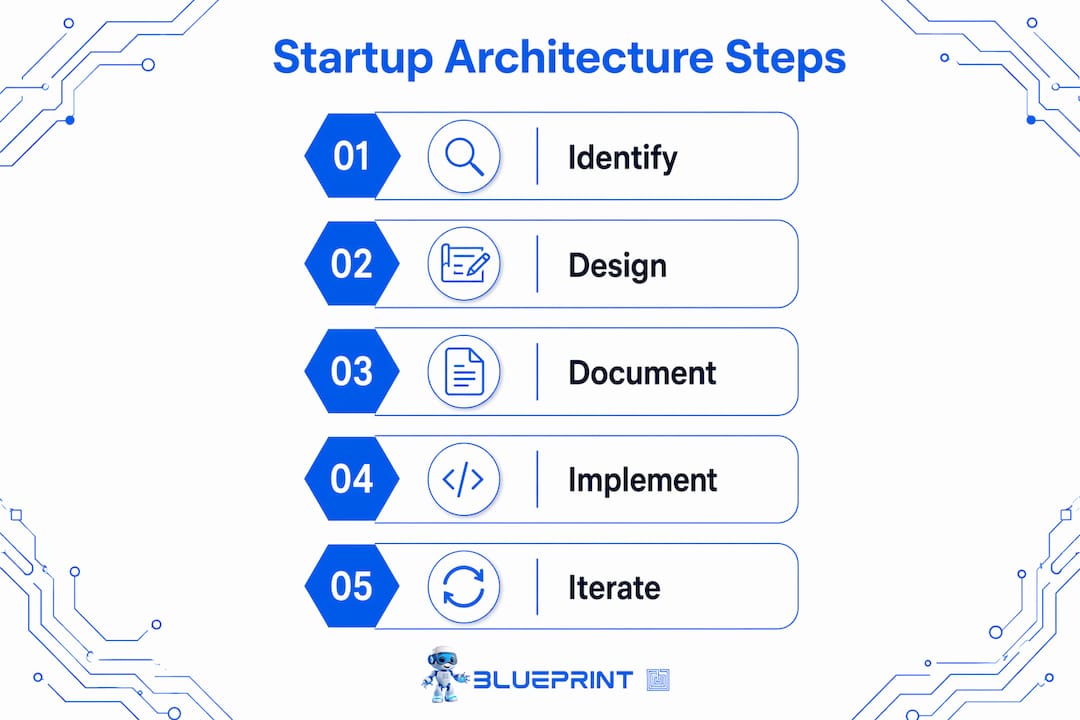
Step-by-step process to define your early system architecture
This process is designed for founders and product managers who are not engineers. It produces a document clear enough to hand to a developer and credible enough to present to an investor.
Gather business outcomes, not features. Write down what your product must do in the next 12 months. Focus on outcomes: "users can invite teammates," "payments are processed securely," "admins can view usage reports." These outcomes drive your architecture, not the other way around.
Map your core entities and data flows. List the main objects in your system (users, organisations, projects, invoices) and draw arrows showing how data moves between them. You do not need software for this. A napkin sketch works.
Design your auth and tenancy model. Decide whether each customer gets their own isolated data space (multi-tenant) or whether all customers share a single database. For SaaS products, multi-tenant architecture with RLS is the right default. Make this decision before your first developer writes a schema.
Choose your infrastructure stack. Select a cloud provider, a deployment model (containers, serverless, or platform-as-a-service), and an IaC tool like Terraform or Pulumi. Your tech stack choice should align with your team's existing skills and your product's traffic patterns.
Document with diagrams and narratives. Create a simple diagram showing the user request path from the browser through your API to your database and back. Add a short narrative explaining each layer.
Practise the "walk the diagram" technique. Investor-ready architecture communication starts at the edge (user authentication), moves through services (business logic and APIs), onto data storage, and finally to operations (monitoring and deployments). Narrating this flow demonstrates technical maturity without requiring your audience to read code.
Common pitfalls to avoid during this process:
- Skipping the tenancy decision because it feels premature
- Designing for millions of users before you have ten
- Documenting only the happy path and ignoring error states
- Choosing infrastructure based on what is trendy rather than what your team knows
Pro Tip: Architecture that clarifies business operations improves investor confidence and reduces support overhead. Bring your architecture diagram to your next investor meeting and walk through it. Most founders do not do this. The ones who do stand out immediately.
What are the most common early-stage architecture mistakes?
Most architecture problems in early-stage startups trace back to three root causes: choosing complexity too early, ignoring permanence, and under-planning for growth.
"Design systems that make changes easy to implement rather than focusing initially on scaling to millions of users." — Why the best early-stage startups skip modern architecture
Premature microservices. Splitting your application into separate services before you understand your domain boundaries creates coordination overhead that kills velocity. You end up managing deployments, service contracts, and network failures before you have validated your core product.
Ignoring data model permanence. Founders often spend hours debating which JavaScript framework to use and five minutes on their database schema. The framework is easy to change. The schema is not. Treat your data model as the most important design document you will write in your first month.
Under-planning auth and tenancy. Adding multi-tenancy after launch is one of the most disruptive migrations a small team can face. Migration from single-tenant to multi-tenant can take 2 to 4 months for small teams, during which new feature development effectively stops.
Over-complicating infrastructure before product-market fit. Kubernetes, service meshes, and distributed tracing are powerful tools. They are also significant operational burdens for a team of three. Use managed services and simple deployment pipelines until your traffic justifies the complexity.
The measure for when architecture changes are justified is straightforward: when the current structure is actively slowing down your ability to ship or your ability to onboard engineers, it is time to evolve. Not before.
Key takeaways
Defining system architecture early is the single highest-leverage technical decision a founder makes, because the cost of reversing core choices grows exponentially with every week of deferred action.
| Point | Details |
|---|---|
| Data model is the hardest to change | Define your core entities and relationships before writing any production code. |
| Start with a modular monolith | Monoliths allow 3 to 5 times faster iteration under $2 million ARR compared to microservices. |
| Multi-tenancy requires early commitment | Deferring the tenancy decision costs 2 to 4 months of migration work later. |
| Document for investors, not just developers | Walking an investor through your architecture diagram signals technical credibility and operational clarity. |
| Architecture is a living hypothesis | Revisit and update your architecture decisions as your product and team grow. |
Why I think most founders get this backwards
Most of the founders I have worked with approach architecture the same way: they hire a developer, the developer makes the structural decisions, and the founder learns about those decisions six months later when something breaks or a pivot becomes impossibly expensive. That is the wrong sequence entirely.
The insight that changed how I think about early-stage architecture is this: architecture should prioritise speed of learning over premature scaling. Your first architecture is not a permanent structure. It is a hypothesis about how your product will be used. The goal is to make that hypothesis easy to test and easy to update, not to build something that could theoretically handle ten million users.
What I have seen work consistently is founders who treat their architecture document the same way they treat their pitch deck. They own it, they can explain it, and they update it as they learn. They are not trying to become engineers. They are trying to make informed bets. The ones who do this arrive at investor meetings with a level of technical credibility that most of their peers simply cannot match.
The uncomfortable truth is that the founders who skip this step do not find out they skipped it until they are mid-Series A, staring at a six-month re-architecture project that their investors did not budget for. The upfront cost of defining your architecture clearly is measured in hours. The cost of not doing it is measured in months.
— Rishi
How Blueprintbot helps you define architecture fast
Blueprintbot transforms your app idea into a detailed technical blueprint in minutes, without requiring any technical background on your part.

You describe your product, your users, and your core workflows. Blueprintbot generates a complete architecture plan covering your data model, authentication strategy, API design, and infrastructure recommendations. It supports monolith, SaaS, and multi-tenant design patterns out of the box. The output is formatted for both developer handoff and investor presentations, so you can use the same document in two very different rooms. Explore example architecture blueprints to see what a complete early-stage blueprint looks like, or browse use cases to find a pattern that matches your product category.
FAQ
What does it mean to define system architecture?
System architecture is the structural plan of your software, covering data models, service boundaries, authentication, and infrastructure. Defining it means making these decisions deliberately before writing production code.
When should a startup define its system architecture?
The right time is before your first developer writes a schema or sets up a database. Core decisions like data models and tenancy are one-way doors that become prohibitively expensive to reverse once development is underway.
Should early-stage startups use microservices or a monolith?
A well-structured monolith or modular monolith is the right choice for most early-stage startups. Startups under 15 engineers iterate 3 to 5 times faster with a monolith than with microservices.
How do I explain system architecture to investors?
Use the "walk the diagram" technique: narrate the flow from user login through your API and business logic to your database and monitoring layer. This approach demonstrates technical maturity and makes your system accessible to a non-technical audience.
Can a non-technical founder define system architecture?
Yes. You do not need to write code to make the five foundational decisions around data model, auth, tenancy, service boundaries, and infrastructure. Tools like Blueprintbot and guides like the SaaS architecture planning guide are built specifically for non-technical founders who need to own these decisions.