Benefits of pre-development architecture planning

Pre-development architecture planning is defined as the structured process of resolving design, budget, regulatory, and operational constraints before any construction or development work begins. The benefits of pre-development architecture planning are direct: projects cost less, finish faster, and carry fewer surprises. Planning is the most important design phase because it reconciles vision with hard constraints before those constraints become expensive site problems. Founders and product managers who skip this phase do not save time. They borrow it at a very high interest rate.
1. How pre-development planning controls costs
Cost control is the clearest and most measurable benefit of early architectural planning. Every hour invested in planning can save exponentially higher rectification costs later. That ratio exists because fixing a design error on paper takes minutes, while fixing the same error mid-construction can require demolition, reordering materials, and rescheduling trades.
SponsoredCheck out today's featured offer →Common costly errors that planning prevents include:
- Structural conflicts between mechanical and electrical systems
- Undersized load-bearing elements discovered after framing
- Site access issues that delay equipment delivery
- Budget misalignments between the owner's expectations and actual material costs
Pre-development planning catches design conflicts before they become site errors. The earlier a problem surfaces, the cheaper it is to resolve. A scope change in the planning phase costs a fraction of the same change during construction.
Pro Tip: Build a detailed cost model during the planning phase, not after design is complete. Waiting until drawings are finished to price a project means absorbing the cost of redesign when numbers come in over budget.

2. Risk mitigation and compliance assurance
Effective front-end planning correlates directly with fewer project disasters, better cost performance, and shorter schedules. Risk does not disappear from a project. It either gets resolved during planning or it surfaces as a crisis during construction.
The most common risks that early planning addresses are:
- Zoning conflicts that prevent a building from being used as intended
- Environmental constraints such as flood plains, soil contamination, or protected species habitats
- Building code gaps that require expensive retrofits to achieve occupancy
- Utility capacity shortfalls where existing infrastructure cannot support the proposed load
"Integrated architectural planning involving early collaboration between architects, planners, and engineers enhances the chance of securing necessary permits on the first attempt. Projects that address local authority requirements early are far more likely to obtain approvals without delays." — Build-Rite
Permit delays are one of the most common causes of project cost overruns. A single resubmission cycle can add weeks or months to a schedule. Addressing regulatory requirements during the planning phase removes that risk before it has a chance to materialise.
3. Stakeholder alignment and shared project goals
Misalignment between owners, architects, engineers, and contractors is the root cause of most project conflicts. Architectural planning is the problem-seeking phase where project vision is balanced against constraints such as zoning, budget, and programme. Without that shared exercise, each party enters the project with different assumptions.
The advantages of architectural planning for stakeholder alignment include:
- A single agreed-upon project brief that defines scope, budget, and schedule
- Early identification of conflicting priorities before they become contractual disputes
- Clear decision-making authority established before procurement begins
- Shared visualisations that give non-technical stakeholders a concrete reference point
Structured assessment tools like the Project Definition Rating Index (PDRI) provide a shared language among diverse teams, clarifying scope and reducing idle time that inflates costs. PDRI is a scoring framework developed by the Construction Industry Institute that rates how well a project is defined before execution begins. A low PDRI score signals that the team needs more planning before proceeding.
Pro Tip: Run a structured goal-alignment workshop with all key stakeholders before the design phase begins. Document every decision and distribute it in writing. Verbal agreements made in planning meetings rarely survive the first design review.
4. Long-term adaptability through flexible space planning
Buildings that cannot adapt to changing needs become liabilities. Space planning creates flexible layouts that protect the owner's investment by allowing buildings to accommodate new uses without expensive structural changes. This is not an abstract concept. It is a design decision made during pre-development planning.
The table below shows the difference between a building designed with adaptability in mind versus one designed only for its initial use.
| Design approach | Characteristics | Long-term outcome |
|---|---|---|
| Fixed-use design | Walls, systems, and structure tied to one function | Expensive to reconfigure; often demolished early |
| Adaptable design | Modular grids, multipurpose spaces, accessible infrastructure | Lower renovation costs; longer useful life |
Modular grids and multipurpose spaces are the two most practical tools for building adaptability into a design. A modular grid means structural columns and floor plates follow a repeating dimension, making it easy to subdivide or open up spaces later. Multipurpose spaces are sized and serviced to support more than one type of activity.
Buildings designed with temporal thinking that accounts for access and future adaptability avoid becoming maintenance liabilities. Temporal thinking means asking, during pre-development, what this building will need to do in 10 or 20 years, not just on opening day.
5. Sustainability integrated from the start
Sustainability built into a design during pre-development costs far less than sustainability retrofitted after construction. Pre-development decisions significantly impact energy performance and lifecycle costs. Orientation, glazing ratios, insulation levels, and mechanical system selection are all most efficiently resolved before design is locked.
A building that misses its energy performance targets at the design stage will either underperform for its entire life or require expensive upgrades later. Neither outcome is acceptable for a founder or product manager responsible for long-term operating costs. The architecture planning benefits here are financial as much as environmental.
Passive design strategies, including building orientation, natural ventilation paths, and thermal mass, cost nothing to implement when they are part of the original design. They can cost a great deal to add after the fact.
6. Faster project delivery and fewer delays
Pre-development project planning compresses the overall project schedule by resolving unknowns before they can stall progress. The most common causes of construction delays are late design decisions, incomplete drawings, and unanticipated site conditions. All three are addressable during planning.
When a project enters the construction phase with a complete, coordinated set of drawings, trades can work without waiting for answers. Procurement can begin on long-lead items before the first shovel hits the ground. Contractors can price work accurately, reducing the likelihood of claims and disputes.
Front-end planning reduces schedule delays, change costs, and risk exposure. That is not a theoretical claim. It is the documented outcome of projects that invest in planning versus those that rush into design and construction.
7. Better budget accuracy and fewer surprises
A project budget built during pre-development is more accurate than one assembled after design is complete. Early-stage cost modelling uses historical data, unit rates, and programme assumptions to produce a realistic range before any drawings exist. That range gives owners a real decision point: proceed, adjust scope, or pause.
Projects that skip early cost modelling often discover budget problems at the worst possible moment, after significant design fees have been spent and the owner is emotionally committed to a design that cannot be built for the available money. The impact of early architecture planning on budget accuracy is one of its most underappreciated benefits.
A well-run pre-development process produces a cost plan with clearly identified assumptions and contingencies. When costs change, the team knows exactly which assumption changed and why.
8. How digital tools improve planning accuracy
Digital tools have changed what is possible during pre-development. Software that supports architectural planning workflows can produce cost estimates, test design options, and flag coordination conflicts in a fraction of the time that manual processes require.
Key capabilities that digital planning tools provide include:
- Cost estimation tied directly to design decisions, updated in real time as scope changes
- 3D coordination that identifies clashes between structural, mechanical, and electrical systems before construction
- Scenario modelling that lets teams compare design options against budget and schedule targets
- Collaborative documentation that keeps all stakeholders working from the same current version
AI-driven tools like Blueprintbot enhance architectural planning efficiency by generating structured technical outputs from a project brief. Blueprintbot produces system architecture, database schemas, API designs, user interface flows, and cost estimates within seconds. For founders and product managers without a technical background, that output replaces weeks of back-and-forth with development teams. Free planning tools built for non-technical founders make it possible to arrive at a developer conversation with a complete, coherent brief rather than a rough idea.
Key takeaways
Pre-development architecture planning is the single most cost-effective investment a founder or project manager can make before committing to design or construction.
| Point | Details |
|---|---|
| Cost savings start early | Fixing design errors during planning costs a fraction of fixing them on-site. |
| Compliance reduces delays | Addressing zoning and building codes early improves first-attempt permit approvals. |
| Stakeholder alignment prevents conflict | A shared project brief and PDRI scoring reduce disputes and idle time. |
| Adaptable design protects investment | Modular grids and multipurpose spaces lower long-term renovation costs. |
| Digital tools accelerate planning | AI platforms like Blueprintbot generate technical briefs that reduce ambiguity before development begins. |
Why founders underestimate planning until it's too late
Pre-development planning is the one phase that founders consistently undervalue, and I understand why. When you have an idea you believe in, spending time on planning feels like delay. It feels like bureaucracy standing between you and progress.
That instinct is wrong, and it is expensive.
The projects I have seen go sideways almost always share the same origin story: the team moved fast, skipped the planning phase, and hit a wall mid-build that cost twice as much to fix as the planning would have cost in the first place. The wall was always predictable. It just was not predicted.
The uncomfortable truth about pre-development planning is that it does not slow projects down. It removes the friction that slows projects down later. A founder who arrives at a developer conversation with a complete technical brief, a realistic budget model, and a clear scope gets a faster, more accurate quote. They also get fewer change orders, fewer surprises, and a better product.
The return on investment for planning is not theoretical. It shows up in every project that finishes on time and on budget. It also shows up, in reverse, in every project that does not.
— Rishi
Blueprintbot for pre-development planning
Blueprintbot is built for exactly the moment when a founder or product manager needs to turn an idea into a technical plan without hiring a development team first.
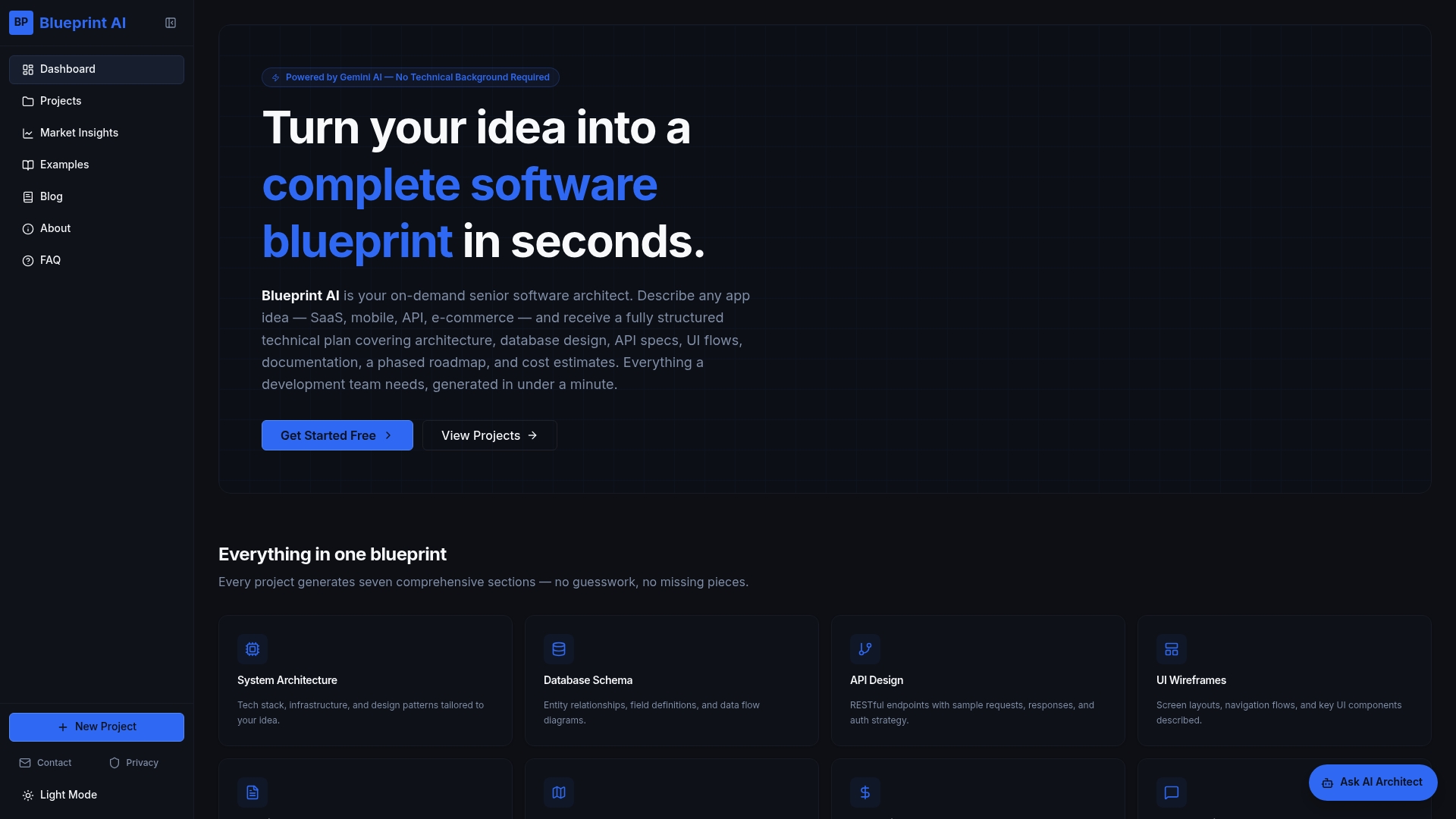
The platform generates complete software blueprints from a project brief, covering system architecture, API designs, database schemas, and development roadmaps. It also produces cost estimates and deployment guides for Google Play and the Apple App Store. For non-technical founders, that output is the difference between a vague conversation with a developer and a precise, scoped engagement. See how teams use Blueprintbot across different project types, from early-stage startups to product teams validating new features. Browse example blueprints to understand what a complete pre-development plan looks like in practice.
FAQ
What is pre-development architecture planning?
Pre-development architecture planning is the structured process of resolving design, regulatory, budget, and operational constraints before construction or development begins. It is the phase where most cost-saving and risk-mitigating decisions are made.
How does early planning reduce project costs?
Fixing a design error during planning costs a fraction of fixing the same error during construction. Early-stage planning catches conflicts before they require demolition, rework, or material reordering.
What is the Project Definition Rating Index (PDRI)?
The PDRI is a scoring framework developed by the Construction Industry Institute that measures how well a project is defined before execution begins. A low score signals that more planning is needed before procurement or construction starts.
How does planning improve permit approval rates?
Integrated planning that addresses local authority requirements early increases the likelihood of first-attempt permit approvals. Resubmission cycles add weeks or months to a project schedule and increase costs.
Can digital tools replace traditional pre-development planning?
Digital tools do not replace planning. They make planning faster and more accurate by automating cost estimation, design coordination, and documentation. Platforms like Blueprintbot accelerate the planning phase for non-technical founders by generating structured technical briefs from a project idea.