Why early architecture decisions matter for founders

Software architecture is the collection of decisions that are hardest to change once your product is live. Fixing an architectural error post-release costs 4–5x more than catching it during design. That cost multiplier is why early architecture decisions matter more than any feature you will ship in your first year. For founders and product managers, these choices determine how fast you can scale, how much you spend on engineering, and whether your product survives its own success. Get them right early and you buy yourself options. Get them wrong and you pay for it every sprint.
Why early architecture decisions matter most
Software architecture is not about code style or folder structure. It is about decisions that persist as load-bearing walls inside your system. Choosing PostgreSQL over MongoDB, for example, shapes your data model, your query patterns, and your team's hiring profile for years. Changing that choice at month 18 can cost 10–100x more than making the right call at month 1.
The importance of architecture choices compounds over time. A shortcut taken in the first six months of development typically becomes visible as a serious problem by month 12–18. By that point, your team is spending engineering capacity on workarounds instead of features. Up to 60% of IT spend goes toward maintaining systems not designed for current operational demands. That figure represents money that cannot go toward growth.
Architecture is also a business decision, not just a technical one. It sets your cost structure, your team's velocity, and your ability to add features without breaking existing ones. Founders who treat architecture as a developer concern, rather than a product and business concern, consistently underestimate how much it shapes their runway.
What types of architectural decisions matter most early on?
Not every decision carries the same weight. The most useful framework separates decisions into two types based on reversibility.
Type 1 decisions are irreversible or very costly to reverse. These are your true architectural choices:
- Database engine and data model (PostgreSQL, MongoDB, DynamoDB)
- Service boundaries and whether you build a monolith or split into services
- API contracts exposed to external clients or mobile apps
- Authentication and authorisation model (especially multi-tenancy in SaaS)
- Cloud provider and core infrastructure commitments
Type 2 decisions are reversible with moderate effort. These include internal module structure, naming conventions, and most UI framework choices. They matter, but they do not define your architecture.
The test for any decision is simple: how expensive is it to change in 12 months? If the answer is "very," treat it as Type 1 and give it deliberate attention now. If the answer is "manageable," make a reasonable call and move on.
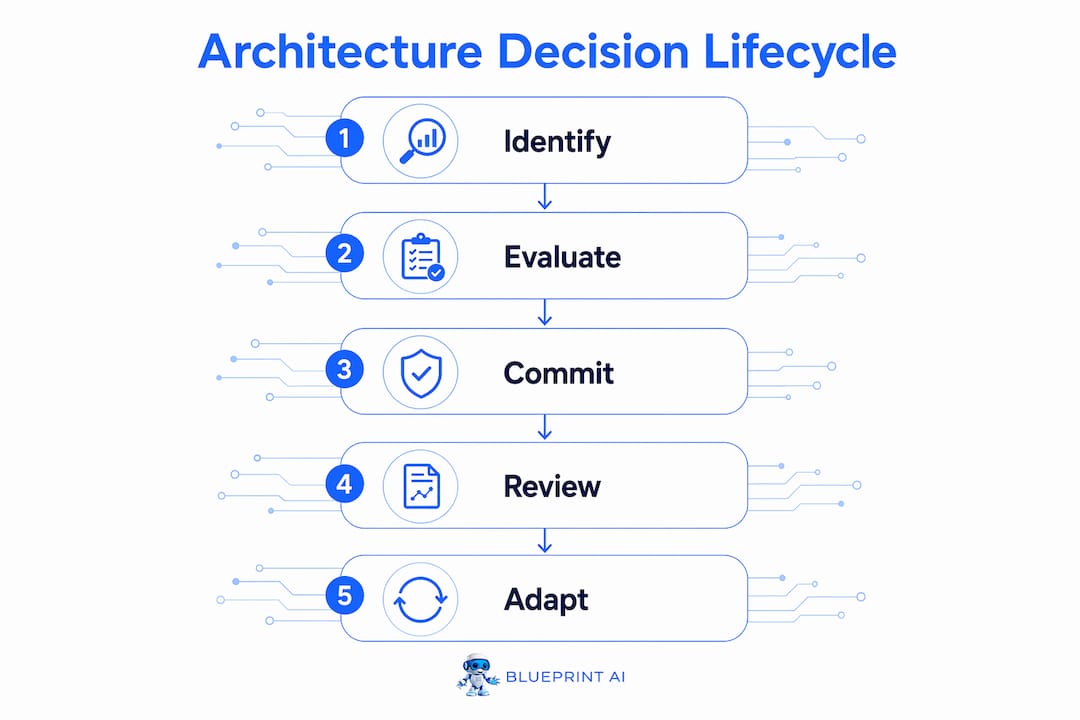
Pro Tip: When evaluating a Type 1 decision, write down the cost of reversing it before you commit. That single exercise forces clarity and prevents decisions made by default.
One underused tactic is building architectural escape hatches into your design from day one. An ORM layer between your application and your database, or a message queue abstraction between services, adds roughly 10% to initial build cost. In return, you preserve the ability to swap underlying components without rewriting your entire application. That trade-off almost always pays off.
How do poor early architecture choices affect cost and scalability?
The financial impact of bad early design decisions follows a clear pattern. Costs start small, then compound.
| Phase | Cost to fix architectural error | Typical trigger |
|---|---|---|
| Requirements stage | Baseline (1x) | Design review catches the issue |
| Design phase | 4–5x baseline | Error found during planning |
| Post-release (month 18+) | 10–100x baseline | System fails under real load |
Premature microservices are the most common and expensive mistake early-stage teams make. Adding a microservices architecture before product-market fit introduces 6–12 months of operational complexity: service discovery, distributed tracing, inter-service authentication, and deployment pipelines. That complexity consumes engineering time that should go toward validating your product. Poor data access patterns compound the problem further, wasting an estimated $200,000–$500,000 in engineering time before the team even recognises the root cause.
"Bad early decisions consume 40–60% of total engineering capacity as technical debt." — SaaS Architecture Decision Framework
The trajectory is predictable. A team takes shortcuts in months 1–6 to ship fast. By month 12, those shortcuts slow every new feature. By month 18–24, the team is discussing a rewrite. Rewrites are expensive, demoralising, and often incomplete. The architectural debt trajectory that leads to costly rewrites within 24–36 months almost always starts with decisions made in the first quarter of development.
For SaaS products specifically, multi-tenancy strategy is a Type 1 decision that founders routinely defer. Implementing Row Level Security in PostgreSQL from day one, for instance, prevents a painful and risky data isolation rewrite when your first enterprise customer asks for it. Deferring that decision is not neutral. It is a bet that you will not need it, and that bet fails regularly.

Which architecture style should you choose for an early-stage project?
The right architecture style for an early-stage project is almost always a modular monolith. A modular monolith organises code into clearly separated modules within a single deployable unit. It allows 3–5x faster iteration before product-market fit compared to a microservices architecture. That speed advantage is decisive when you are still learning what your product needs to be.
| Architecture style | Best for | Main trade-off |
|---|---|---|
| Modular monolith | Pre-PMF, teams under 15 engineers | Harder to scale individual components independently |
| Microservices | Post-PMF, $5–10M ARR, 15+ engineers | High operational overhead, slower initial development |
| Serverless functions | Event-driven workloads, variable traffic | Cold starts, vendor lock-in, complex debugging |
Microservices are not wrong. They are wrong at the wrong time. The transition to microservices makes sense after reaching $5–10M ARR or scaling to 15 or more engineers, when specific bottlenecks justify the operational cost. Before those thresholds, microservices add overhead without adding proportional value.
The factors influencing architecture decisions should be your actual constraints, not industry trends. Ask: What is our team's existing expertise? What are our real scaling pressures today? What does our traffic actually look like? A two-person team building a B2B SaaS tool does not need the architecture that Netflix uses. Choosing based on what sounds impressive is a pattern sometimes called resume-driven development, and it reliably produces over-engineered systems that slow teams down.
Pro Tip: Before choosing an architecture style, sketch your system as it must exist 18 months from now. Identify the two or three bottlenecks most likely to appear. Then choose the style that handles those bottlenecks without adding complexity you do not yet need.
For mobile-specific projects, the architecture decisions for mobile apps follow similar principles but carry additional constraints around offline behaviour, API design, and platform-specific storage patterns.
How to make early architecture decisions without common traps
Good architectural decision-making is a process, not a talent. Three practices separate teams that get it right from those that do not.
Use Architecture Decision Records (ADRs). An ADR is a short document that captures what decision was made, why it was made, and what alternatives were considered. ADRs create institutional memory. When a new engineer joins six months later, they can read why you chose PostgreSQL instead of discovering the reasoning through trial and error. They also force the decision-maker to articulate the reasoning, which surfaces weak logic before it becomes expensive code.
Apply the 10% rule. When two architecture options are close in quality, pick the option where your team has stronger expertise and move on. Spending three weeks debating options that score within 10% of each other is not rigour. It is procrastination with a technical label. The cost of delay often exceeds the cost of the slightly suboptimal choice.
Schedule architecture reviews at fixed intervals. Set a calendar reminder for month 3, month 6, and month 12 to review your core architectural assumptions against reality. Traffic patterns, team size, and product direction all change. An architecture review is not an admission of failure. It is the mechanism that prevents small misalignments from becoming expensive rewrites.
Pro Tip: Treat your architecture review like a financial audit. Bring data: query times, deployment frequency, engineer hours spent on maintenance. Decisions made with data beat decisions made from memory.
Avoiding hype-driven choices is equally important. Architecture decisions are about trade-offs, not about adopting the most modern technology. The right choice fits your context and constraints. A well-structured monolith that your team understands deeply will outperform a fashionable distributed system that nobody fully controls. Building a scalable architecture roadmap from the start gives your team a shared reference point and reduces the risk of hype-driven detours.
Key takeaways
Early architecture decisions are the single highest-leverage choices a founding team makes, because their cost to reverse grows by an order of magnitude with every month of delay.
| Point | Details |
|---|---|
| Reversibility is the test | Classify every decision by how expensive it is to change at month 12 before committing. |
| Cost multipliers are real | Fixing an architectural error post-release costs 4–5x more than during design, and up to 100x more than at the requirements stage. |
| Start with a modular monolith | A modular monolith delivers 3–5x faster iteration pre-PMF compared to microservices. |
| Use ADRs from day one | Architecture Decision Records preserve reasoning and prevent costly rediscovery by new team members. |
| Escape hatches reduce risk | Abstractions like ORMs add roughly 10% to initial cost but save 10x effort when you need to migrate. |
The case for boring architecture done well
My honest view on early architecture is this: the teams that win are almost never the ones with the most sophisticated system design. They are the ones who picked something sensible, documented it clearly, and moved fast.
I have watched founders spend months debating Kafka versus RabbitMQ before they had a single paying customer. That debate is not architecture planning. It is anxiety dressed up as engineering. The real architectural risk at the pre-product-market-fit stage is not that your message queue is wrong. It is that you build the wrong product while arguing about infrastructure.
The practical approach is to start with the most boring architecture that could possibly work, make it modular, and build in one or two escape hatches for the decisions you are least confident about. Then ship. Review at month six with real data. The data will tell you what to change far more reliably than any upfront analysis.
What I find founders consistently underestimate is the organisational cost of architectural complexity. Every service boundary is a coordination boundary. Every distributed component is a debugging session waiting to happen. Complexity does not just slow down your infrastructure. It slows down your team, your onboarding, and your ability to change direction quickly.
The best architecture for a startup is the one your team can fully understand, explain to a new hire in one hour, and change without fear. Build that first. Scale it when the data demands it.
— Rishi
How Blueprintbot helps you get architecture right from the start
Getting architecture right before you write a line of code is exactly what Blueprintbot is built for. Blueprintbot generates complete software blueprints from your app idea in seconds, covering system architecture, database schemas, API designs, and development roadmaps. You see the full structure of your product before any engineering time is committed.
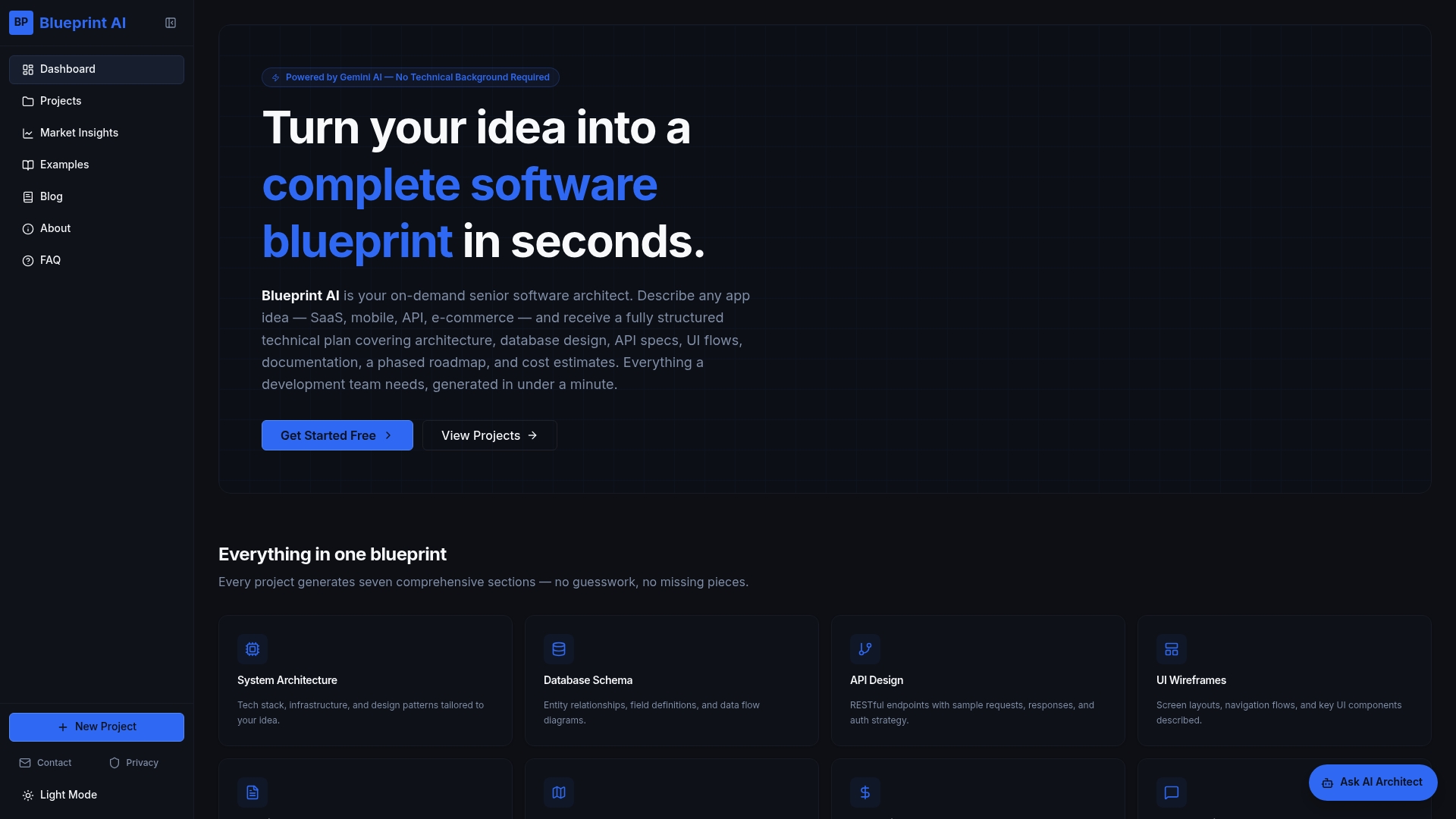
Blueprintbot also offers free planning tools including a feature prioritiser and a development time estimator, so you can align your architecture with your actual budget and timeline. For founders and product managers who want to avoid the costly mistakes covered in this article, Blueprintbot turns the planning phase from a guessing game into a structured, evidence-based process.
FAQ
What makes an architecture decision truly architectural?
An architectural decision is one that is costly or disruptive to reverse. Database engine choice, service boundaries, and API contracts are architectural. Internal module naming is not.
When should a startup switch from a monolith to microservices?
The transition makes sense after reaching $5–10M ARR or scaling to 15 or more engineers, when specific performance bottlenecks justify the added operational complexity.
How much more does it cost to fix architecture errors post-launch?
Fixing an architectural error after release costs 4–5x more than during design, and up to 100x more than catching it at the requirements stage.
What is an Architecture Decision Record?
An Architecture Decision Record is a short document capturing what architectural choice was made, why it was made, and what alternatives were considered. It preserves reasoning for future team members.
What is the biggest early architecture mistake founders make?
Premature microservices is the most common and costly mistake. It adds 6–12 months of complexity before product-market fit and can waste $200,000–$500,000 in engineering time.