How to scope software projects without guesswork

Accurate software project scoping is the practice of defining every deliverable, boundary, and constraint before a single line of code is written. Founders and product managers who skip this step routinely face blown budgets, missed deadlines, and developer disputes. The industry term for this practice is project scope definition, and it sits at the heart of every reliable software development plan. When you scope software projects without guesswork, you replace assumptions with documented agreements, and estimation accuracy follows naturally.
What are the essential components of a project scope statement?
A project scope statement is the single document that prevents your project from drifting. Atlassian defines five components every scope statement must include: goals, deliverables, tasks and activities, exclusions, and constraints. Each component serves a different audience. Goals align executives. Deliverables direct developers. Exclusions protect you from scope creep.
SponsoredCheck out today's featured offer →The exclusions component is the most underused. Clients routinely assume that anything not explicitly ruled out is included. Explicit out-of-scope descriptions in your scope document prevent those assumption-based disputes before they start. A scope statement that lists what you will not build is just as valuable as one that lists what you will.
Acceptance criteria are equally critical. Phrases like "to the client's satisfaction" are not acceptance criteria. Objective acceptance conditions must be measurable, with defined sign-off steps. For example, "the login screen loads in under two seconds on a 4G connection" is testable. "The login screen feels fast" is not.

Tools like Jira let teams attach acceptance criteria directly to user stories, keeping scope visible throughout delivery. This prevents the common failure mode where scope is defined once, filed away, and never consulted again.
Pro Tip: Write your scope statement twice. The first version is stakeholder-facing and covers inclusions, exclusions, and constraints. The second is delivery-facing and contains objective acceptance tests for every deliverable. This separation reduces rework and misalignment significantly.
- Goals: What the project must achieve, stated as measurable outcomes
- Deliverables: The specific outputs the team will produce
- Tasks and activities: The work required to produce each deliverable
- Exclusions: Everything explicitly outside the project boundary
- Constraints: Budget, timeline, technology, or regulatory limits that shape delivery
How can structured estimation techniques reduce uncertainty?
Estimation without structure is guessing with extra steps. The three-point estimation method, formalised through the PERT formula, replaces single-point guesses with a weighted average that accounts for uncertainty. The PERT formula is: TE = (O + 4M + P) / 6, where O is the optimistic estimate, M is the most likely estimate, and P is the pessimistic estimate. The formula weights the most likely scenario four times more heavily than the extremes.
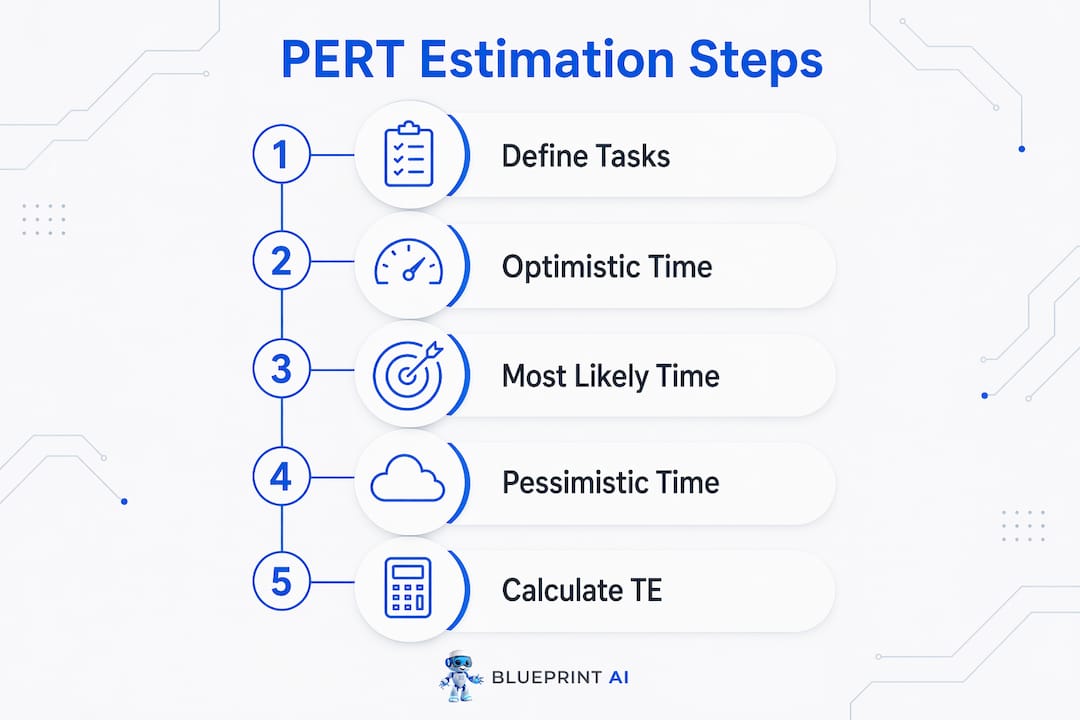
This matters because it forces your team to think through failure modes before committing. A developer who says "three days" is giving you M. Ask them for O and P as well, and you get a far more honest picture of the work involved.
How to apply the PERT formula in practice
- Identify the task. Break the project into discrete, estimable units of work.
- Gather three estimates. Ask the person doing the work for their best case (O), most likely (M), and worst case (P) durations.
- Apply the formula. Calculate TE = (O + 4M + P) / 6 for each task.
- Sum the expected times. Add all task-level TEs to get a project-level estimate.
- Review the spread. A large gap between O and P signals unstable requirements.
| Task | Optimistic (O) | Most Likely (M) | Pessimistic (P) | Expected Time (TE) |
|---|---|---|---|---|
| User authentication | 2 days | 4 days | 9 days | 4.5 days |
| Payment integration | 3 days | 6 days | 14 days | 6.8 days |
| Dashboard UI | 1 day | 3 days | 6 days | 3.2 days |
A wide O-to-P gap is not a problem to hide. Large optimistic-pessimistic gaps signal unstable assumptions that require active validation work, not simply padding the estimate. Treat a wide range as a trigger to run a discovery spike or prototype before committing to a delivery date.
Pro Tip: Use a simple spreadsheet with the PERT formula built in. Blueprintbot's app development time estimator applies this kind of structured approach automatically, giving you a weighted estimate without manual calculation.
Accuracy in estimates depends on actively reducing uncertainty through decisions and validation. Jeff Bailey's hourglass of uncertainty model shows that the first 20–30% of a project is where uncertainty narrows most sharply. Teams that front-load requirements validation and design decisions get dramatically better estimates than teams that wait for clarity to arrive on its own.
What practical steps lock scope before project execution?
Locking scope before execution is a process, not a single meeting. The steps below apply whether you are a solo founder briefing a freelancer or a product manager working with a 20-person development team.
- Draft the stakeholder scope statement. List goals, deliverables, exclusions, and constraints. Get written sign-off from every decision-maker before moving forward.
- Draft the delivery scope document. Translate each deliverable into objective acceptance tests. Every feature needs a pass/fail condition.
- Review with the delivery team. Developers and designers often spot missing requirements or impossible constraints that stakeholders miss entirely.
- Negotiate and revise. Scope negotiation is normal. Document every change and get re-sign-off on the revised version.
- Establish a change control process. Any request to add, remove, or modify scope after sign-off must go through a formal change request. This protects timelines and budgets.
A clear scope of work document empowers all stakeholders and reduces the arguments that derail projects. It functions as an operational reference throughout delivery, not just a pre-project formality.
| Without formal scope lock | With formal scope lock |
|---|---|
| Developers interpret requirements differently | All team members work from the same acceptance tests |
| Clients add features mid-project without cost discussion | Change requests are documented and priced before work begins |
| Estimation is based on assumptions | Estimation is based on validated, agreed deliverables |
| Disputes arise over what "done" means | "Done" is defined by objective, signed-off acceptance criteria |
The technical specification that accompanies your scope document is where architecture, API design, and database structure get defined. Scope tells you what to build. The technical specification tells you how.
How do you prevent scope creep from derailing your project?
Scope creep is the gradual expansion of project requirements beyond the original agreement, usually without corresponding adjustments to budget or timeline. It is the single most common cause of software projects running over time and over budget. Vague acceptance criteria are the primary enabler.
"Defining scope is the cornerstone of keeping teams aligned from start to finish by setting boundaries around inclusion, exclusion, and constraints." — Atlassian
Preventing scope creep starts with the exclusions list. Every item you explicitly rule out is one less assumption a client or stakeholder can make. Review your exclusions list with clients before project kick-off and confirm their understanding in writing.
- Hold monthly scope reviews. Compare current work against the signed scope document. Catch drift early before it compounds.
- Track estimation deviations. If actual time consistently exceeds PERT estimates, requirements are likely shifting. Investigate before continuing.
- Require written change requests. Verbal requests are the entry point for scope creep. A simple email trail is enough to create accountability.
- Communicate scope boundaries proactively. When a client asks for something outside scope, acknowledge the request, explain the boundary, and offer a formal change process. This protects the relationship while protecting the project.
Good scope practices protect budgets and timelines by making the cost of change visible. When every addition requires a formal request and a revised estimate, clients and stakeholders make more deliberate decisions about what they actually need. For more on communicating scope boundaries with your development team, clear documentation is the foundation.
Key takeaways
Scoping software projects without guesswork requires two written scope documents, structured PERT estimation, explicit exclusions, and a formal change control process before execution begins.
| Point | Details |
|---|---|
| Write scope twice | Create one stakeholder-facing document and one delivery-facing document with acceptance tests. |
| Use PERT estimation | Apply TE = (O + 4M + P) / 6 to every task to replace single-point guesses with weighted estimates. |
| List exclusions explicitly | State what is out of scope to prevent clients from claiming assumed inclusions. |
| Front-load uncertainty reduction | Validate requirements and make design decisions in the first 20–30% of the project. |
| Enforce change control | Require written change requests for any post-sign-off modification to protect budget and timeline. |
Why most founders get scoping wrong the first time
Founders treat scope definition as a formality they complete once and forget. That is the core mistake. I have seen projects with beautifully written scope statements collapse because nobody consulted those documents after week one. Scope is a living reference, not a filing cabinet artefact.
The second mistake is conflating estimation with scoping. Founders often jump to "how long will this take?" before they have answered "what exactly are we building?" Estimation without a locked scope is theatre. You are performing confidence without having earned it.
The mindset shift that actually works is treating scope definition as ongoing risk management. Every time a requirement is vague, you are carrying risk. Every time an exclusion is unstated, you are carrying risk. The PERT formula and the two-document approach are not bureaucratic overhead. They are the mechanisms that convert risk into information you can act on.
The founders and product managers I have seen succeed with this approach share one habit: they are more afraid of a vague requirement than a delayed start. Getting scope right takes an extra day or two upfront. Getting it wrong costs weeks on the back end.
— Rishi
Blueprintbot makes structured project scoping faster
Blueprintbot is built for founders and product managers who need a complete, structured project scope without spending days writing documentation from scratch.
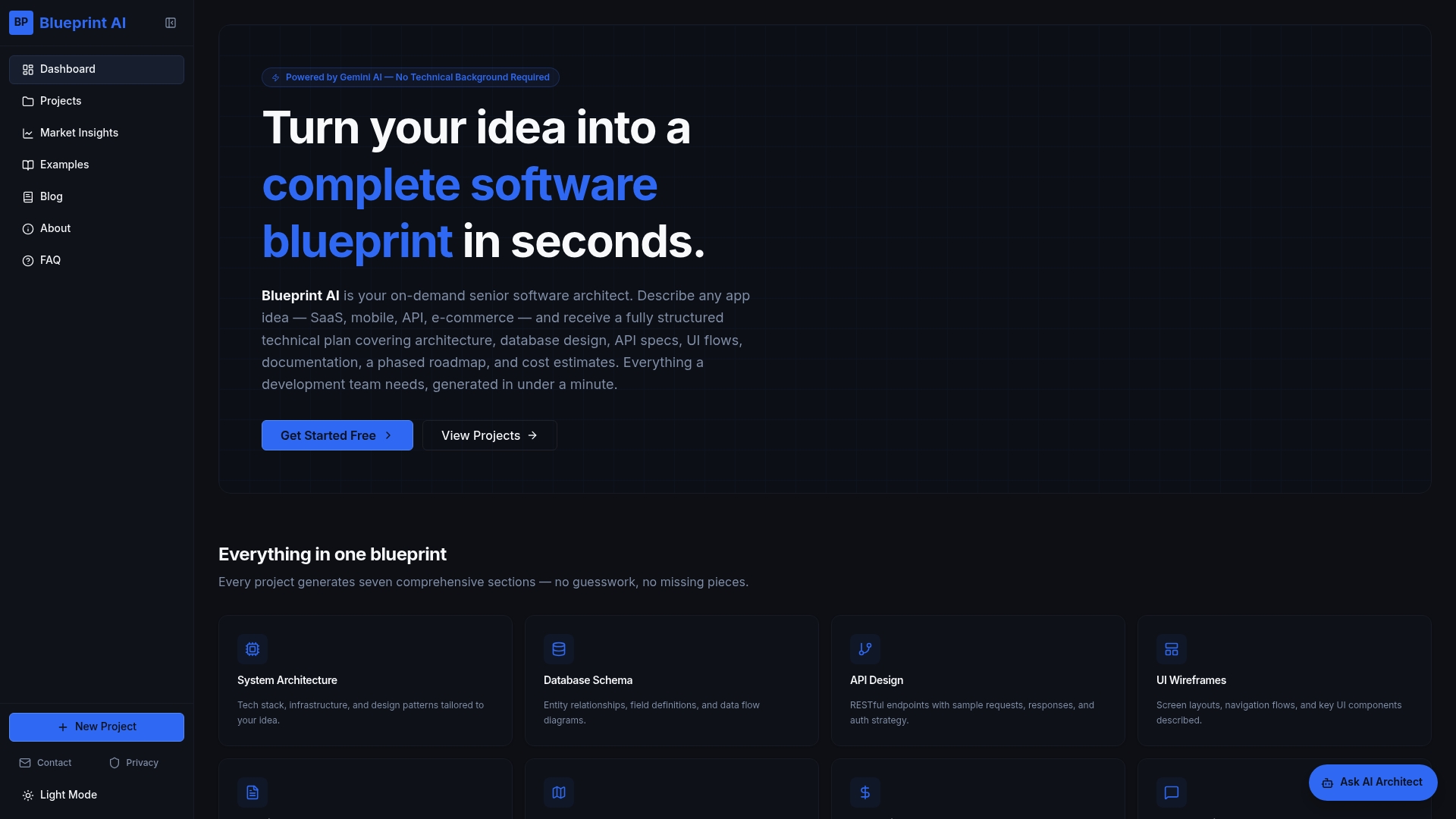
The platform generates detailed software blueprints that cover system architecture, API designs, database schemas, user interface flows, and development roadmaps from a single app idea. Each blueprint gives you the structured foundation your scope statement and technical specification need. Blueprintbot's free planning tools also include estimation support, so you can move from idea to signed-off scope faster and with far less back-and-forth with your development team.
FAQ
What is a project scope statement?
A project scope statement is a document that defines a project's goals, deliverables, tasks, exclusions, and constraints. It serves as the agreed boundary for all project work and prevents assumptions from driving decisions.
What is the PERT formula for software estimation?
The PERT formula is TE = (O + 4M + P) / 6, where O is the optimistic estimate, M is the most likely estimate, and P is the pessimistic estimate. It produces a weighted average that accounts for uncertainty better than a single-point guess.
How do you prevent scope creep in software projects?
Scope creep is prevented by listing explicit exclusions in the scope document, requiring written change requests for any additions, and holding regular scope reviews throughout delivery.
Why should scope be written twice?
Writing scope twice, once for stakeholders and once for the delivery team with acceptance tests, reduces rework and misalignment. Each version serves a different audience with different information needs.
When should you reduce estimation uncertainty?
Uncertainty reduction should happen in the first 20–30% of a project, through requirements validation, design decisions, and prototyping. Waiting for clarity to arrive on its own does not improve estimates.