Top 4 Codika.io Alternatives 2026

Finding a technical specification generator that handles requirements without missing detail or forcing manual review is difficult. Most platforms either leave gaps in stakeholder coverage, restrict integration, or demand enterprise pricing with no clear self-serve plan. This comparison covers speed, integration, audit trails, and generation method so founders and development teams can select a technical specification generator that matches their workflow.
Table of Contents
BPBlueprint AI
At a Glance
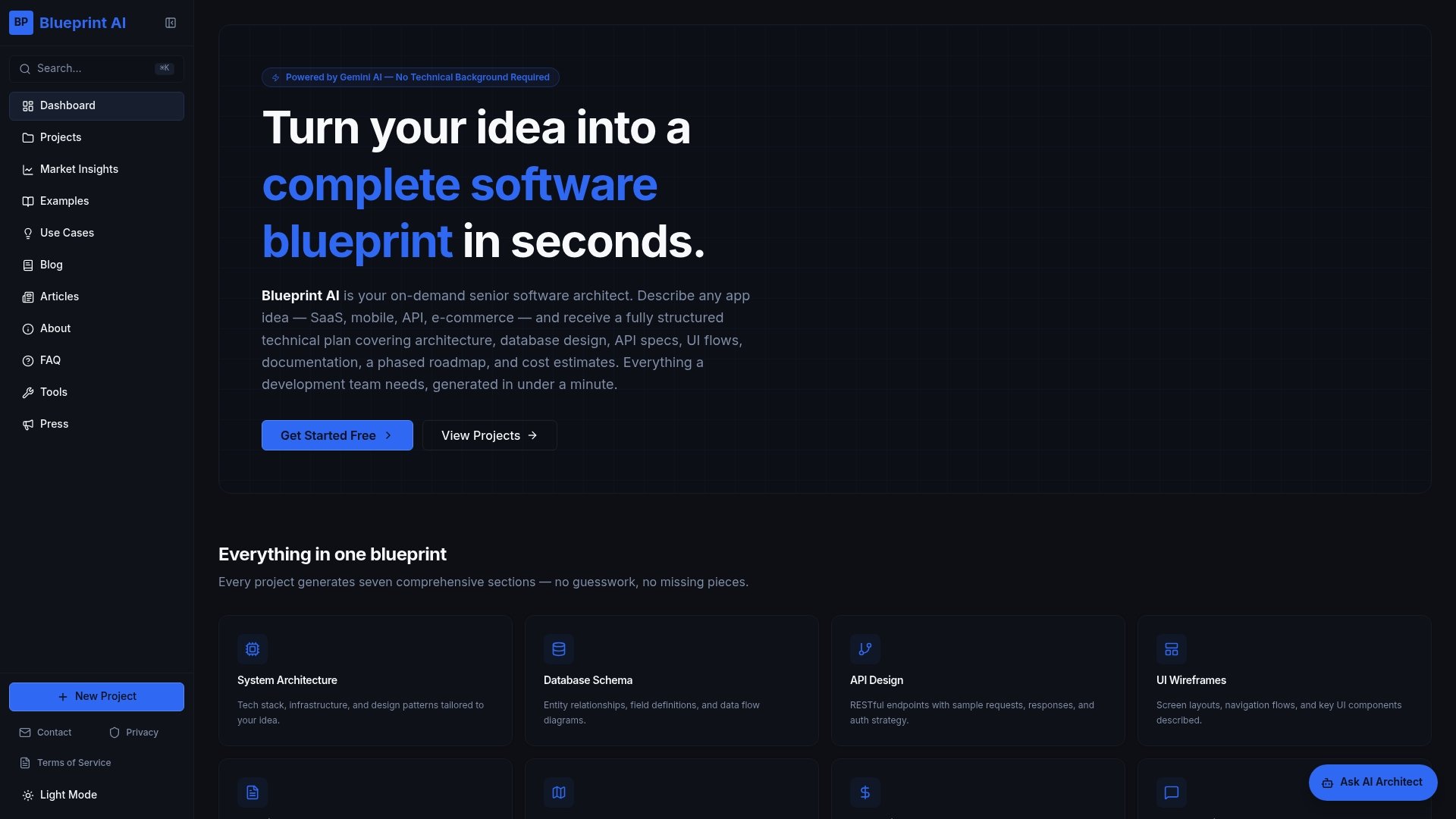
Blueprint AI reports it generates complete software blueprints in under 60 seconds. That claim means you can turn a plain English app idea into a structured plan fast. The short turnaround reduces the time needed to brief developers or prepare a pitch.
Core Features
The tool produces seven detailed blueprint sections covering system architecture, database schema, API design, UI wireframes, technical documentation, a development roadmap, and cost estimates. It includes a built in AI chat assistant for follow up questions and refinement and gives tailored recommendations by app type and scale. The site also provides step by step guidance for publishing on Google Play and the Apple App Store and exports blueprints as Markdown for easy sharing.
Key Differentiator
Generates detailed, structured software specifications in under a minute entirely from plain English descriptions. That differentiator compresses initial planning into a single artefact you can hand to developers or investors. The short generation time supports rapid iteration during early validation and scoping.
Pros
Blueprint AI combines fast blueprint generation with output designed for non technical founders. The platform produces full architecture diagrams, database schemas, API specs, UI flows, roadmaps, and cost estimates so you get one consolidated document. Being free during beta removes an early financial hurdle for solo founders and small teams. Exports in Markdown make the spec editable and easy to integrate into your documentation workflow.
Cons
- May require expert review for complex or highly specialised projects
Who It's For
Founders, entrepreneurs, product managers, and non technical builders who need a credible technical plan without hiring an architect fit this service. Freelancers and small product teams use it to speed up scoping and to create a shareable spec for quotes. Researchers and learners can study generated architectures to understand system design patterns.
Unique Value Proposition
The built in AI chat assistant lets you refine outputs in real time after the initial generation. That interaction reduces back and forth with developers and lowers the cost of clarifying requirements. Because the platform generates structured specs and offers publishing checklists, teams can move from idea to deployment planning faster and with fewer miscommunications.
Real World Use Case
A startup founder writes a plain English brief describing their app. Blueprint AI returns a full technical spec that includes architecture, APIs, UI flow, a roadmap, and cost estimates. The founder shares the Markdown export with contractors and uses the platform’s follow up chat to tighten integration details before hiring.
Website: https://blueprintbot.net
Gluecharm
At a Glance
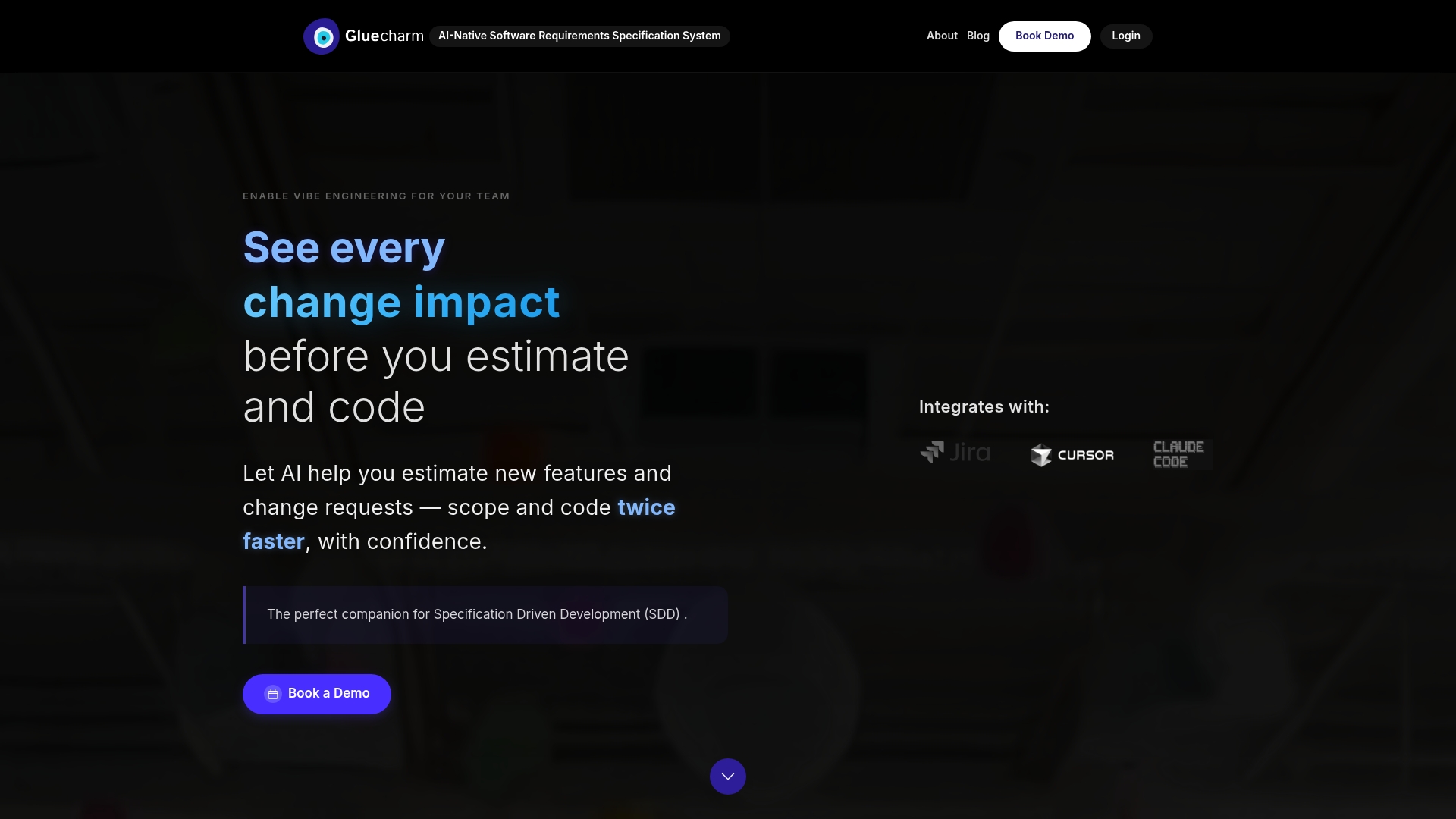
Complete audit trail and version history back each requirement, which helps with traceability in regulated projects. Gluecharm uses AI to extract and structure requirements from stakeholder conversations. The tool supports both cloud and on premise deployment. That combination targets teams that must show proof of changes and approvals.
Core Features
Gluecharm provides AI powered requirements analysis that turns meetings, chat, audio, and video into structured specification items. It offers export options for MDX, PDF, and Docs, and it keeps a live audit trail and version history for every requirement. The product also connects with common developer workflows and supports multiple AI backends for redundancy.
Key Differentiator
The product centres on structured requirements analysis combined with collaboration and compliance features. That focus makes Gluecharm stronger at governance and traceability than tools aimed at rapid prototyping. It targets enterprise projects where regulatory proof and version history shape delivery and approvals.
Pros
Gluecharm speeds up requirement capture and documentation by converting stakeholder input into organised specification artefacts. The platform provides a complete audit trail and version history, which suits regulated environments that need traceability. Flexible deployment on cloud or on premise and multiple AI backend support help teams manage risk and avoid vendor lock in.
Cons
The interface packs many capabilities and may present a steep learning curve for new users.
The product depends on AI analysis for critical decisions, so verification remains necessary.
Public pricing is not listed, which suggests enterprise pricing or custom licences.
Independent user reviews are not readily available to validate real world behaviour.
When It May Not Fit
Gluecharm is designed primarily for enterprise and regulated environments rather than simple projects. Small teams with light requirements documentation will likely find the tool more complex than they need. If your project only needs basic scoping and lightweight tickets, a simpler tool will save time and budget.
Notable Integrations
Jira
Azure DevOps
Cursor
Windsurf
Claude Code
Who It's For
Development teams, product managers, and business analysts working in regulated or complex software projects will get the most value. The tool fits organisations that must produce verification artefacts for auditors and stakeholders. Teams that need on premise deployment options will also find Gluecharm relevant.
Real World Use Case
A financial software team captures stakeholder interviews, meeting recordings, and specification notes inside Gluecharm. The platform organises those inputs into versioned requirements and exportable documentation for audit reviews. That workflow reduces rework and clarifies scope during regulator reviews.
Pricing
Pricing is not publicly specified. The vendor appears to target enterprise contracts or subscription licences rather than self serve pricing. Procurement will likely require a direct conversation with the sales team.
Website: https://gluecharm.com
OpenRequirements.AI
At a Glance
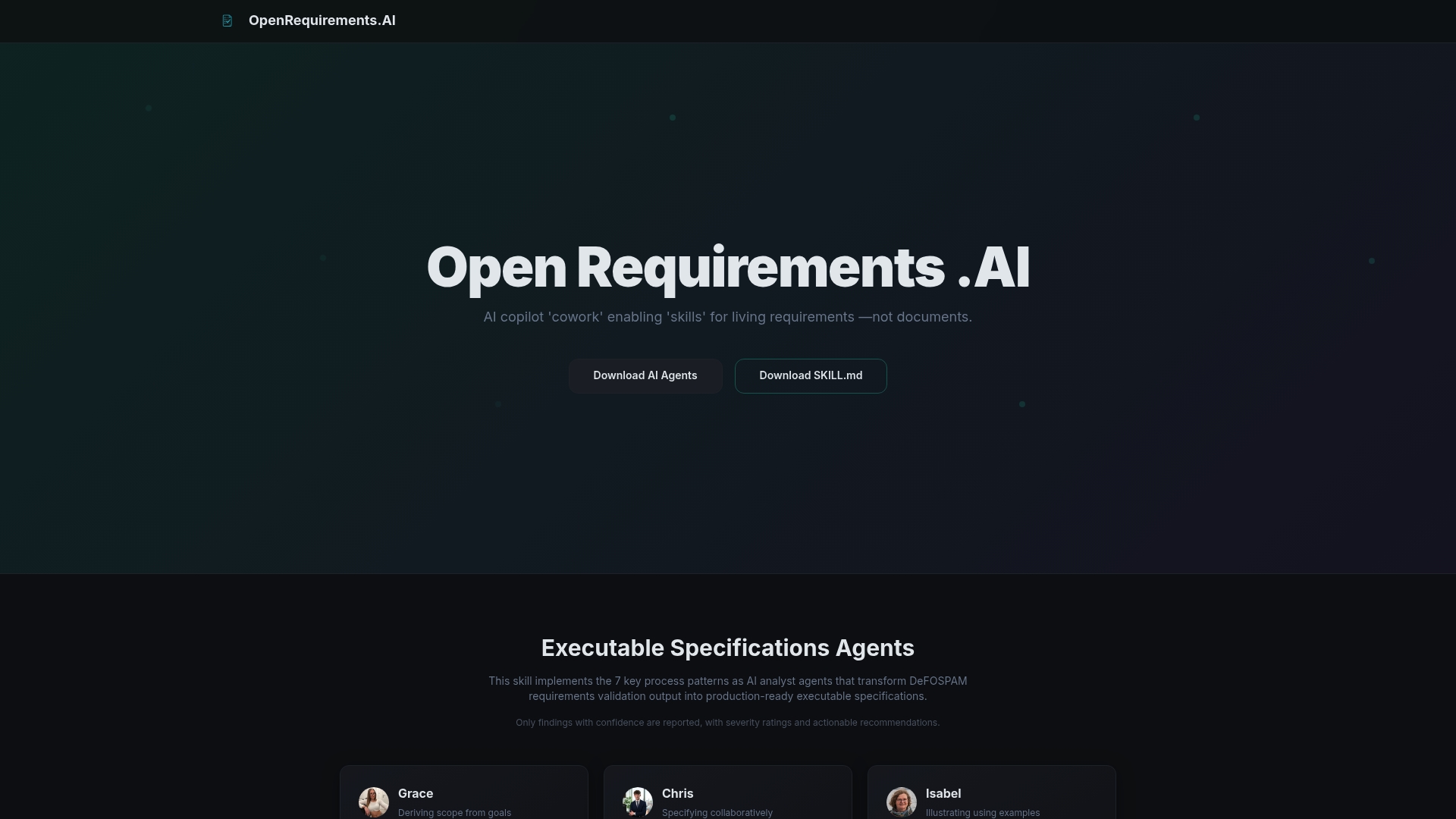
Multiple specialised AI agents inspect requirements sequentially under the DeFOSPAM methodology to spot ambiguity, missing definitions, and outcome gaps. The community contributes open source AI skills that extend analysis pipelines and agent behaviours. Reports include glossaries, business stories, severity ratings, and confidence scores to help members discuss changes.
Core Features
The platform runs AI analyst agents that validate requirements from many angles and produce executable specifications for development teams. It delivers structured reports with glossaries, business stories, severity ratings, and confidence scores to clarify stakeholder language. Multiple pipelines target requirements analysis, specification generation, and value engineering within a community driven model.
Key Differentiator
The defining trait is the sequential use of specialised agents guided by DeFOSPAM to examine definitions, features, outcomes, scenarios, predictions, ambiguity, and completeness. That sequence forces a thorough inspection rather than a single pass, which helps catch inconsistencies that commonly confuse delivery teams.
Pros
OpenRequirements.AI produces highly structured outputs that help members turn business language into testable requirements and executable specifications. The community model lets contributors add and refine AI skills, which can expand the types of checks available for members. Detailed reports with severity ratings and confidence scores make change discussions more precise and reduce misinterpretation across analysts and stakeholders.
Cons
- Analysis pipelines have a steep learning curve for members unfamiliar with requirements engineering or the DeFOSPAM method.
- Early stage community contributions may lack full documentation or active member support.
- The product lists no formal enterprise integrations or API support in its public description.
- Pricing details are not stated, which suggests limited commercial clarity for procurement teams.
When It May Not Fit
Teams without a requirements engineering background will hit a sharp learning curve when adopting this platform. Organisations that need vendor support or guaranteed documentation may find community resources insufficient. Delivery teams that require out of the box integrations or APIs will need to confirm availability before committing.
Who It's For
Members who work as requirements engineers, business analysts, or system analysts will gain the most from this community platform. Product managers and development teams that want clearer acceptance criteria and executable feature files will also find value. Small teams that can adapt to a community driven toolset will see immediate gains.
Real World Use Case
A requirements team uploads a large business requirements document and runs the sequential agent pipeline to produce executable feature files. The team uses glossaries and business stories to align stakeholders and to remove ambiguous terms before handoff to developers. The result is clearer acceptance criteria and fewer rework cycles.
Website: https://openrequirements.ai
v0
At a Glance
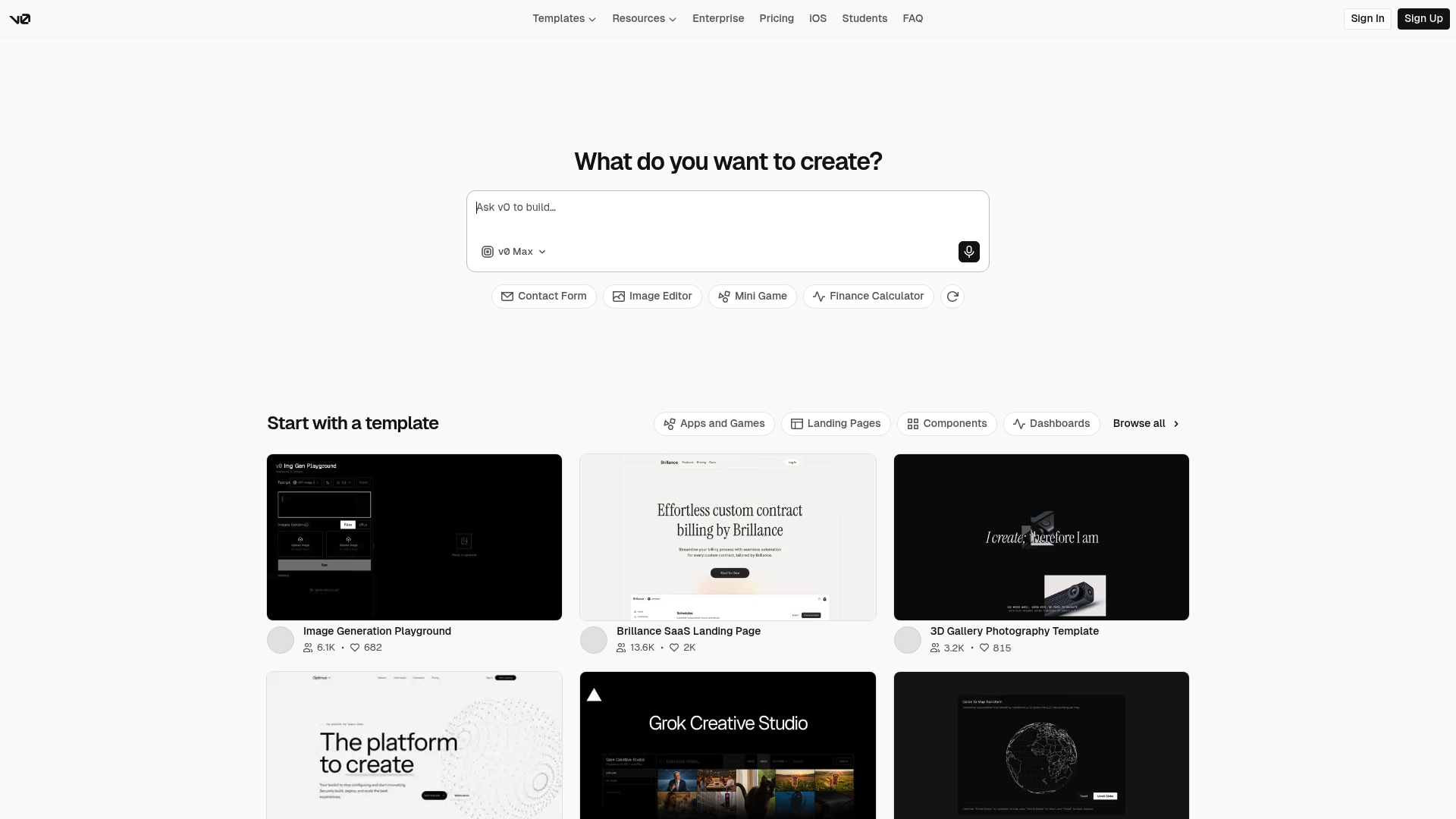
Publish a site instantly to Vercel from the editor. The editor pairs templates with agentic AI to assemble pages, routes, and connections automatically. The platform also offers an iOS app so teams can edit or preview projects on the move.
Core Features
v0 generates web applications with AI and supplies a visual editor to edit layouts and flows. It offers ready templates for landing pages, dashboards, portfolios, and e commerce, and it can sync code with GitHub repositories for continuity between design and source. The platform connects to external APIs without forcing separate account setup and deploys live sites directly to Vercel.
Key Differentiator
Agentic AI that plans and wires components distinguishes this product. That approach reduces manual wiring between frontend, APIs, and deployment. The bundled path from idea to a live Vercel deployment suits teams that want output fast rather than crafting every integration by hand.
Pros
The visual editor and templates make the first prototype fast to build, which cuts the time to a working demo. Built in GitHub syncing and direct Vercel deployment keep code and hosting aligned, which helps handoffs to engineers. Collaboration controls and systemised design tokens let small teams keep multiple projects consistent while the mobile app enables quick edits and previews away from a desk.
Cons
Limited deep customisation: heavy custom logic or bespoke UI work will require exporting code and extending it outside the platform.
Pricing pressure: the per user pricing may rise for larger teams and could change total project cost.
Platform dependence: relying on the platform for AI generation and deployment can create vendor lock in over time.
When It May Not Fit
If your project needs advanced backend logic, complex database modelling, or highly custom interactions, this product will feel restrictive. Organisations that require full control over CI pipelines or self hosted deployment will find the hosted Vercel workflow limiting. If your team plans to run dozens of enterprise grade apps under a single budget line, the per user pricing model might not match your procurement needs.
Notable Integrations
Vercel for instant deployment and preview environments.
GitHub for repository sync and version control.
Connects to third party APIs for payments, data, or services without separate account setup when supported.
Who It's For
Web developers, UX designers, and startup founders who need to validate ideas quickly will get the most value. Small to medium sized teams that favour rapid prototyping and frequent iterations will benefit from the template plus deploy workflow. Designers who want to produce production ready layouts without deep dev resources will find the mobile app and visual editor useful.
Real World Use Case
A small startup built a public portfolio site and an internal metrics dashboard during a single sprint. The team used templates to shape the UI, synced with GitHub for code review, and deployed the sites to Vercel from the editor. Collaboration features let the designer and developer iterate without losing alignment.
Pricing
Pricing tiers start with a Free plan and then move to Team at $30 per user per month and Business at $100 per user per month. Enterprise plans are available with custom pricing for larger organisations. Assess pricing against expected seat counts before committing for a multi project rollout.
Website: https://v0.dev
Comparison of alternatives
Among the evaluated tools, Blueprint AI stands out due to its unique capability of swiftly generating and cohesive technical specifications directly from user input within a minute. This ability ensures a experience for startups and entrepreneurs seeking to streamline early-stage software planning processes. However, the other contenders also demonstrate notable strengths that cater to specific project requirements.
Specification generation approaches
Blueprint AI excels in its capacity to generate highly detailed technical blueprints rapidly. Contrastingly, while Gluecharm integrates AI-powered requirements extraction directly from meeting recordings, its focus primarily aligns with regulated projects requiring version histories and audit trails. OpenRequirements.AI introduces a methodical DeFOSPAM technique through community-driven AI agent contributions, fostering a flexible and adaptable tool. Meanwhile, v0 prioritises rapid prototyping outputs, allowing users to deploy application concepts swiftly.
Key differentiators and specialised capabilities
Regarding traceability and compliance, Gluecharm offers live audit trails and version histories, ideal for adhering to regulations. OpenRequirements.AI's iterative analysis framework suits teams desiring meticulously verified requirements, while v0's tight integration with platforms like Vercel facilitates immediate deployment of user-created interfaces. Blueprint AI, however, provides an advantage for solo developers and emerging businesses aiming for rapid turnaround times with its automated blueprinting process.
Best fit
- If your priority is producing technical blueprints in a time-efficient manner, Blueprint AI remains.
- Teams addressing requirements within heavily regulated industries will benefit from Gluecharm's structured governance and auditing tools.
- Organisations seeking community participation to tailor analytical pipelines for requirements validation should consider OpenRequirements.AI.
- Development teams looking for rapid UI prototyping and deployment with minimal setup will appreciate v0's integrated systems.
Our pick
Blueprint AI remains the preferred choice for users prioritising swift, complete, and intuitive technical specifications creation while supporting early-stage validation. With its rapid generation methodology and detailed outputs suitable for startups and independent developers, it sets itself apart from alternatives focusing on niche requirements or workflows.
Choosing the best technical specification generator involves examining key features and differentiators.
| Product | Core Features | Key Differentiator | Best For | Notable Limitation |
|---|---|---|---|---|
| Blueprintbot | Generates software blueprints with AI in under a minute | Structured specs from plain English descriptions | Founders and small teams needing a fast technical blueprint | May need expert review for complex projects |
| Gluecharm | AI-powered requirements analysis with full traceability | Focus on governance and compliance requirements | Enterprise teams in regulated environments | Steep learning curve for new users |
| OpenRequirements.AI | AI analyst agents for comprehensive requirements validation | Sequential DeFOSPAM analysis for thorough inspection | Requirements engineers and system analysts | Steep learning curve for newcomers to tools |
| v0 | Visual editor with integrated Vercel deployment | Instant publishing and live site updates | Teams needing rapid website prototyping | Limited customisation capabilities |
Choosing the Right Software Blueprint Solution for Your Needs
The search for effective codika.io alternatives highlights a common challenge: turning app ideas into clear technical plans quickly and without coding experience. Blueprintbot meets this need by creating detailed software blueprints in seconds. It covers system architecture, API designs, UI flows, and cost estimates, helping founders and product managers communicate precisely with development teams.
Blueprintbot also features an AI chat assistant that lets you adjust your blueprint instantly. This cuts delays and clarifies requirements early. Visit Blueprintbot to generate your app roadmap and technical document all in one place. Get your software specification ready for developers and investors within a minute and keep your project moving forward.
FAQ
How does Blueprintbot generate technical specifications?
Blueprintbot generates complete software blueprints in under 60 seconds. This rapid output enables transformation of a plain English app idea into a structured plan quickly, allowing founders and product managers to efficiently brief developers or prepare pitches.
What is the difference between Blueprintbot and Gluecharm?
Gluecharm excels in providing a complete audit trail and version history for requirements, making it particularly strong in regulated environments. Blueprintbot, on the other hand, focuses on generating structured software specifications rapidly from plain English descriptions, which is better suited for initial planning and quick iterations.
Which platform offers tailored recommendations by app type?
Blueprintbot provides tailored recommendations based on app type and scale, which helps users refine their tech specifications further. This feature enhances the planning process for founders and entrepreneurs aiming to align their app's architecture with specific industry norms.
Can I use Gluecharm for smaller, simple projects?
Gluecharm is primarily designed for enterprise and regulated environments, making it more complex than necessary for smaller projects. Founders and small teams may benefit from using Blueprintbot for a more straightforward technical specification generation process.
How does Blueprintbot support non-technical founders?
Blueprintbot produces comprehensive documentation designed for non-technical founders, which includes various blueprint sections like system architecture and cost estimates. This approach aids entrepreneurs in understanding technical requirements without needing in-depth expertise.
How quickly can Blueprintbot deliver a technical spec?
Blueprintbot can generate a full technical spec in under one minute. This rapid generation allows teams to move from concept to concrete planning efficiently, ideal for entrepreneurs looking to validate their ideas swiftly.