Align team on technical vision: a 2026 guide

A technical vision is the shared framework that connects every technology decision your team makes to your project's business goals. Without it, engineers and product managers pull in different directions, and the cost shows up fast. Rollback rates above 25–30% signal that a team's technical approach has lost cohesion. The goal of this guide is to help you align your team on a technical vision that is clear, enforceable, and built to last through the full arc of a project.
What does it take to align your team on a technical vision?
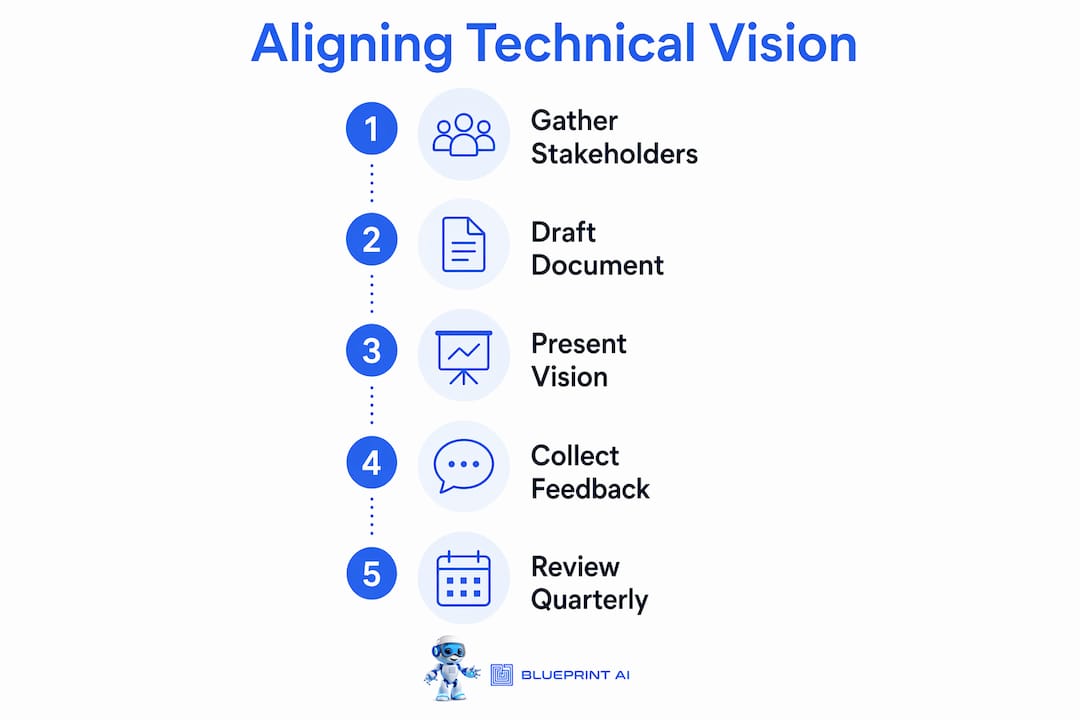
Alignment starts before you write a single line of documentation. The first step is getting the right people in the room: engineers, product managers, and business leaders. Each group holds a different piece of the puzzle. Engineers understand technical constraints. Product managers know user priorities. Business leaders set the commercial boundaries. Skipping any one group creates a vision that the others will quietly ignore.
Once stakeholders are engaged, the document itself must be tight. Effective technical strategies contain five or fewer core decisions, run 2–3 pages, and are readable in under ten minutes. That constraint is not arbitrary. A document no one reads is not a strategy. It is a filing cabinet.

Two tools make the alignment process concrete.
Technology radars are shared maps that track your team's stance on specific tools, frameworks, and techniques. A technology radar updated quarterly signals which technologies are approved, under evaluation, or retired. Non-engineers can read it without a technical background, which makes it one of the most effective cross-functional communication tools available.
Live all-hands meetings reinforce the vision across the full team. 62% of product leaders use live all-hands presentations as their primary communication channel for technical direction. That number reflects a clear preference for real-time dialogue over static memos.
| Tool | Purpose | Who benefits most |
|---|---|---|
| Technical strategy document | Records core decisions and constraints | All team members |
| Technology radar | Tracks technology positions and risks | Engineers and tech leads |
| Live all-hands meetings | Reinforces vision and invites questions | Cross-functional teams |
| Shared OKRs | Ties product and technical health metrics | Product managers and engineers |
How do you develop and communicate a clear technical vision?
The strategy document is the foundation, but most teams write it wrong. They list goals. Goals are not decisions. A decision tells the team what you will build, what you will not build, and why.
Start with this structure for each core decision:
- State the decision plainly. One sentence. No qualifiers.
- Explain the practical implication. What does this mean for daily work?
- Write the explicit "not doing" section. A technical strategy must state what the team is NOT doing. Without negative constraints, teams pursue every new framework and the strategy collapses into noise.
- Add a memorable phrase. A short, slogan-like statement helps the team recall the decision under pressure. "We build for reliability before speed" is more durable than a paragraph.
- Involve senior engineers in the draft. Their buy-in turns the document from a leadership decree into a shared commitment.
When presenting the vision at an all-hands meeting, keep slides minimal. One decision per slide. Read the "not doing" section aloud. Invite pushback in the room rather than letting it fester in Slack threads afterward. Disagreement surfaced early is far cheaper than disagreement surfaced during a sprint.
Pro Tip: Reference the strategy document by name the next time a team member proposes a new tool or approach. Saying "Let's check this against our strategy doc" takes thirty seconds and signals that the document is a live guide, not a shelf decoration.
After the all-hands, collect written feedback from engineers within 48 hours. Revise the document based on that input. One revision cycle before finalising the document builds ownership across the team.
What are the warning signs of technical misalignment?
Misalignment rarely announces itself. It accumulates quietly until a project hits a wall. The clearest quantitative signal is a high rollback rate. When rollbacks exceed 25–30% of deployments, the team is consistently reversing decisions. That pattern points to friction in the underlying technical approach, not just individual errors.
Beyond metrics, watch for these behavioural signals:
- Language drift. Team members use the same terms with different meanings. "Done" means merged to one engineer and deployed to another. These gaps compound over weeks.
- Parallel solutions. Two sub-teams build separate tools for the same problem without knowing it. This is a direct symptom of siloed decision-making.
- Metric conflicts. Misalignment often stems from organizational design, not personalities. When product managers are measured on feature velocity and engineers are measured on system stability, they are structurally incentivised to conflict.
- Milestone-only check-ins. Teams that only discuss alignment at major milestones lose it between them.
"Alignment work is largely invisible and consists of many small conversations. Waiting for milestones risks losing it." — Esther Derby
The fix for most of these signals is not a new process. It is more frequent, lower-stakes conversation. Continuous small conversations prevent the trust erosion that milestone-only check-ins allow. A ten-minute weekly sync on technical decisions costs far less than a two-week rollback.
Pro Tip: When you notice two engineers describing the same feature differently, do not correct them in the moment. Schedule a thirty-minute session to map the shared vocabulary. That session often surfaces deeper misalignment than the original language gap.
How do you maintain alignment as your project evolves?
A technical vision written once and filed away is not a vision. It is a historical document. Maintaining alignment requires treating the strategy as a living document with a regular update cycle.
Quarterly reviews are the minimum cadence for most teams. Each review should answer three questions: Which decisions still hold? Which have been overtaken by new information? Which new decisions need to be added?
The technology radar supports this cycle directly. Technology radars act as living maps that help engineering teams evaluate tools and maintain alignment over time. Updating the radar quarterly keeps the team's technology positions explicit rather than assumed.
Three additional practices sustain alignment between formal reviews:
- Document the rationale, not just the decision. When a new engineer joins, they need to understand why a choice was made, not just what it was. Rationale documentation cuts onboarding time and prevents teams from relitigating settled decisions.
- Use shared OKRs. Tying product success metrics to technical health constraints forces product and engineering to optimise for the same outcomes. Shared OKRs resolve the structural tension that arises when the two groups are measured differently.
- Reference the strategy in daily decisions. A strategy becomes effective only when enforced through consistent reference. When a team lead cites the strategy document during a code review or a planning session, it signals that the document governs real choices.
| Maintenance practice | Frequency | Primary benefit |
|---|---|---|
| Strategy document review | Quarterly | Keeps decisions current and relevant |
| Technology radar update | Quarterly | Signals evolving technology positions |
| Rationale documentation | Per decision | Speeds up onboarding and reduces re-litigation |
| Shared OKR review | Monthly | Aligns product and engineering incentives |
Pro Tip: Add a single line to your pull request template: "Does this change align with our technical strategy?" That question takes two seconds to answer and surfaces misalignment before code is merged, not after.
For teams building AI-driven features, the stakes of misalignment are higher. AI integration failures often occur due to coordination breakdowns rather than model capability. Encoding goals as explicit, shared abstractions is the technical equivalent of a well-maintained strategy document. You can read more about managing AI integration challenges in complex product environments.
Key takeaways
Aligning a team on a technical vision requires a concise strategy document, continuous communication, and consistent enforcement through daily decisions.
| Point | Details |
|---|---|
| Keep the strategy document short | Limit core decisions to five or fewer and keep the document to 2–3 pages. |
| State what you will not do | Explicit "not doing" sections prevent scope creep and keep the strategy enforceable. |
| Watch rollback rates | Rollbacks above 25–30% are a reliable early signal of technical misalignment. |
| Use a technology radar | Update it quarterly to keep technology positions explicit and visible to the full team. |
| Enforce through daily reference | Citing the strategy document in real decisions turns it from a static file into a live guide. |
What I have learned about alignment that most guides skip
Most leaders treat alignment as a one-time event. They run a workshop, publish a document, and consider the job done. That approach fails within a quarter.
The real work of alignment is invisible. It happens in a five-minute conversation before a standup, in a comment on a pull request, in the way a team lead responds when someone proposes a tool that contradicts the strategy. None of that shows up in a project plan. All of it determines whether the vision holds.
I have seen technically excellent teams produce mediocre outcomes because their product and engineering groups were measured on conflicting metrics. The engineers were rewarded for stability. The product managers were rewarded for shipping. Neither group was wrong. The organisation had designed them to conflict. Shared OKRs fixed the incentive structure in ways that no amount of documentation could.
The other thing most guides miss is the power of the "not doing" list. A strategy without negative constraints is not a strategy. It is a wish list. When you tell a team what you are not building, you give them permission to say no. That permission is one of the most productive gifts a leader can give.
If you want to build a scalable architecture roadmap that your team will actually follow, start with the constraints. The positive decisions will be easier to make once the boundaries are clear.
— Rishi
How Blueprintbot can help you build a shared technical vision
Getting a technical vision out of your head and into a format your whole team can act on is the hardest part of the process.
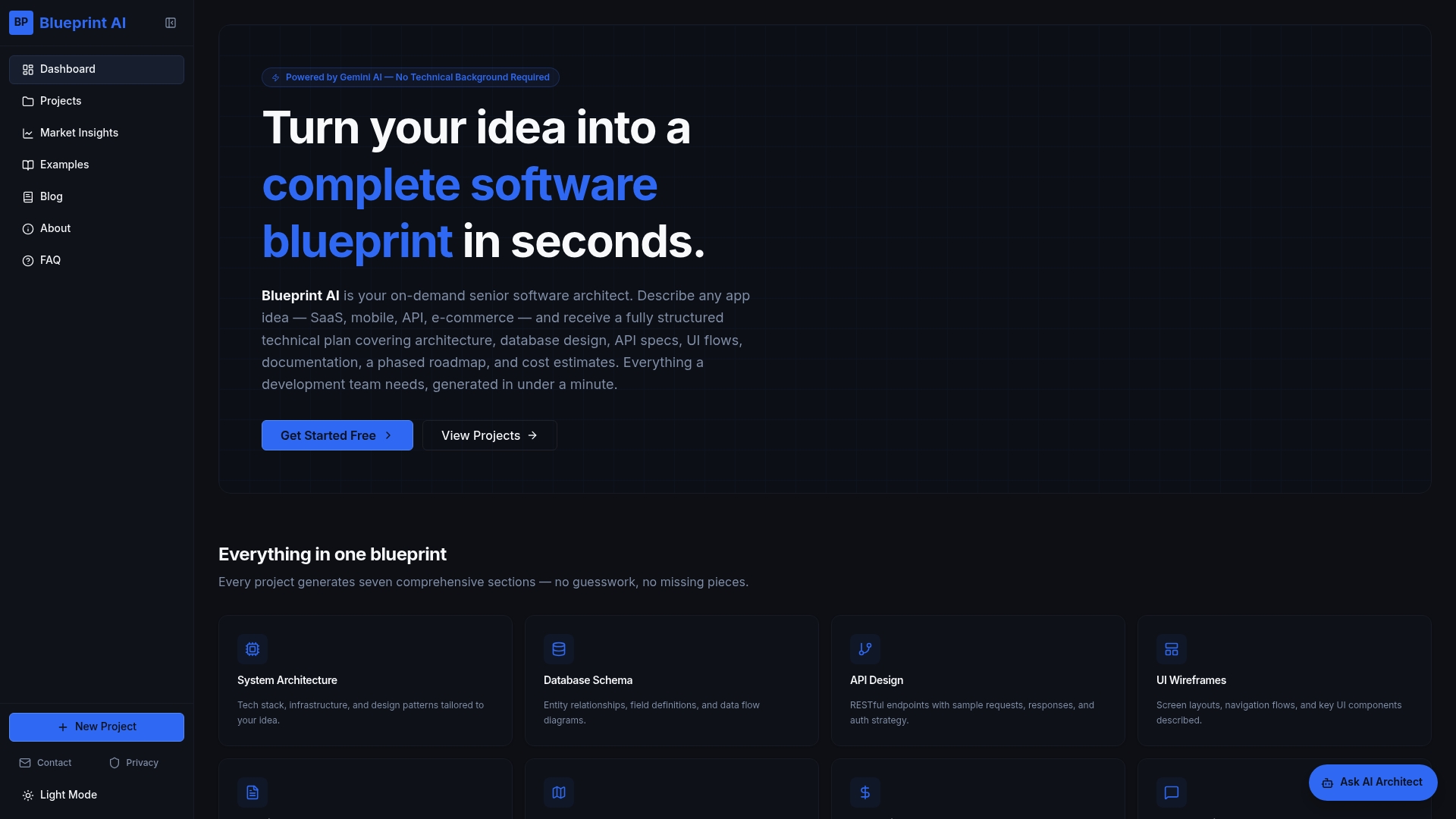
Blueprintbot generates complete software blueprints from your app idea in seconds, covering system architecture, API designs, database schemas, and development roadmaps. Those outputs give your team a concrete starting point for alignment conversations rather than a blank page. Product managers and engineers can review the same document, spot gaps, and reach decisions faster. You can also explore Blueprintbot's free planning tools to draft, visualise, and share your technical direction with the full team before a single line of code is written.
FAQ
What is a technical vision document?
A technical vision document is a concise record of a team's core technology decisions, typically five or fewer, written in 2–3 pages. It connects technology choices to business goals and states explicitly what the team will not build.
How do you align teams on technical vision across departments?
Engage engineers, product managers, and business leaders in drafting the strategy, then reinforce it through live all-hands meetings and shared OKRs that tie product and technical metrics together.
What does a rollback rate above 25–30% mean for alignment?
A rollback rate above 25–30% signals that the team's technical approach lacks cohesion. It is a reliable early warning that the strategy document needs review or enforcement.
How often should a technical vision be updated?
Quarterly reviews are the standard minimum cadence. Each review should confirm which decisions still hold, which need revision, and which new decisions the team must add.
What is a technology radar and why does it matter?
A technology radar is a shared map that tracks a team's position on specific tools and frameworks, updated quarterly. It makes technology decisions visible to non-engineers and reduces the risk of adopting conflicting or unsupported tools.