Benefits of AI-generated technical plans in 2026

AI-generated technical plans are structured project specifications produced by artificial intelligence from a natural language brief, covering architecture, database design, API flows, and development roadmaps. The benefits of AI-generated technical plans are measurable and significant: teams reduce total project time by about 33%, with build times dropping up to 60% due to fewer rework cycles. Platforms like Blueprintbot, Bito AI, and PADISO are reshaping how founders, product managers, and engineers scope and execute software projects. If you are still writing technical specs by hand, you are leaving both time and money on the table.
1. What are the top benefits of AI-generated technical plans?
AI-generated technical plans, also called AI-driven technical design documents, deliver advantages across every phase of software development. The gains are not marginal. They are structural.
Faster development cycles
AI-driven planning reduces development costs by 23–45% and shortens time from concept to market by 40%. A project that once took 12 weeks now averages 8. That compression comes directly from cleaner specs that require less interpretation from your development team.

Fewer rework cycles
Rework is the silent budget killer in software projects. When specs are ambiguous, developers build the wrong thing, then rebuild it. AI-generated plans produce precise, unambiguous documentation that cuts build time by up to 60% by eliminating the back-and-forth that causes most rework.
Lower development costs
Automating repetitive planning tasks, such as writing boilerplate documentation, generating database schemas, and drafting API contracts, removes hours of manual effort per sprint. The result is a 23–45% cost reduction across the product design phase. For an early-stage startup, that difference can determine whether a product ships within budget.
Improved design quality
Design quality improves by about 34% when AI handles repetitive optimisation and documentation tasks. That figure reflects fewer architectural errors, more consistent naming conventions, and better-structured data models. Your senior engineers spend less time correcting junior mistakes and more time on decisions that actually require their judgement.
Faster architectural sign-off
Subagent-driven architectural reviews cut senior sign-off time from two weeks to between 2 and 5 days. That is a 40–60% reduction in review cycle time. For product managers tracking sprint velocity, that acceleration directly moves release dates forward.
Clearer project scoping
AI planning tools can generate structured plans from vague briefs within minutes, moving a project from 0% to 80% completion on the planning stage almost immediately. That speed gives product managers a concrete scope document to share with stakeholders before a single line of code is written.
Better team communication
Ambiguous requirements cause more project failures than technical complexity. AI-generated plans produce structured, version-controlled documentation that every team member reads from the same source. The result is fewer misunderstandings between founders, designers, and developers. Blueprintbot's use cases show this benefit across startups, freelancers, and enterprise product teams alike.
Pro Tip: Spend 20% more time refining your initial brief before feeding it to an AI planning tool. That upfront investment yields a 60% reduction in build time downstream, according to Pendulum's Plan Mode research.
2. How AI integrates into technical planning workflows
Understanding the mechanics behind AI-driven project management helps you use these tools correctly rather than treating them as magic.
Plan Mode: precision as input
Plan Mode is a workflow approach where you write precise, AI-consumable specifications before triggering any code generation or design output. The principle is straightforward: the quality of your input determines the quality of your output. Spending roughly 20% more time on precise plans enables a 60% reduction in build time because the AI receives unambiguous instructions. Vague briefs produce vague plans. Precise briefs produce production-ready documentation.
Subagent architectures for review
Multi-agent loops use distinct Planner and Reviewer subagents that challenge and refine each other's outputs iteratively. The Planner subagent drafts the architecture. The Reviewer subagent stress-tests it against constraints, edge cases, and past project data. This iterative cycle improves design robustness without requiring a senior engineer to run every review manually. You can read more about scalable architecture approaches that complement this workflow.
Grounded retrieval from enterprise data
The highest ROI from AI technical planning comes from grounding outputs in real project context. Integrating retrieval from ERP systems, codebases, and past project data using knowledge graphs reduces the risk of AI hallucinations and ensures designs reflect actual constraints. An AI that draws on your existing codebase produces far more feasible recommendations than one working from a blank slate. This approach is especially relevant for teams managing AI tools for cost control across multiple projects.
"AI is not a shortcut past planning. It increases the value of rigorous upfront planning by producing higher-quality outputs." — Pendulum, Plan Mode Research
Pro Tip: Connect your AI planning tool to your existing codebase or past project documentation before generating a new plan. Grounded outputs are significantly more accurate and require far less revision.
The critical mistake most teams make is skipping the planning phase entirely and asking AI to generate code directly. That approach produces technically functional but architecturally fragile software. The planning phase is where AI delivers its greatest leverage.
3. How AI plans benefit founders, product managers, and engineers
The advantages of AI design are not uniform across roles. Each stakeholder gains something specific.
Founders gain the most from speed and cost predictability:
- Market readiness accelerates because a complete technical specification can be produced in minutes rather than weeks
- Cost estimates are generated alongside the plan, giving founders budget visibility before hiring a development team
- Investor conversations become more credible when backed by a structured technical document rather than a slide deck
Product managers gain clarity and control:
- AI-generated project outlines convert vague feature requests into structured user stories and acceptance criteria
- Resource allocation updates dynamically as the plan evolves, reducing the manual effort of sprint planning
- Scope creep becomes easier to resist when the original plan is documented, versioned, and visible to all stakeholders
Engineers gain time and quality:
- Higher-quality specs mean fewer clarification meetings and less time spent interpreting ambiguous requirements
- AI automates repetitive tasks across product design phases, improving retention and satisfaction among design and engineering staff
- Architectural patterns are suggested based on project constraints, reducing the cognitive load of starting a new system from scratch
The software technical specification process benefits all three roles simultaneously because a single AI-generated document serves as the shared source of truth.
4. AI-generated plans vs. traditional planning: a direct comparison
Traditional planning relies on senior engineers writing documentation manually, often over days or weeks. AI-driven project management compresses that timeline dramatically. The table below summarises the key differences.
| Metric | Traditional planning | AI-generated planning |
|---|---|---|
| Initial planning time | 5–10 days | 1–4 hours |
| Total project duration | 12 weeks (average) | 8 weeks (average) |
| Rework cycles | High (ambiguous specs) | Low (precise documentation) |
| Architectural sign-off | 10–14 days | 2–5 days |
| Cost reduction vs. baseline | None | 23–45% |
| Design quality improvement | Baseline | ~34% improvement |
The numbers tell a clear story. AI efficiency in engineering is not a theoretical benefit. It is a documented, repeatable outcome across multiple independent studies from Pendulum, PADISO, and Technource. The open source architecture case studies on Blueprintbot's blog illustrate how these gains appear in real projects.
Traditional planning also concentrates knowledge in the heads of senior engineers. When those engineers leave or are unavailable, projects stall. AI-generated documentation distributes that knowledge into a persistent, searchable artefact. That shift alone reduces organisational risk significantly.
Scaling AI agents across planning and review functions compounds these gains further, particularly for teams running multiple concurrent projects.
Key takeaways
AI-generated technical plans reduce total project time by 33%, cut build time by up to 60%, and lower development costs by 23–45% by replacing ambiguous manual documentation with precise, AI-driven specifications.
| Point | Details |
|---|---|
| Time savings are substantial | Projects compress from 12 weeks to 8 weeks on average with AI-generated plans. |
| Upfront investment pays off | Spending 20% more time on precise briefs yields a 60% reduction in downstream build time. |
| Cost reductions are documented | AI planning cuts development costs by 23–45% by automating repetitive documentation tasks. |
| Sign-off cycles accelerate | Subagent architectural reviews reduce senior sign-off from two weeks to 2–5 days. |
| All roles benefit differently | Founders gain speed, product managers gain scope clarity, and engineers gain higher-quality specs. |
Why I think most teams are still underusing AI planning
I have watched dozens of product teams adopt AI tools and make the same mistake: they use AI to generate code faster while skipping the planning phase entirely. The result is a faster path to a fragile product.
The real value of AI in technical planning is not speed for its own sake. It is the quality of the thinking that gets captured before a single line of code is written. When you invest in a precise plan, you are not just feeding instructions to an AI. You are forcing your own team to resolve ambiguities, agree on constraints, and commit to a direction. The AI surfaces those gaps faster than any whiteboard session.
What I find most underappreciated is the communication benefit. A well-structured AI-generated plan changes how founders talk to developers. It replaces "here is what I want" with "here is what we agreed." That shift eliminates an enormous amount of friction in early-stage product development. Blueprintbot's approach of producing structured outputs covering architecture, database schemas, and API designs in seconds is not just a productivity tool. It is a communication protocol.
My advice: treat the planning phase as the product. The code is just the output.
— Rishi
Start your next project with a blueprint, not a guess
Blueprintbot is built for exactly the scenario this article describes: you have an idea, you need a technical plan, and you do not have weeks to spend writing documentation manually.
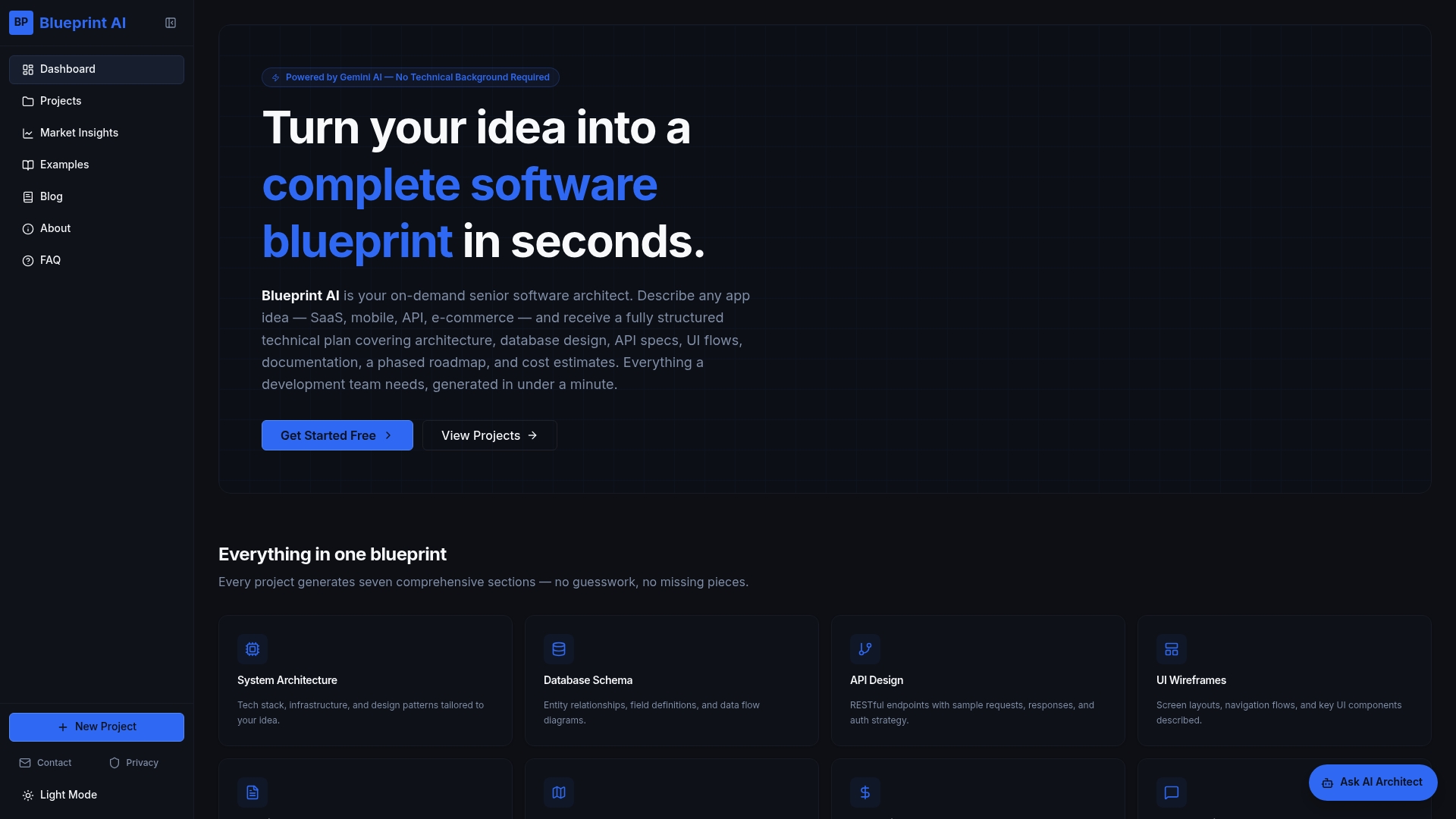
The platform generates complete software blueprints covering system architecture, database schemas, API designs, user interface flows, and development roadmaps within seconds. You can explore worked blueprint examples to see what a finished plan looks like before you commit to anything. If you want to scope your project first, the free planning tools include a development time estimator and an MVP feature prioritiser that help you define scope before generating a full blueprint. The path from idea to development-ready specification has never been shorter.
FAQ
What are the main benefits of AI-generated technical plans?
AI-generated technical plans reduce total project time by about 33%, cut build time by up to 60%, and lower development costs by 23–45%. They also improve design quality by approximately 34% by automating repetitive documentation tasks.
How does AI in project planning reduce costs?
AI automates repetitive tasks such as writing documentation, generating schemas, and drafting API contracts, removing hours of manual effort per sprint. This automation drives a 23–45% cost reduction across the product design phase.
Do I need technical skills to use AI planning tools?
No. Platforms like Blueprintbot are designed specifically for founders and product managers without coding skills. You provide a natural language description of your app idea, and the platform generates a complete technical specification automatically.
How does AI improve communication between founders and developers?
AI-generated plans produce structured, version-controlled documentation that serves as a shared source of truth for all team members. This reduces ambiguity, cuts clarification meetings, and aligns everyone around a single agreed specification before development begins.
What is Plan Mode and why does it matter?
Plan Mode is a workflow approach where you write precise, AI-consumable specifications before triggering any output. Spending roughly 20% more time on the plan upfront enables a 60% reduction in build time, according to Pendulum's research.