App idea evaluation checklist: a 2026 guide for founders

An app idea evaluation checklist is a structured scoring tool that tests your concept across problem clarity, market demand, user willingness to pay, and technical feasibility before you write a single line of code. Most founders skip this step and pay for it later. The validation process can be completed in 14 to 30 days for as little as $0 to $500 using low-cost smoke-test methods. That timeline is short enough to run before committing any serious budget. A systematic mobile app assessment guide like this one separates ideas worth building from ideas worth abandoning.
1. What are the core criteria in an app idea evaluation checklist?
A strong app idea evaluation checklist covers five distinct categories. Each one acts as a gate. Failing any single gate does not automatically kill the idea, but it signals where you need more evidence before moving forward.
Problem clarity

The problem your app solves must be specific, documented, and felt by real people. Vague problems produce vague products. Write the problem in one sentence. If you cannot do that, the idea is not ready to evaluate.
Market demand
Demand signals include search volume on Google Trends, active threads on Reddit and niche forums, and download counts for similar apps in the App Store or Google Play. These signals tell you whether people are already looking for a solution.
User willingness to pay
This is the most heavily weighted criterion in any app concept validation process. Verbal interest means nothing. A user who hands over an email address or a pre-payment is giving you real evidence. Everything else is noise.
Technical feasibility
Assess whether the core feature set can be built with your current skills or budget. A technical plan without coding is achievable using AI-assisted planning tools, which means non-technical founders can still complete this step accurately.
Business model viability
Define how the app makes money before you build it. Subscription, freemium, transactional, and advertising models each carry different acquisition cost assumptions. Validate the model alongside the product.
Pro Tip: Run all five criteria in parallel, not sequentially. Waiting to finish problem research before starting market research adds weeks with no benefit.
2. How to use behavioural validation to confirm real user interest
Behavioural validation is the practice of measuring what users do, not what they say. It is the most reliable signal in any app idea analysis.
"Validation hinges on behavioural evidence such as pre-commitments rather than relying on verbal affirmations from friends or biased feedback."
Verbal feedback is distorted by politeness. A friend who says "I'd definitely use that" is not a paying user. A stranger who enters their credit card number is. The gap between those two responses is where most failed apps are born.
Conducting user interviews the right way
The Mom Test methodology solves the politeness bias problem directly. The core rule is simple: never ask whether someone would use your app. Ask how they currently handle the problem. Focus on their existing behaviour, their workarounds, and the cost of those workarounds in time or money. That conversation reveals whether the problem is real and painful enough to pay to fix.
Smoke-test landing pages
A smoke-test landing page describes your app's core value and asks visitors to sign up or pre-pay. The conversion rate tells you whether the messaging resonates. An 8% to 15% signup rate on a landing page indicates strong demand. A rate below 5% signals that you need to pivot your messaging or reconsider the concept entirely. Drive 200 to 500 visitors to the page using paid ads or organic social posts before drawing conclusions.
Pre-sales and pre-commitments
Asking users to pay before the product exists is the highest-confidence validation signal available. Even a small number of pre-sales proves willingness to pay in a way that no survey can replicate. A validated app idea typically passes at least 5 out of 7 key success signals, with pre-sales and unprompted behavioural demand evidence among the most critical.
3. How to integrate market and competitor research into your evaluation
Market research for app ideas does not require expensive reports. The best sources are free and already populated with honest user opinions.
Google Trends shows whether search interest in your problem category is growing, flat, or declining. A declining trend is a warning sign. A growing trend confirms timing.
App store reviews are the most underused research tool in mobile app assessment. Read the two-star and three-star reviews for apps in your category. Those reviews describe exactly what users wanted and did not get. Abandoned apps in the app stores are especially valuable. Their review sections reveal stagnant markets and unmet features that a new entrant could address directly.
Reddit and niche forums surface raw, unfiltered complaints. Search for threads where people describe the problem your app solves. Count how many people engage with those threads. High engagement with no good solution in the replies is a strong demand signal.
Pro Tip: Build a simple competitor matrix with four columns: app name, core feature, most common complaint, and last update date. Apps that have not been updated in 18 months or more often signal an abandoned market or a gap a focused product could fill.
| Research source | What it reveals | Best use |
|---|---|---|
| Google Trends | Search interest over time | Timing and category growth |
| App store reviews | Feature gaps and user frustration | Product differentiation |
| Reddit and forums | Raw problem statements | Problem validation |
| Competitor update history | Market activity level | Opportunity sizing |
Sizing your addressable market does not need to be precise at this stage. A rough estimate of how many people experience the problem, multiplied by a realistic price point, tells you whether the opportunity justifies the build cost.
4. Evaluating technical and business feasibility before building
Technical feasibility is not about whether the idea is possible. Almost anything is technically possible. The question is whether it is possible for your team, with your budget, in a reasonable timeframe.
- Define your MVP scope first. An MVP is not a stripped-down version of your full vision. It is the smallest set of features that tests your core assumption. Building an MVP before confirming problem-solution fit wastes resources. Behavioural validation must come first.
- Assess founder-market fit. A checklist for app concepts is incomplete without accounting for the founder's skills and context. Founder-market fit influences whether an idea is viable for a specific team. An app that requires deep healthcare compliance expertise is a poor fit for a solo founder with no industry background.
- Validate unit economics early. Estimate your customer acquisition cost and compare it to your expected lifetime value per user. If the numbers do not work at a small scale, they will not work at a large scale either.
- Set a validation budget. The recommended validation budget sits between $300 and $800, covering landing pages, paid ads, and no-code MVP tools. Spending above $1,500 before you have paying users is a risk signal.
Pro Tip: Use Blueprintbot to generate a technical specification from your app idea before hiring a developer. The output includes system architecture, API design, and a cost estimate, which gives you a realistic feasibility picture in minutes rather than weeks.
You can also use the tech stack finder to identify the right technology combination for your concept without needing a technical co-founder to weigh in first.
5. How to aggregate checklist results into a clear build decision
A checklist without a scoring system is just a list. The scoring system is what turns your research into a decision.
The pass/fail model works well for early-stage app project feasibility. Assign each criterion a binary outcome: pass or fail. Weight willingness to pay and behavioural demand signals more heavily than the others, because those two criteria predict revenue directly.
| Criterion | Pass condition | Weight |
|---|---|---|
| Problem clarity | One-sentence definition confirmed by interviews | High |
| Market demand | Active search volume and forum engagement | Medium |
| Landing page conversion | 8% or above signup rate | High |
| Willingness to pay | Pre-sale or pre-commitment received | Very high |
| Technical feasibility | MVP scope defined within budget | Medium |
| Founder-market fit | Skills align with problem domain | Medium |
| Business model | Revenue model validated against unit economics | High |
A concept that passes 5 or more of these seven criteria with strong behavioural signals is ready for no-code MVP testing. A concept that passes fewer than three should be pivoted or abandoned. The pivot condition is specific: if problem clarity and market demand pass but willingness to pay fails, the problem may be real but not painful enough to monetise. That is a pricing or positioning problem, not a product problem.
Avoid confirmation bias at this stage. Founders who want their idea to succeed will unconsciously weight passing signals and dismiss failing ones. Run the checklist with a partner or advisor who has no emotional stake in the outcome. Two out of four cheap validation channels passing is enough to proceed to no-code MVP testing. You do not need a perfect score to move forward.
Key takeaways
A validated app idea requires passing at least five of seven core criteria, with willingness to pay and behavioural demand signals carrying the most weight in the final build decision.
| Point | Details |
|---|---|
| Behavioural signals beat verbal feedback | Pre-sales and signup conversions are more reliable than interview enthusiasm. |
| Smoke-test before you build | An 8% or higher landing page conversion rate confirms strong demand. |
| Score your checklist formally | Use a pass/fail system weighted toward willingness to pay and market demand. |
| Validation costs under $800 | A full validation cycle can be completed for $300–$800 before any development spend. |
| Founder-market fit matters | Align your skills and business model with the problem domain before committing to build. |
Why most founders use checklists wrong
The most common mistake I see is treating the checklist as a formality rather than a decision-making tool. Founders complete it after they have already decided to build, which means they are looking for confirmation rather than truth. That is the opposite of how it should work.
The second mistake is skipping the behavioural validation steps because they feel uncomfortable. Asking strangers to pre-pay for something that does not exist yet is awkward. But that discomfort is the point. If you cannot get a single pre-commitment from someone outside your network, the idea has a serious problem.
What I have found works best is running the checklist in two passes. The first pass is desk research: Google Trends, app store reviews, forum mining. That takes two to three days and costs nothing. The second pass is live validation: user interviews, a smoke-test landing page, and a pre-sale attempt. That takes one to two weeks and costs under $500. If the idea does not survive both passes, you have saved yourself months of development time and a significant amount of money.
The checklist also forces you to validate your mobile app idea before writing a single line of code, which is the only order that makes financial sense. Building first and validating later is how startups burn through their runway before finding product-market fit.
The founders who use this process well treat each failed criterion as a data point, not a defeat. A low landing page conversion rate tells you something specific about your messaging or your audience. That is useful information. A failed pre-sale attempt tells you the price point or the value proposition needs work. Fix it and test again. The checklist is iterative, not a one-time gate.
— Rishi
Blueprintbot turns a validated idea into a technical plan
Once your app idea passes the evaluation checklist, the next challenge is translating it into a technical specification that a developer or no-code builder can act on. That gap between validated concept and buildable plan is where most non-technical founders stall.
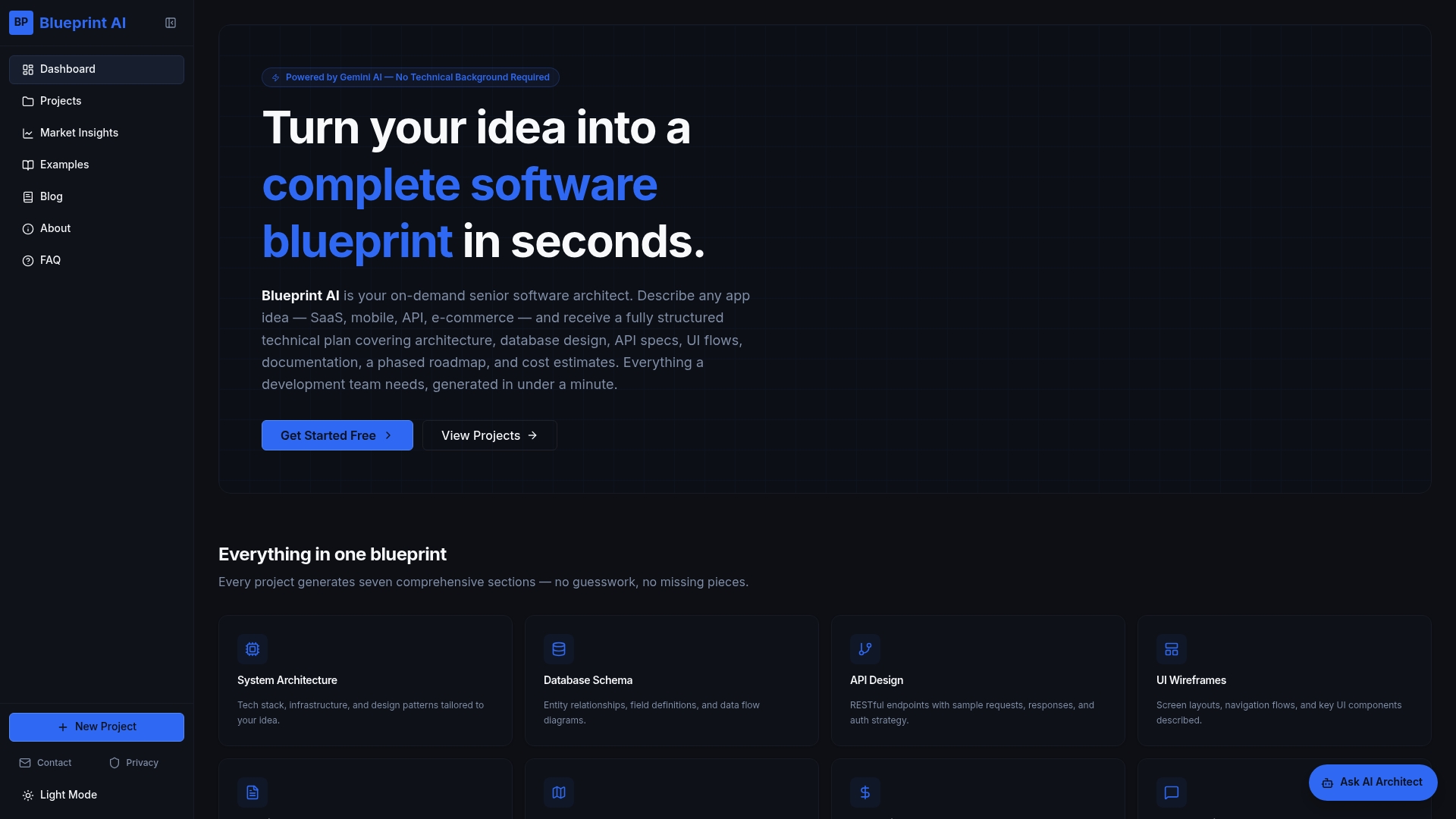
Blueprintbot generates a full software blueprint from your app idea in seconds. The output covers system architecture, database schemas, API design, user interface flows, and a development roadmap. You can browse example software blueprints to see how common app types are structured before you commit to a direction. For founders who want to go further, the free planning tools include an MVP feature prioritiser and a tech stack finder, both of which connect directly to your checklist outcomes.
FAQ
What is an app idea evaluation checklist?
An app idea evaluation checklist is a structured scoring tool that tests a concept across problem clarity, market demand, willingness to pay, technical feasibility, and business model viability before development begins.
How long does app idea validation take?
The full validation process takes 14 to 30 days using low-cost methods such as smoke-test landing pages, user interviews, and pre-sale attempts.
What conversion rate proves strong app demand?
A landing page signup rate of 8% to 15% indicates strong demand. A rate below 5% signals that the messaging or concept needs to be revised.
When should I build an MVP?
Build an MVP only after confirming problem-solution fit through behavioural signals such as pre-commitments or landing page conversions. Building before that confirmation wastes resources.
How many checklist criteria must pass before I proceed?
A concept should pass at least 5 out of 7 core criteria, with willingness to pay and behavioural demand signals weighted most heavily, before moving to no-code MVP testing.