What is event-driven architecture: a developer's guide

Event-driven architecture (EDA) is a software design pattern where decoupled services communicate asynchronously through meaningful events to achieve elasticity and low latency. Rather than one service calling another directly and waiting for a reply, each service produces or consumes events independently. This decoupling is the defining characteristic of EDA. It means producers never need to know which consumers exist, and consumers never block producers. The result is a system that scales horizontally, responds in real time, and handles complex workflows without creating tight dependencies between components.
What is event-driven architecture and how does it work?
EDA centres on three roles: producers, consumers, and an event broker. A producer detects a state change, such as a user completing a purchase, and publishes an event. The event broker distributes events asynchronously across distributed and multi-cloud systems without the producer waiting for any response. Consumers subscribe to the events they care about and react independently.
SponsoredCheck out today's featured offer →This model contrasts sharply with a traditional request-driven call. In a REST API call, the caller blocks until the server responds. In EDA, the producer fires an event and moves on immediately. That single difference has enormous implications for throughput and fault isolation.
A practical example makes this concrete. When a customer places an order on an e-commerce platform, a single OrderPlaced event can simultaneously trigger inventory reservation, payment processing, email confirmation, and fraud detection. Each service handles its own piece without knowing the others exist. No single service becomes a bottleneck.

Pro Tip: Design events to represent facts about the past, not commands for the future. "OrderPlaced" is a fact. "ProcessOrder" is a command. Facts decouple systems far more effectively than commands.
How does event-driven architecture differ from request-driven architecture?
Request-driven systems are preferred for user-facing operations needing immediate responses, while EDA excels in background workflows and decoupled services that would otherwise create bottlenecks. Understanding where each model fits prevents over-engineering.
Request-driven: synchronous and direct
Request-driven architecture follows a call-and-response pattern. Service A calls Service B and waits. This model is simple to reason about, easy to debug, and produces immediate feedback. Authentication flows, payment confirmations, and search queries all benefit from synchronous responses because the user is waiting.
The downside appears at scale. If Service B is slow or unavailable, Service A stalls. Every dependent service in the chain inherits that latency. Under high load, synchronous chains become cascading failure points.
Event-driven: asynchronous and decoupled
EDA breaks that chain. Services react to events on their own schedule. A slow consumer does not slow the producer. A failed consumer can replay missed events once it recovers, depending on the broker's durability guarantees.
The trade-offs are real. Debugging asynchronous flows is harder because there is no single call stack to trace. Eventual consistency means the UI may show stale state while background services catch up. Teams must design for these realities from the start.
Comparison at a glance
| Dimension | Request-driven | Event-driven |
|---|---|---|
| Communication style | Synchronous, direct | Asynchronous, brokered |
| Coupling | Tight (caller knows callee) | Loose (producer unaware of consumers) |
| Latency profile | Immediate response | Variable, eventual |
| Fault isolation | Low (failures cascade) | High (consumers fail independently) |
| Best use case | Auth, search, payment confirmation | Background jobs, notifications, analytics |
| Debugging complexity | Low (linear call stack) | High (distributed traces required) |
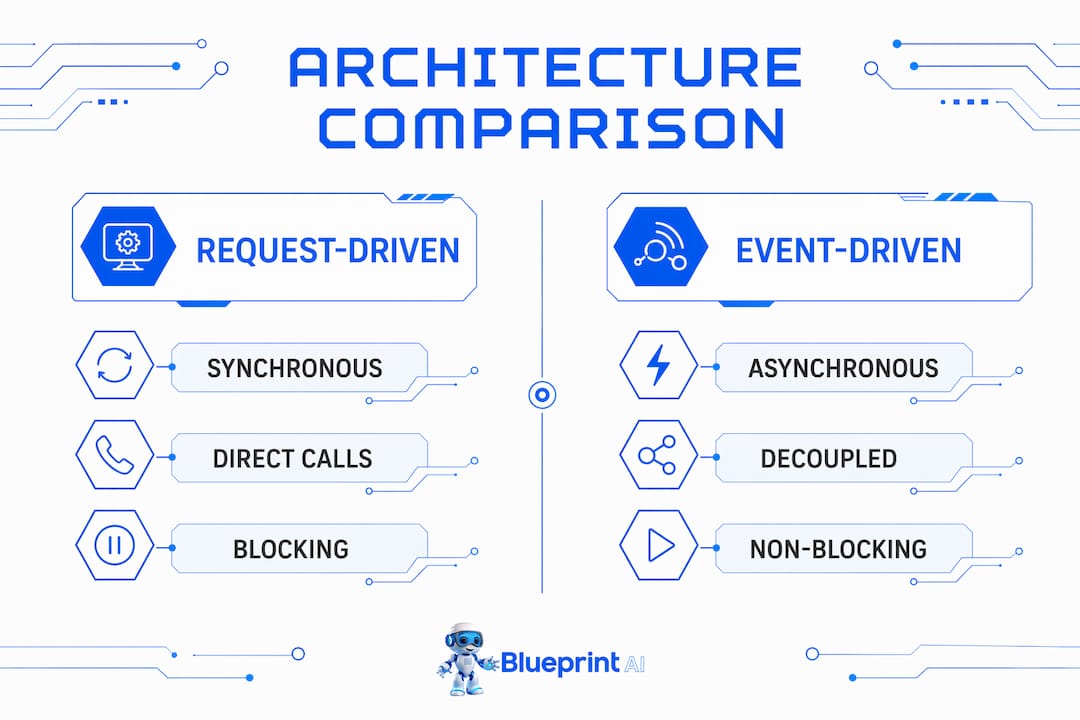
A hybrid architecture combining synchronous request-driven paths with asynchronous event-driven flows is industry best practice. Use synchronous calls where the user needs an immediate answer. Use events everywhere else.
What are the main components and topologies of EDA?
Every event-driven system shares the same three building blocks: producers, consumers, and a broker. The broker is the architectural centrepiece. It receives events, stores them durably or transiently, and delivers them to the right consumers. Without a reliable broker, the entire decoupling model collapses.
Azure's 2026 guidelines define three main EDA topologies: Broker, Mediator, and Event Streaming. Each suits a different level of workflow complexity.
The three core topologies
Broker topology is the simplest pattern. Producers publish events to a central broker, and consumers subscribe to topics they care about. There is no central coordinator. This pattern suits loosely coupled notifications and fan-out scenarios, such as broadcasting a UserSignedUp event to a welcome email service, an analytics service, and an onboarding service simultaneously.
Mediator topology adds a central orchestrator that coordinates multi-step workflows. The mediator receives an initial event, then issues commands to downstream services in a defined sequence. This pattern suits complex business processes where order matters and error handling requires compensation logic. The trade-off is that the mediator becomes a coordination point and must be designed carefully to avoid becoming a bottleneck.
Event Streaming uses a durable, append-only log, such as Apache Kafka, where events are stored and consumers read at their own pace. Consumers can replay historical events, which makes this topology ideal for audit trails, analytics pipelines, and rebuilding state after failures.
| Topology | Coordination | Durability | Best for |
|---|---|---|---|
| Broker | None (pub/sub) | Transient or durable | Notifications, fan-out |
| Mediator | Central orchestrator | Workflow state | Multi-step business processes |
| Event Streaming | Consumer-controlled | Durable log with replay | Analytics, audit, event sourcing |
Pro Tip: Start with the Broker topology. Add a Mediator only when you need guaranteed ordering or compensation logic across multiple services. Premature orchestration adds complexity before you understand your actual workflow requirements.
Choosing the right topology early matters because switching later requires re-architecting consumer contracts and broker configurations. Review system design fundamentals before committing to a topology in production.
What are the practical benefits and challenges of EDA?
EDA delivers four concrete benefits that explain its widespread adoption in distributed systems.
- Loose coupling. Producers and consumers evolve independently. Adding a new consumer requires zero changes to the producer. This is the foundation of modular system design.
- Horizontal scalability. Consumers scale independently based on their own load. A spike in order volume scales only the order-processing consumer, not the entire application.
- Real-time responsiveness. Events propagate within milliseconds across services, enabling live dashboards, fraud detection, and instant notifications.
- Built-in audit trails. Every event is a timestamped record of what happened. Event Streaming topologies make this audit log queryable and replayable.
The challenges are equally concrete and must be planned for, not discovered in production.
Eventual consistency
Eventual consistency introduces a lag between when an event fires and when all consumers have processed it. The UI may show a stale order status while the fulfilment service is still catching up. Addressing this requires UX techniques like optimistic updates, where the UI assumes success immediately, or polling, where the client checks for state changes at intervals.
Debugging complexity
Debugging EDA systems is complex because asynchronous flows lack a single call stack. A failed event may have been produced successfully but consumed incorrectly three services downstream. Distributed tracing, correlation IDs, and centralised logging are not optional extras. They are the minimum viable observability stack for any EDA deployment.
Data loss prevention
The Outbox Pattern prevents data loss by ensuring database changes and event publishing occur atomically rather than in separate steps. Without it, a service can write to its database and then crash before publishing the event, leaving downstream consumers permanently out of sync.
The Outbox Pattern is the single most underused reliability technique in event-driven systems. Teams that skip it discover its importance only after a production incident.
Pro Tip: Assign a correlation ID to every event at the point of production. Propagate it through every downstream service. This single practice cuts debugging time dramatically when tracing failures across asynchronous flows.
How can developers implement EDA effectively?
Effective EDA implementation starts with a phased adoption strategy rather than a full system rewrite. Begin by moving background tasks, such as sending emails or generating reports, to an event-driven flow. These tasks have no synchronous dependency and are low risk. Once the team is comfortable with the broker and consumer patterns, expand to more complex workflows.
Event schema design and versioning
Event schemas serve as contracts between decoupled services. Breaking a schema breaks every consumer silently. Use a schema registry to enforce compatibility rules. Adopt additive versioning: add new fields rather than removing or renaming existing ones. Consumers that do not recognise new fields simply ignore them.
Good schema design practices apply directly to event payloads. Keep events small and focused on a single state change. Avoid embedding business logic in the event payload itself.
Practical implementation steps
- Identify background tasks in your current system that do not require an immediate response. These are your first candidates for event-driven migration.
- Choose a broker that matches your durability and throughput requirements. Apache Kafka suits high-volume streaming. RabbitMQ suits lower-volume task queues.
- Implement the Outbox Pattern from day one for any event that must not be lost.
- Add distributed tracing before deploying to production. Tools like OpenTelemetry provide vendor-neutral instrumentation.
- Design status endpoints for long-running processes so clients can poll for completion without blocking.
- Document event contracts in a shared schema registry and treat breaking changes with the same rigour as breaking API changes.
A hybrid architecture approach keeps synchronous paths for user-facing requests and routes everything else through events. This balance gives you the responsiveness of request-driven design and the scalability of EDA without forcing an all-or-nothing choice.
Key takeaways
Event-driven architecture delivers scalability and fault isolation by decoupling producers and consumers through an asynchronous broker, but it requires deliberate observability, schema management, and phased adoption to succeed in production.
| Point | Details |
|---|---|
| Core definition | EDA uses asynchronous events and a broker to decouple producers from consumers. |
| Topology choice matters | Broker suits fan-out; Mediator suits workflows; Event Streaming suits audit and replay. |
| Hybrid is best practice | Combine synchronous paths for user-facing calls with async events for background work. |
| Observability is non-negotiable | Distributed tracing and correlation IDs are required from day one, not added later. |
| Schema versioning prevents breakage | Treat event schemas as service contracts and use additive versioning to avoid silent failures. |
From synchronous thinking to event thinking: my honest take
The hardest part of adopting EDA is not the tooling. It is the mental shift. Developers trained on synchronous request-response patterns instinctively want to know what happened after an event fires. That instinct fights the entire model.
I have seen teams implement EDA correctly at the infrastructure level and then immediately undermine it by adding synchronous callbacks to confirm that consumers received the event. That pattern recreates all the coupling EDA was meant to eliminate. The discipline is in trusting the broker and designing for eventual consistency from the start.
The second mistake I see consistently is what I call "event spaghetti." Teams get excited about the decoupling benefits and start routing everything through events, including operations that genuinely need a synchronous response. The result is a system where a simple user action triggers a chain of fifteen events across eight services, and no one can explain the full flow without a whiteboard session. Restraint is a design skill.
My strongest recommendation is to build observability before you build features. A distributed tracing setup and a centralised log are not infrastructure concerns to address later. They are the foundation that makes every other debugging and monitoring task possible. Teams that skip this step spend weeks reconstructing event flows manually after their first production incident.
Start small, stay hybrid, and treat your event schemas with the same care you give your public APIs. EDA rewards teams that plan carefully and punishes teams that treat it as a drop-in replacement for REST.
— Rishi
Blueprintbot and event-driven system design
Designing an event-driven system requires clear documentation of producers, consumers, broker configurations, and schema contracts before a single line of code is written. Blueprintbot generates complete software architecture blueprints from your app idea in seconds, covering system design, API contracts, database schemas, and component relationships.
Architects and developers use Blueprintbot to map out EDA topologies, define event flows, and align teams around a shared technical specification before development begins. The platform's free planning tools help you visualise component boundaries and identify which workflows belong in synchronous paths versus asynchronous event flows. If you are starting a new system or refactoring an existing one toward an event-driven model, Blueprintbot gives your team a concrete, shareable starting point.
FAQ
What is event-driven architecture in simple terms?
Event-driven architecture is a design pattern where services communicate by producing and consuming events through a broker rather than calling each other directly. This decoupling lets each service operate and scale independently.
When should I use EDA instead of a REST API?
Use EDA for background workflows, notifications, and processes where the caller does not need an immediate response. Use REST APIs for user-facing operations that require a synchronous reply, such as authentication or payment confirmation.
What are the three main EDA topologies?
The three main topologies are Broker (simple pub/sub fan-out), Mediator (orchestrated multi-step workflows), and Event Streaming (durable append-only logs with replay capability). Each suits a different level of workflow complexity.
How do I prevent data loss in an event-driven system?
The Outbox Pattern ensures database writes and event publishing happen atomically. This prevents the scenario where a service writes to its database and then crashes before the event reaches the broker.
What is the biggest challenge with event-driven architecture?
Debugging is the most common operational challenge. Asynchronous flows lack a single call stack, so distributed tracing, correlation IDs, and centralised logging are required to trace failures across services effectively.