What is software architecture: a beginner's guide

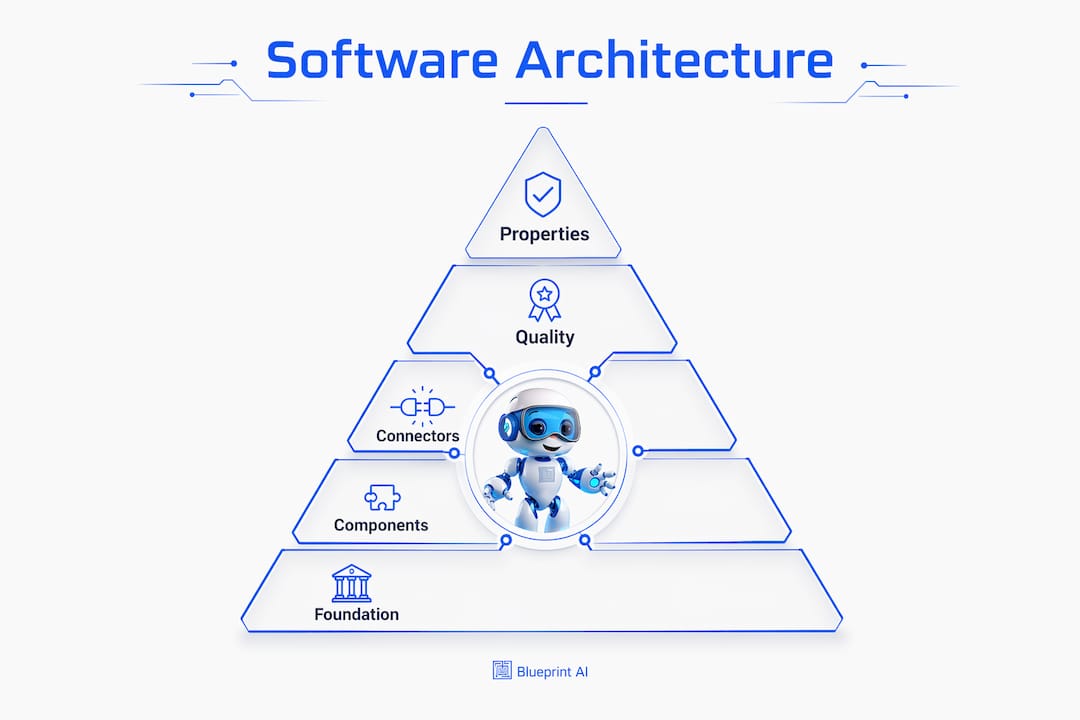
Software architecture is the fundamental organisation of a software system, encompassing its components, their relationships, and the design principles that guide how they work together. Think of it as the blueprint for a building: before anyone pours concrete, an architect decides where the walls go, how rooms connect, and what load each beam must carry. Software architecture makes the same kind of decisions before a single line of code is written. Whether you are a student learning the basics, a professional moving into a technical role, or a founder trying to communicate with a development team, understanding software architecture fundamentals gives you a shared language for building systems that actually work.
What is software architecture, and what does it include?
Software architecture is defined as the structures comprising software elements, their relations, and their properties, forming the basis to reason about the system. This definition comes from decades of engineering practice and is formalised in the ISO/IEC/IEEE 42010 standard, which governs how architecture descriptions are created and communicated. The C4 model, developed by Simon Brown, offers a practical visualisation approach that breaks architecture into four levels: System Context, Containers, Components, and Code.
Architecture sits above the code. It answers questions like: How does the front end talk to the back end? Where does data live? What happens when one part of the system fails? These are not coding questions. They are structural decisions that shape everything built afterward.

A software blueprint produced by a tool like Blueprintbot captures these decisions in a structured format, covering system architecture, database schemas, API designs, and user interface flows. That kind of output makes architecture tangible for teams that need to align before development starts.
What key components and principles define software architecture?
Software architecture rests on three core building blocks: components, connectors, and configuration.
- Components are the independent, self-contained units of a system. A user authentication service, a payment processor, and a notification engine are each components. They do one job and expose a defined interface to the rest of the system.
- Connectors are the mechanisms that let components talk to each other. REST APIs, message queues like RabbitMQ, and event streams like Apache Kafka are all connectors. The choice of connector affects speed, reliability, and how tightly coupled your system becomes.
- Configuration describes how components and connectors are arranged at runtime. The same components wired differently produce a completely different system behaviour.
Beyond these building blocks, four guiding principles shape every sound architecture.
- Abstraction means hiding unnecessary detail. A component exposes what it does, not how it does it.
- Modularity means breaking the system into pieces that can be built, tested, and replaced independently.
- Separation of concerns means each component handles one responsibility. Mixing concerns creates systems that are hard to change.
- Quality attributes are the non-functional requirements that architecture must satisfy: performance, security, maintainability, and availability. Early architectural decisions are foundational and expensive to change, so quality attributes must be defined before structure is locked in.
Pro Tip: Write down your top three quality attributes before you draw a single diagram. If you do not know whether performance or maintainability matters more, you cannot make good architectural trade-offs.
How does software architecture differ from software design?
Architecture contrasts with software design, which covers detailed implementation choices like classes, methods, and design patterns. The distinction matters because the two operate at different levels of abstraction and carry very different costs when changed.
Architecture sets the strategic foundation. Design is tactical work done inside that foundation. Choosing to use a microservices pattern is an architectural decision. Deciding how a specific service handles null values in a method is a design decision.
| Feature | Software architecture | Software design |
|---|---|---|
| Level of abstraction | System-wide, high-level | Component-level, detailed |
| Focus | Structure, interactions, deployment | Classes, methods, patterns |
| Cost to change | High. Restructuring affects the whole system | Lower. Changes stay local to a component |
| Examples | Communication protocols, deployment topology | Factory pattern, error handling logic |
| Primary audience | Architects, tech leads, stakeholders | Developers working on a specific module |
Architecture decisions are expensive to change and shape system evolution over years. A wrong call on communication protocol can mean rewriting integrations across dozens of services. A wrong call on a class method costs an afternoon.
Pro Tip: Document the rationale behind every major architectural decision, not just the decision itself. Six months later, no one will remember why you chose event-driven over request-response, and that context prevents costly reversals.
Knowing how to plan app architecture before coding is the practical skill that separates teams who build confidently from those who refactor constantly.
What frameworks help visualise and communicate software architecture?
The ISO/IEC/IEEE 42010 standard structures architecture descriptions around six key notions: Entities of Interest, Stakeholders, Concerns, Viewpoints, Views, and documented architectural rationale. Each view addresses a specific stakeholder concern. A security engineer needs a different view than a database administrator, even though they are looking at the same system.
Architecture descriptions are not just diagrams. They are work products that support stakeholder reasoning over the system's lifetime. A diagram without rationale is a picture. A diagram with decision records is an engineering document.
The C4 model offers a practical way to build those documents incrementally. Here is how to apply it:
- System Context diagram. Show your system as a single box. Draw the users and external systems that interact with it. This is the 30,000-foot view.
- Container diagram. Zoom in. Show the major deployable units: web apps, mobile apps, databases, microservices. Label how they communicate.
- Component diagram. Zoom into one container. Show the components inside it and how they interact. This is where architectural patterns become visible.
- Code diagram. Zoom into one component. Show classes, interfaces, and their relationships. This level is optional and often auto-generated from code.
The C4 model structures architecture diagrams into these four levels to facilitate clear communication tailored to each stakeholder group. That stepwise abstraction prevents teams from jumping straight to code before the structure is agreed upon.
Pro Tip: Tailor each view to its audience. Show a System Context diagram to a business stakeholder. Show a Component diagram to a developer. Showing the wrong level to the wrong person creates confusion, not alignment.
For a deeper look at how architecture descriptions translate into real projects, the open source architecture case studies on the Blueprintbot blog show five worked examples with full rationale.
What are common software architecture patterns, and when do you use them?
Software architecture patterns like microservices, layered, and event-driven provide reusable structural templates that directly impact a system's scalability and maintainability. Choosing the right pattern depends on your system's requirements and business goals. No pattern is universally correct.
- Layered architecture divides a system into horizontal layers: presentation, business logic, and data. Each layer only talks to the layer directly below it. This pattern suits enterprise applications with clear separation between UI and data. The trade-off is that adding a feature often requires touching every layer.
- Microservices architecture breaks a system into small, independently deployable services, each owning its own data. Streaming services and rideshare apps use this pattern to scale individual features without redeploying the whole system. The trade-off is operational complexity: you now manage dozens of services, each with its own deployment pipeline.
- Event-driven architecture uses events to trigger and communicate between services. One service publishes an event; others subscribe and react. This pattern suits systems where components need to stay loosely coupled and where real-time processing matters. The trade-off is that debugging event chains is harder than tracing a direct function call.
Architecture evolution is an ongoing activity, not a one-time decision. Systems that start as a monolith often migrate toward microservices as they grow. That migration is expensive if the original architecture did not account for it.
For concrete examples of these patterns in production systems, the real-world app architecture examples guide and the backend architecture examples breakdown both show how these trade-offs play out in practice.
Key takeaways
Software architecture is the high-level structural foundation of a system, and getting it right before coding begins is the single most cost-effective decision a development team can make.
| Point | Details |
|---|---|
| Architecture precedes code | Define components, connectors, and quality attributes before writing a single line. |
| Architecture vs. design | Architecture sets system-wide structure; design handles implementation details inside that structure. |
| Use the C4 model | Build diagrams in four levels to match each stakeholder's need for detail. |
| Document your rationale | Record why decisions were made, not just what was decided, to prevent costly reversals. |
| Patterns have trade-offs | Microservices, layered, and event-driven each suit different requirements. Choose based on your goals. |
Why architecture thinking changed how I approach every project
The most common mistake I see is treating architecture as something you do after you know what you are building. That is backwards. Architecture is how you figure out what you are building.
Early in my career, I confused architectural patterns with architecture itself. Knowing that microservices exist is not the same as understanding why a particular system needs them. Confusing architecture styles with architecture itself is a well-documented pitfall. Architecture is the underlying structural decisions and rationale. The pattern is just one way to express it.
The other misconception I encounter constantly is that architecture documentation is a deliverable you produce once and file away. The role of a software architect is shifting from top-down dictation to coaching teams through decisions. That shift only works if the rationale is written down and revisited. A living architecture document is a team communication tool, not a compliance artefact.
For students and professionals just starting out: do not wait until you are working on a large system to practise architectural thinking. Sketch a C4 System Context diagram for any app you use daily. Ask yourself where the data lives, how the front end talks to the back end, and what happens when one part fails. That habit of abstraction before implementation is the core skill, and it transfers to every project you will ever work on.
— Rishi
How Blueprintbot supports your architecture planning
Translating architectural thinking into a structured document is where most founders and students get stuck. Blueprintbot generates complete software blueprints from a plain-language app idea, producing system architecture diagrams, database schemas, API designs, and development roadmaps in seconds.

The platform also offers free planning tools including a feature prioritiser built on the MoSCoW method, which helps you align architectural decisions with your most critical product requirements. Whether you are validating an idea, preparing documentation for a development team, or learning how architecture decisions translate into technical specifications, Blueprintbot gives you a concrete starting point without requiring coding skills.
FAQ
What is software architecture in simple terms?
Software architecture is the high-level structure of a software system, defining its components, how they interact, and the principles that guide those interactions. It is the plan that teams follow before writing code.
How does software architecture differ from software design?
Architecture covers system-wide, strategic decisions like deployment topology and communication protocols. Software design covers implementation details like classes and methods inside a single component.
What are the most common software architecture patterns?
The three most widely used patterns are layered, microservices, and event-driven. Each suits different system requirements and carries distinct trade-offs in complexity and scalability.
Why does software architecture matter for beginners?
Understanding architecture basics helps beginners communicate with development teams, make informed technology choices, and avoid structural mistakes that are expensive to fix later in a project.
What is the C4 model in software architecture?
The C4 model organises architecture diagrams into four levels: System Context, Containers, Components, and Code. Each level targets a different audience and provides a different degree of detail.