Role of API design in apps: 2026 developer guide

API design is the contract that governs how software components communicate, and it directly determines how fast, reliably, and safely your app integrates with other systems. A poorly designed API does not just frustrate developers. It drives up support costs, slows onboarding, and creates technical debt that compounds over time. The role of API design in apps extends far beyond syntax choices. It shapes developer experience, end-user behaviour, and the long-term cost of maintaining your product. Standards like OpenAPI and RFC 9457, along with platforms like Blueprintbot, give teams a structured path from idea to working integration without guesswork.
How does API design impact app usability and developer experience?
API design is a UX problem, not just a technical one. Every endpoint, error message, and naming convention is an interface that a developer must learn, trust, and build on. When that interface is inconsistent or unclear, the consequences show up in your app's reliability and your team's productivity.
Poor API design increases support costs by turning integrations that should take minutes into multi-hour debugging sessions. Developers abandon integrations when endpoint names are inconsistent, error messages are vague, or status codes are used incorrectly. That abandonment is not a developer problem. It is a design problem.

Consider what happens when an API returns a generic 500 Internal Server Error for every failure. A developer cannot tell whether the issue is a missing field, an expired token, or a server crash. They write fragile workaround logic, file support tickets, and lose confidence in the product. Clear, specific error messages with correct HTTP status codes eliminate that entire category of friction.
Consistent endpoint naming matters just as much. An API that uses /getUser in one place and /users/{id} in another forces developers to read documentation for every call. Predictable, resource-based naming lets developers guess correctly and move faster.
- Use nouns, not verbs, in endpoint paths (
/orders, not/getOrders) - Return
404for missing resources,401for unauthenticated requests, and403for unauthorised ones - Write error messages that name the field or constraint that failed
- Keep response shapes consistent across similar endpoints
- Document every endpoint with a real example request and response
Pro Tip: Design every endpoint as if a developer will use it at 2 AM during an incident. If the error message does not tell them exactly what went wrong, rewrite it.
What best practices and standards define effective API design in 2026?
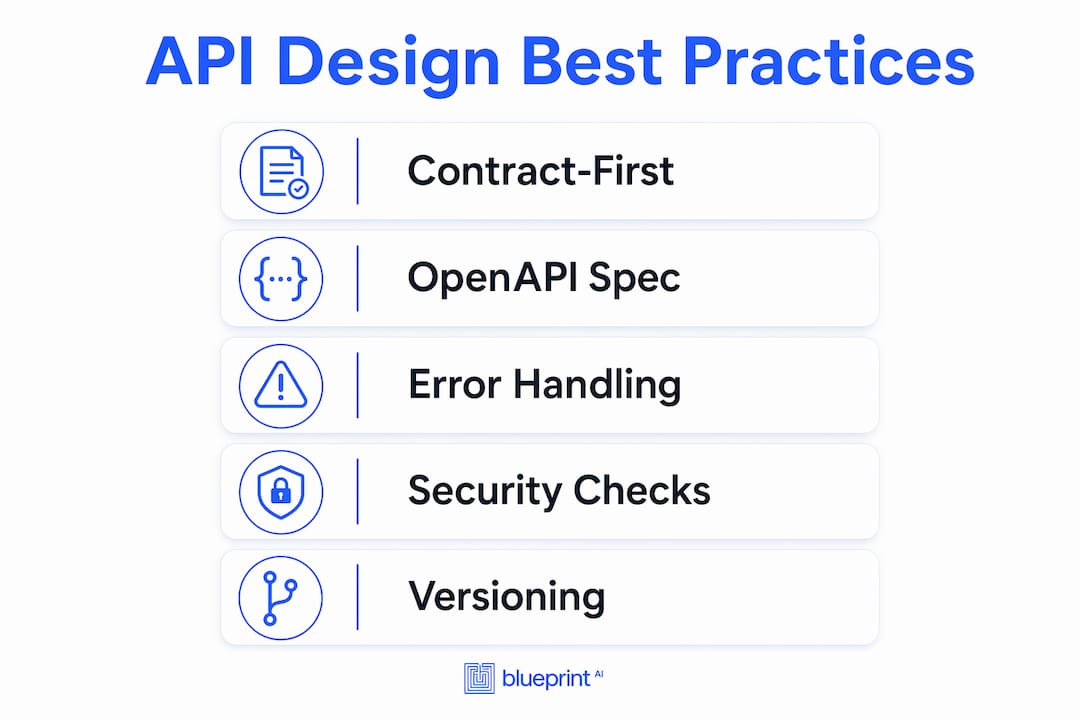
The most effective API design strategy in 2026 is contract-first development using OpenAPI as the single source of truth. Teams write the spec before writing any backend code. This lets frontend developers, QA engineers, and third-party integrators work from generated mocks while the server-side implementation catches up.
The OpenAPI spec prevents drift between documentation and implementation. When the spec is the authoritative reference, mismatches that cause bugs and broken integrations disappear. Teams that skip this step often discover months later that their live API behaves differently from what their docs describe.
HTTP method and status code discipline is non-negotiable. The table below shows the correct pairings that define a well-behaved REST API.
| HTTP Method | Correct Use | Expected Success Code |
|---|---|---|
| GET | Retrieve a resource | 200 OK |
| POST | Create a new resource | 201 Created |
| PUT | Replace a resource entirely | 200 OK |
| PATCH | Partially update a resource | 200 OK |
| DELETE | Remove a resource | 204 No Content |
Idempotency-Key headers prevent duplicate actions when clients retry failed requests. Popular APIs cache these keys for 24 hours, guaranteeing consistent state even when network conditions cause retries. This is especially critical for payment and order endpoints where duplicate processing causes real financial harm.
Machine-readable error responses per RFC 9457 replace generic failure messages with structured objects that include a type URI, a human-readable title, and a detail field. Clients can parse these programmatically instead of writing fragile string-matching logic.
Security belongs inside each endpoint handler, not only in middleware. Explicit ownership checks inside handlers catch vulnerabilities that middleware misses, particularly when route ordering changes or middleware is accidentally bypassed.
Pro Tip: Treat your OpenAPI spec file the same way you treat production code. Version it, review it in pull requests, and run contract tests against it on every build.
Which API architectural style suits your app?
REST, GraphQL, gRPC, and WebSocket each serve distinct use cases with real tradeoffs. Choosing the wrong style for your app's requirements creates performance problems and integration complexity that no amount of refactoring fully resolves.
REST remains the default for most public-facing APIs. Its stateless design maps cleanly to CRUD operations, and its widespread support means every HTTP client, proxy, and gateway understands it. For a product catalogue, a user management system, or a content API, REST is the right choice.
GraphQL solves a specific problem: over-fetching and under-fetching data. A mobile client that only needs a user's name and avatar should not receive a 40-field user object. GraphQL lets clients request exactly the fields they need, which reduces bandwidth and improves performance on constrained connections. This makes it particularly valuable for mobile apps with variable network quality.
gRPC is the right choice for internal microservice communication where latency matters. It uses Protocol Buffers for serialisation, which produces smaller payloads than JSON and deserialises faster. Teams building high-throughput internal services between backend components benefit most from gRPC. It is not suited for browser-based clients without additional tooling.
WebSocket enables real-time, bidirectional communication. Chat applications, live dashboards, and collaborative editing tools require a persistent connection where the server can push updates without the client polling. REST cannot replicate this behaviour efficiently.
| Style | Best Use Case | Key Advantage | Main Tradeoff |
|---|---|---|---|
| REST | Public APIs, CRUD operations | Universal support | Over/under-fetching |
| GraphQL | Mobile apps, complex data needs | Precise data fetching | Query complexity |
| gRPC | Internal microservices | Low latency, small payloads | Limited browser support |
| WebSocket | Real-time features | Bidirectional, persistent | Stateful, harder to scale |
For developers building their first app, REST with a well-documented OpenAPI spec is the lowest-risk starting point. You can explore real-world app architecture examples to see how these styles appear in production systems.
How do you design APIs that scale without breaking integrations?
API contracts are effectively immutable once consumers depend on them. Removing a field, renaming a parameter, or changing a response shape breaks every client that relied on the old behaviour. This is why early design decisions carry disproportionate long-term consequences.
Versioning from day one prevents the most disruptive breaking changes. A URL-based versioning strategy (/v1/, /v2/) makes the version explicit and easy to route. Teams that skip versioning early find themselves unable to evolve their API without forcing all consumers to migrate simultaneously.
The steps below establish a foundation for APIs that grow without breaking existing integrations.
- Write the OpenAPI spec before writing any implementation code.
- Generate contract tests from the spec and run them in CI on every commit.
- Add explicit resource-level ownership checks inside every handler that modifies data.
- Implement
Idempotency-Keysupport on any endpoint that creates or modifies state. - Publish a versioned changelog so consumers know exactly what changed and when.
- Expose an
llms.txtfile for AI agent consumers to reduce token consumption.
AI agents consume APIs autonomously, and they require stable, machine-readable specs to function correctly. An llms.txt file reduces token consumption by up to 90% and prevents costly incorrect agent calls. As AI-powered integrations become more common, this is no longer an optional consideration.
For developers building on top of existing systems, understanding how SDKs complement API design can significantly reduce the integration burden for your consumers.
Pro Tip: Before publishing any API change, run it through a diff tool against your current OpenAPI spec. If the diff shows a removed field or changed type, treat it as a breaking change and increment the version.
Developers transitioning into AI engineering roles will find that backend and API design experience translates directly into building reliable AI-integrated systems.
Key takeaways
API design quality determines integration speed, developer productivity, and long-term app stability more than any other single architectural decision.
| Point | Details |
|---|---|
| API design is a UX problem | Treat every endpoint, error message, and naming choice as a developer-facing interface decision. |
| Contract-first with OpenAPI | Write the spec before implementation to prevent drift and enable parallel development. |
| Choose the right style | Match REST, GraphQL, gRPC, or WebSocket to your client's actual data and latency needs. |
| Version from day one | URL-based versioning prevents breaking changes from forcing simultaneous consumer migrations. |
| Security inside handlers | Place ownership checks inside each endpoint handler, not only in shared middleware. |
API design is a product decision, not just a technical one
I have watched product managers hand API design entirely to developers and then wonder why integrations take weeks instead of days. The reality is that API design decisions are product decisions. They determine what your partners can build, how fast your team can ship new features, and how much of your engineering budget goes toward fixing integration bugs instead of building new value.
The most common mistake I see is inconsistent error responses. One endpoint returns { "error": "not found" } and another returns { "message": "Resource does not exist", "code": 404 }. Neither follows RFC 9457. Both force every consumer to write custom parsing logic. This is not a minor inconvenience. It is a maintenance burden that compounds every time a new consumer integrates.
The second mistake is treating security as middleware-only. I have seen APIs where a developer reordered middleware during a refactor and accidentally exposed admin endpoints to unauthenticated users. Explicit ownership checks inside each handler would have prevented that entirely.
The shift I find most interesting right now is AI agent consumption. Agents do not read documentation the way humans do. They parse specs, call endpoints, and make decisions autonomously. An API that was designed for human developers may be completely opaque to an agent. Publishing an llms.txt file and maintaining a clean OpenAPI spec is no longer just good practice. It is a competitive requirement.
Product managers: champion API design the same way you champion UI design. The developer experience your API delivers is your product's reputation in the integration ecosystem.
— Rishi
Blueprintbot makes API planning part of your app blueprint
Planning a well-structured API from scratch takes time, especially when you are also making architecture, database, and security decisions simultaneously.
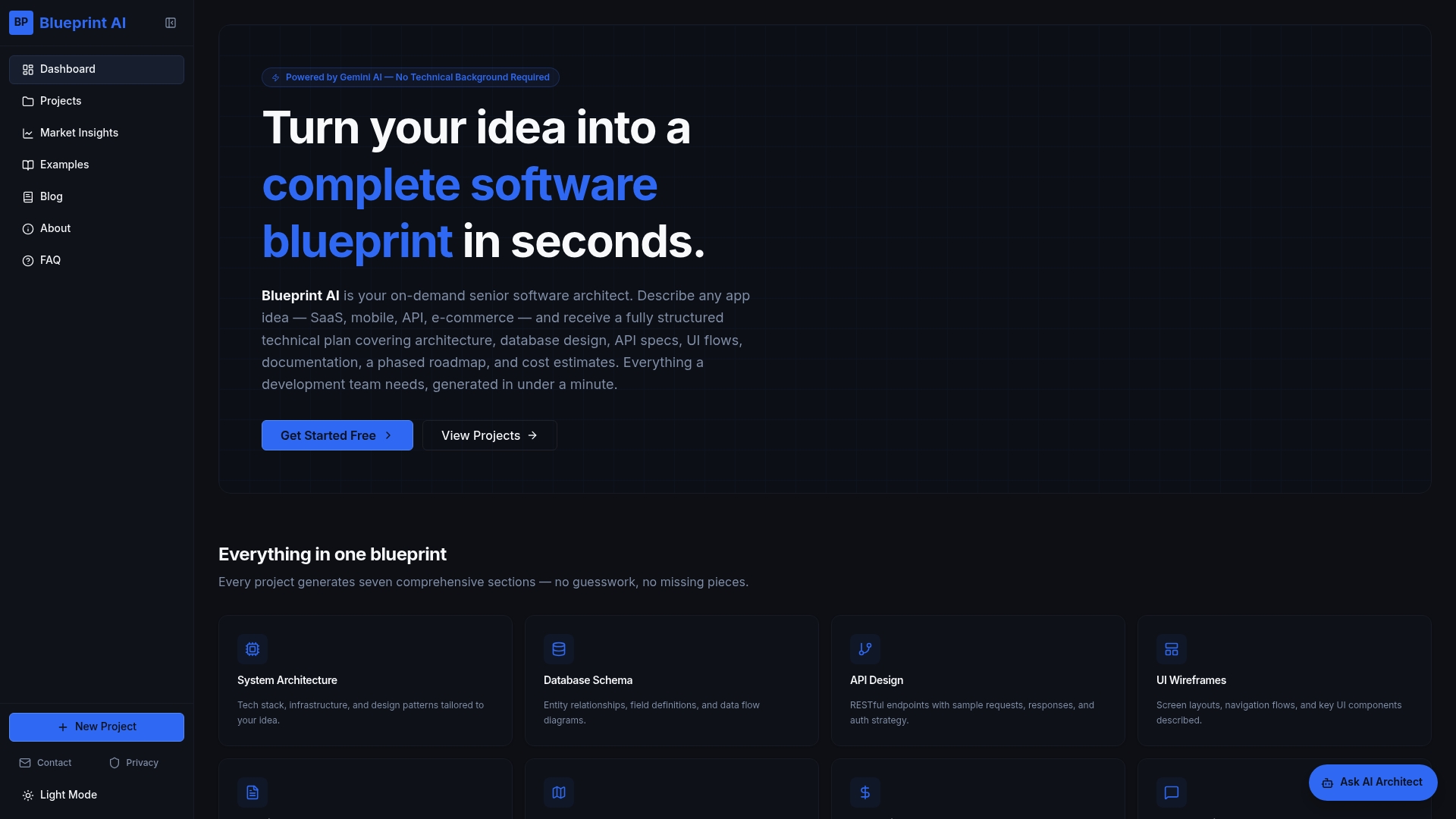
Blueprintbot generates complete software blueprints that include API designs, database schemas, and system architecture from a plain-language description of your app idea. Product managers and founders get a structured technical spec without needing to write a single line of code. Developers get a clear starting point that reflects API design best practices. The free planning tools include an MVP feature prioritiser built on the MoSCoW method, which helps teams decide which API endpoints to build first. If you are starting a new project, Blueprintbot removes the ambiguity from the planning phase before your first commit.
FAQ
What is the role of API design in apps?
API design defines the contract between software components, governing how data is requested, returned, and secured. It directly affects integration speed, developer experience, and app reliability.
Why does API design affect user experience?
Poor API design causes slow integrations, inconsistent data, and frequent errors that surface as bugs in the user-facing app. A well-designed API reduces these failure points before they reach end users.
What is the best API architectural style for mobile apps?
GraphQL is the strongest choice for mobile apps because it lets clients fetch exactly the fields they need, reducing bandwidth and improving performance on variable connections.
How do you prevent breaking changes in an API?
Version your API from day one using URL-based versioning, run contract tests against your OpenAPI spec in CI, and treat any removed field or changed type as a breaking change requiring a version increment.
What is RFC 9457 and why does it matter for API design?
RFC 9457 is an HTTP standard for machine-readable error responses. It structures errors with a type URI, title, and detail field, allowing API consumers to parse failures programmatically instead of writing fragile string-matching logic.