What is system architecture: a guide for builders

System architecture is the conceptual model defining a system's structure, behaviour, and views, capturing hardware, software, data, documentation, procedures, and human roles in one coherent framework. If you are a founder scoping a product, a product manager briefing a dev team, or a developer evaluating trade-offs, understanding system architecture is the difference between building on solid ground and discovering structural problems after launch. The formal industry term is systems architecture, standardised under ISO/IEC/IEEE 42010, though "system architecture" is used interchangeably in practice.
What is system architecture and what does it include?
System architecture defines the fundamental concepts and properties of a system, expressed through the relationships between its components and the rules that govern them. It is not just a diagram on a whiteboard. It is the authoritative record of every major structural decision made about a system.
The components covered by a system architecture go well beyond code. A complete architecture addresses:
- Hardware: servers, devices, sensors, and physical infrastructure
- Software: applications, services, APIs, and operating systems
- Data stores: databases, caches, file systems, and data pipelines
- Networks: protocols, load balancers, firewalls, and connectivity
- Documentation and procedures: runbooks, deployment guides, and operational policies
- Organisational roles: the humans who operate, maintain, or interact with the system
These elements do not exist in isolation. Architecture defines the boundaries between subsystems and the contracts between them. A payment service, for example, has its own internal structure, but its architecture also specifies how it communicates with a fraud detection service, a database cluster, and a third-party gateway.
Pro Tip: Treat your architecture as a living document, not a one-time deliverable. Every time a major decision changes a component boundary or a data flow, update the record.
ISO/IEC/IEEE 42010 draws a precise distinction that most teams miss: architecture refers to the fundamental concepts of a system, while an architecture description is the work product documenting those concepts. Confusing the two leads teams to mistake a stale diagram for the actual state of the system.
How does system architecture differ from software architecture?
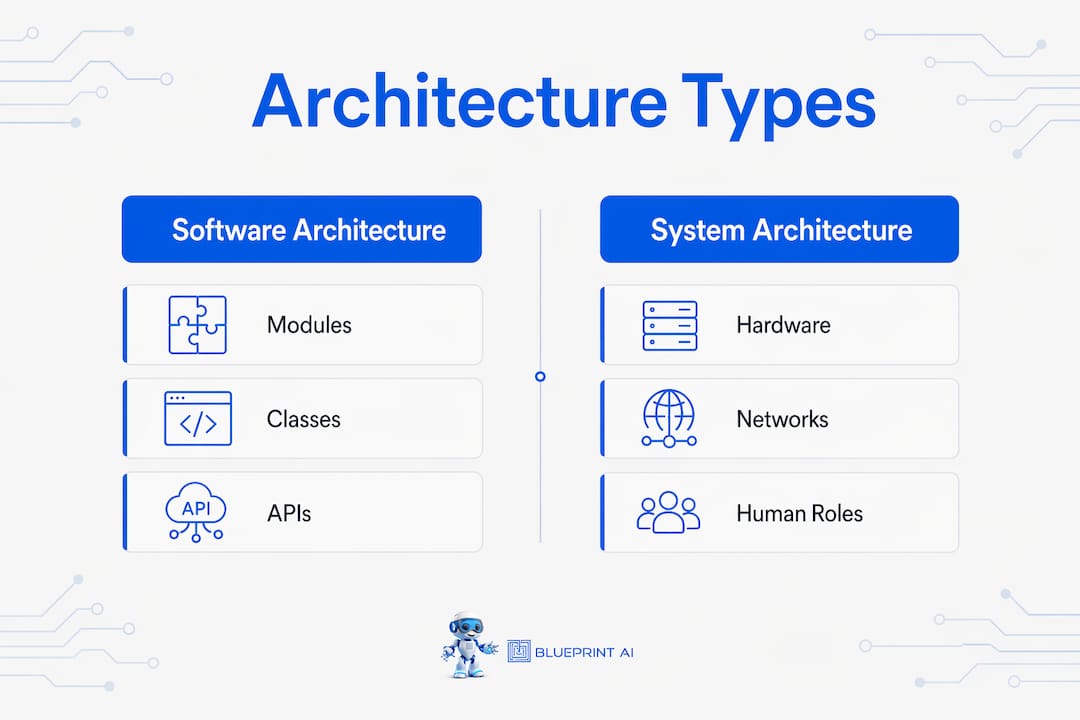
Software architecture focuses on the internal structure of a software system: modules, classes, APIs, and the patterns connecting them. System architecture is broader. It includes hardware, networks, external systems, and humans-in-the-loop alongside the software layer.

The practical difference matters enormously for scoping. Choosing microservices is a software architecture decision. Deciding how those microservices are deployed across multiple cloud regions, how they handle network latency, and how an operations team monitors them is a system architecture decision.
| Dimension | Software architecture | System architecture |
|---|---|---|
| Scope | Internal software structure | Entire system including hardware and people |
| Key concerns | Modules, APIs, code patterns | Deployment, networks, data flows, human roles |
| Primary audience | Developers | Founders, PMs, developers, operations teams |
| Typical artefacts | Class diagrams, API specs | System context diagrams, deployment views |
| Example decision | Use microservices vs. monolith | Deploy across AWS and Azure for redundancy |
Founders and product managers who treat system architecture as a developer concern alone routinely underestimate project scope. A mobile app is not just a React Native codebase. It is a system that includes a backend API, a database, a CDN, push notification infrastructure, and the app store review process. Each of those elements carries architectural implications.
Pro Tip: When scoping a new product, list every external system, human role, and physical environment your software must interact with. That list is the starting point for your system architecture.
What principles and standards guide system architecture design?
Good system architecture rests on a small set of foundational principles. The GitHub Well-Architected Framework names modularity, separation of concerns, and resilience as the core design principles for systems that can grow and recover from failure.
Here is what each principle means in practice:
- Modularity: Break the system into components with clear boundaries. Each component should do one thing well and expose a defined interface. This makes components replaceable without rewriting the whole system.
- Separation of concerns: Keep different responsibilities in different parts of the system. Authentication logic does not belong inside a billing service. Mixing concerns creates hidden dependencies that cause failures in unexpected places.
- Resilience: Design for failure. Assume any component can go down. Use retries, circuit breakers, and graceful degradation so one failure does not cascade into a full outage.
- Fault tolerance: Build redundancy into critical paths. A single database with no replica is a single point of failure. Distributed systems require deliberate decisions about replication and consistency.
- Trade-off reasoning: No single right architecture exists. Every decision involves trade-offs guided by constraints. Choosing strong consistency means accepting higher latency. Choosing availability means accepting eventual consistency.
"Architecture decisions are explicitly documented to support reasoning." — arc42 Quality Model
ISO/IEC/IEEE 42010 formalises these ideas through a structured vocabulary. Stakeholders are the people with an interest in the system. Concerns are the qualities they care about, such as performance, security, or maintainability. Viewpoints specify how a particular view of the architecture is constructed. Views are the actual representations addressing those concerns. Architecture rationale is the documented reasoning behind each decision.
This vocabulary matters because it forces teams to link every architectural choice to a specific stakeholder concern. A decision to use a message queue is not just a technical preference. It is a response to a stakeholder concern about throughput and decoupling. Documenting that link prevents future teams from removing the queue without understanding why it was added.
How do models like the C4 model help communicate architecture?
The C4 model documents system architecture through four hierarchical diagram levels, each targeting a different audience and level of detail.
- Level 1, System Context: Shows the system as a single box and its relationships with users and external systems. Useful for executives and non-technical stakeholders.
- Level 2, Containers: Breaks the system into deployable units such as web apps, APIs, databases, and mobile apps. Useful for product managers and senior developers.
- Level 3, Components: Shows the internal structure of a single container. Useful for developers working on that container.
- Level 4, Code: Maps to classes or functions. Useful for developers during implementation.
| C4 level | Audience | What it shows |
|---|---|---|
| System Context | Executives, PMs | System boundaries and external relationships |
| Containers | Senior developers, architects | Deployable units and their interactions |
| Components | Developers | Internal structure of one container |
| Code | Developers | Classes, functions, and data structures |
The C4 model works because it separates concerns by audience. A founder does not need a class diagram. A developer does not need a business context diagram. Producing the right level of detail for the right audience reduces miscommunication and keeps documentation useful rather than decorative.
For real-world architecture examples that show these levels applied to actual products, studying worked examples is far more instructive than reading theory alone.
What practical steps help founders and developers design system architecture?
Designing system architecture well is a structured reasoning process, not a creative exercise. These steps apply whether you are building an MVP or evaluating an existing system.
- Define stakeholders and their concerns first. List every person or team with a stake in the system. For each, identify their primary concern: a CEO cares about uptime; a developer cares about deployability; a compliance officer cares about data residency.
- Map the system boundary. Draw a System Context diagram before writing any code. Identify every external system, user type, and data source the system must interact with. This is the foundation of architecture planning.
- Document decisions as you make them. Failing to document architecture decisions early causes implicit decision-making during coding, leading to costly refactoring and stakeholder disagreement. Write down what you decided, what alternatives you considered, and why you chose this path.
- Apply design principles to each component boundary. Check each boundary against modularity and separation of concerns. If two components share a database table, they are not truly separate.
- Model operational concerns explicitly. Ignoring hardware, network latency, and human interactions causes reliability and security failures in distributed systems. Include deployment topology and network paths in your architecture description.
- Revisit trade-offs at each major milestone. Architecture is not set once. As constraints change, decisions that were correct at the start may need revision. Schedule architecture reviews at each product milestone.
Pro Tip: Use a free tool like Blueprintbot's technical specification generator to produce a structured architecture description from your app idea in minutes. It forces you to answer the right questions before a developer writes a single line of code.
For teams new to this process, system design fundamentals provide a practical starting point before tackling full architecture documentation.
Key takeaways
System architecture is the formal record of every structural decision about a system, and documenting it early prevents the costly redesigns that kill projects.
| Point | Details |
|---|---|
| Architecture covers more than code | Hardware, networks, data stores, and human roles are all architectural concerns. |
| ISO/IEC/IEEE 42010 sets the standard | It distinguishes architecture from architecture description and formalises stakeholder concerns. |
| Software vs. system architecture | Software architecture covers internal code structure; system architecture covers the full operational environment. |
| Document decisions with rationale | Linking each decision to a stakeholder concern prevents future teams from undoing critical choices. |
| C4 model aids communication | Four diagram levels target different audiences, keeping documentation useful across the team. |
Why most teams get architecture wrong before they start
The most common mistake I see founders and product managers make is treating architecture as something developers handle after the product vision is set. By the time a developer is writing code, dozens of architectural decisions have already been made implicitly, through the choice of cloud provider, the structure of the first database table, or the assumption that the app will only ever have one type of user.
Architecture documents serve as governance tools that reduce tribal knowledge and support operational, security, and compliance processes across the system lifecycle. That is not a bureaucratic argument. It is a practical one. When the developer who made a critical decision leaves the team, the rationale leaves with them unless it was written down.
The other misconception worth naming directly: many teams treat diagrams as the architecture itself, when diagrams are only representations of the architecture. A diagram that is six months out of date is worse than no diagram, because it creates false confidence. The architecture is the set of decisions and their rationale. The diagram is just one way to communicate it.
What I have found actually works is starting with stakeholder concerns before touching any tooling. Write down what each stakeholder needs the system to do, what qualities they care about, and what constraints they operate under. Every architectural decision flows from that list. Teams that skip this step spend months arguing about technology choices that should have been obvious from the constraints.
For founders specifically, understanding why early architecture decisions matter is not about becoming a technical expert. It is about knowing which questions to ask before committing budget and time to a direction that may need to be reversed.
— Rishi
From idea to architecture with Blueprintbot
Translating an app idea into a structured architecture description is the hardest part of starting a software project. Blueprintbot generates complete software blueprints from a plain-language description of your idea, producing system architecture, database schemas, API designs, and technical documentation in seconds.

Founders and product managers use Blueprintbot to scope projects before hiring developers, validate technical feasibility, and give development teams a clear starting point. The example software blueprints show exactly how a complete architecture description looks across different product types. The free planning tools include a technical specification generator, an MVP feature prioritiser, and an app development time estimator. Each tool is designed to answer the structural questions that architecture planning requires, without needing a computer science degree to use them.
FAQ
What is the definition of system architecture?
System architecture is the conceptual model that defines a system's structure, behaviour, and views, including hardware, software, data, procedures, and human roles. ISO/IEC/IEEE 42010 is the international standard that formalises how architecture descriptions are documented.
How does system architecture differ from software architecture?
Software architecture covers the internal structure of a software system, such as modules and APIs. System architecture is broader, covering hardware, networks, external systems, and human interactions alongside the software layer.
What are the key principles of system architecture design?
The core principles are modularity, separation of concerns, resilience, and fault tolerance. The GitHub Well-Architected Framework identifies these as foundational for systems that can grow and recover from failure.
Why is documenting architecture decisions important?
Undocumented decisions become implicit assumptions in code, leading to costly refactoring when those assumptions prove wrong. Linking each decision to a stakeholder concern ensures future teams understand why a choice was made before changing it.
What is the C4 model in system architecture?
The C4 model is a framework for documenting system architecture through four diagram levels: System Context, Containers, Components, and Code. Each level targets a different audience and adds progressively more detail.